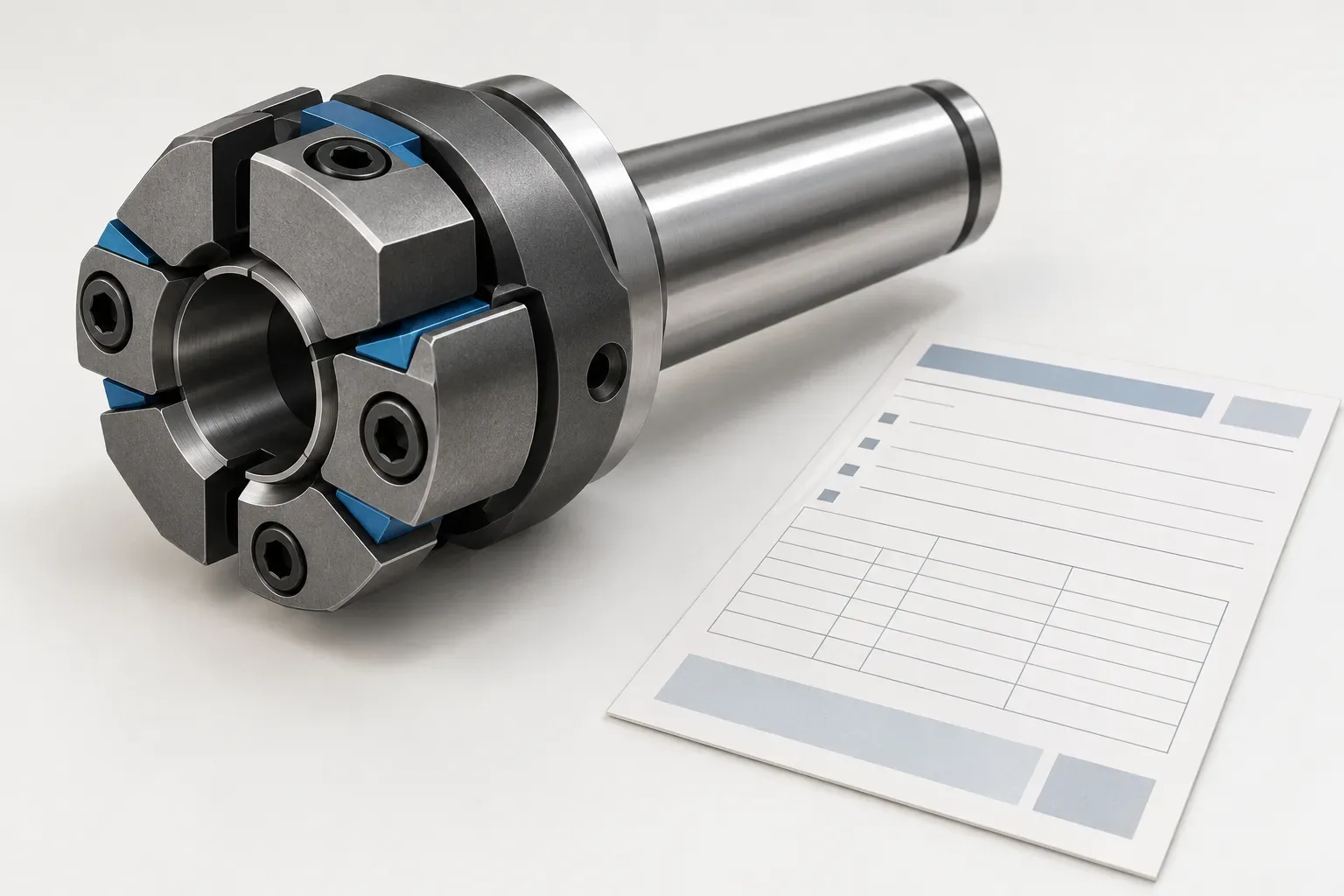
A VDI B1 tool holder enquiry should preserve the form description as well as the complete model designation. In the documented example used here, B1-16x12x24 is identified as a right-hand, short radial holder for a VDI turret application. Those words are part of the product identity, not details that can be dropped once a diameter has been chosen.
The purpose of this guide is to read one B1 configuration carefully. It does not treat every letter or number in the model as a universal code, and it does not claim that a matching nominal interface alone establishes machine compatibility.
Record the full identity before measuring
The B1-16x12x24 radial holder has a separate dimensional record with labelled widths, heights and lengths. Use that record together with the corresponding drawing. A model can identify a candidate, while the drawing explains the features to be compared.
Record “right, short, radial” alongside the designation in the enquiry. If the holder is replacing an installed part, photograph its orientation and identify where the tool sits relative to the workpiece. A photograph of an uninstalled component may not preserve the working context needed to judge direction.
Do not assume that a visually similar B1-labelled item from another source follows the same dimensional or naming conventions. The evidence in this guide applies to the cited configuration and its recorded drawing fields.
Keep all three groups of dimensions visible
The selected record lists the following measurements. The table retains the drawing labels because the drawing determines where each feature is measured.
| Recorded field | Value |
|---|---|
| Diameter d1 | 16 mm |
| Width b1 | 42 mm |
| Width b2 | 23 mm |
| Width b3 | 5 mm |
| Height h1 | 12 mm |
| Height h5 | 20 mm |
| Height h6 | 22 mm |
| Length l1 | 13 mm |
| Length l2 | 24 mm |
A field labelled height should not automatically become a cutting-edge centre-height claim. Similarly, the length labels do not by themselves describe the overall installed tool reach. Read the drawing definition before assigning a more specific physical meaning.
The complete designation contains several numbers, but that does not justify decoding every segment into a dimension. The labelled table provides the measurement information. If an ordering description and a dimensional record appear inconsistent, identify the exact discrepancy before choosing a substitute.
Separate holder direction from the tool requirement
The cited product is identified as right-hand. The cutting tool still requires its own description, including its actual dimensions and intended working orientation. Do not assume that a tool's direction label alone resolves the required holder arrangement.
Describe the operation and the working position on a setup sketch. Show the relevant workpiece surface and the approach direction. This gives the supplier a common reference for discussing the holder rather than relying on an isolated right-or-left word.
A direction question should be resolved before comparing quotations. Otherwise, two prices can appear to concern the same holder size while referring to different arrangements.
Check the complete fit against the turret information
Compare the actual interface, locating and installation requirements with the machine documentation. The recorded d1 value is one feature in that process. It does not establish a permitted machine list, tightening value or clamping compatibility.
The working envelope also includes the installed cutting tool and the surroundings. Review adjacent tooling, the chuck, the workpiece and the intended machine motions. The product record does not specify a universal clearance allowance for these conditions.
Where information is missing, ask a specific question about the unresolved surface, dimension or installation requirement. Do not replace that question with an unsupported assumption drawn from a representative photograph.
Build a useful B1 replacement request
Include the complete designation, the identified form and direction, turret information, required quantity and relevant drawing. Add photographs of the installed arrangement if available and identify the actual cutting tool being used.
List accessories separately and request a quotation that identifies included items. The dimensional record is not proof that a particular tool, fastener package or coolant connection is supplied with the holder.
The tool holders and adapters catalogue provides other candidates, while the VDI selection guide explains the broader arrangement review. Use the specific B1 record to resolve the individual configuration rather than allowing a family-level description to replace the drawing.
Frequently asked questions
What does the cited B1 record identify?
It identifies B1-16x12x24 as a right-hand, short radial holder for a VDI turret application.
Is h1 automatically cutting-edge centre height?
No. The record labels it height h1. A more specific interpretation requires the corresponding drawing and assembled-tool context.
Does d1 alone establish machine compatibility?
No. Compare the complete interface, installation requirements and working envelope with the actual turret documentation.