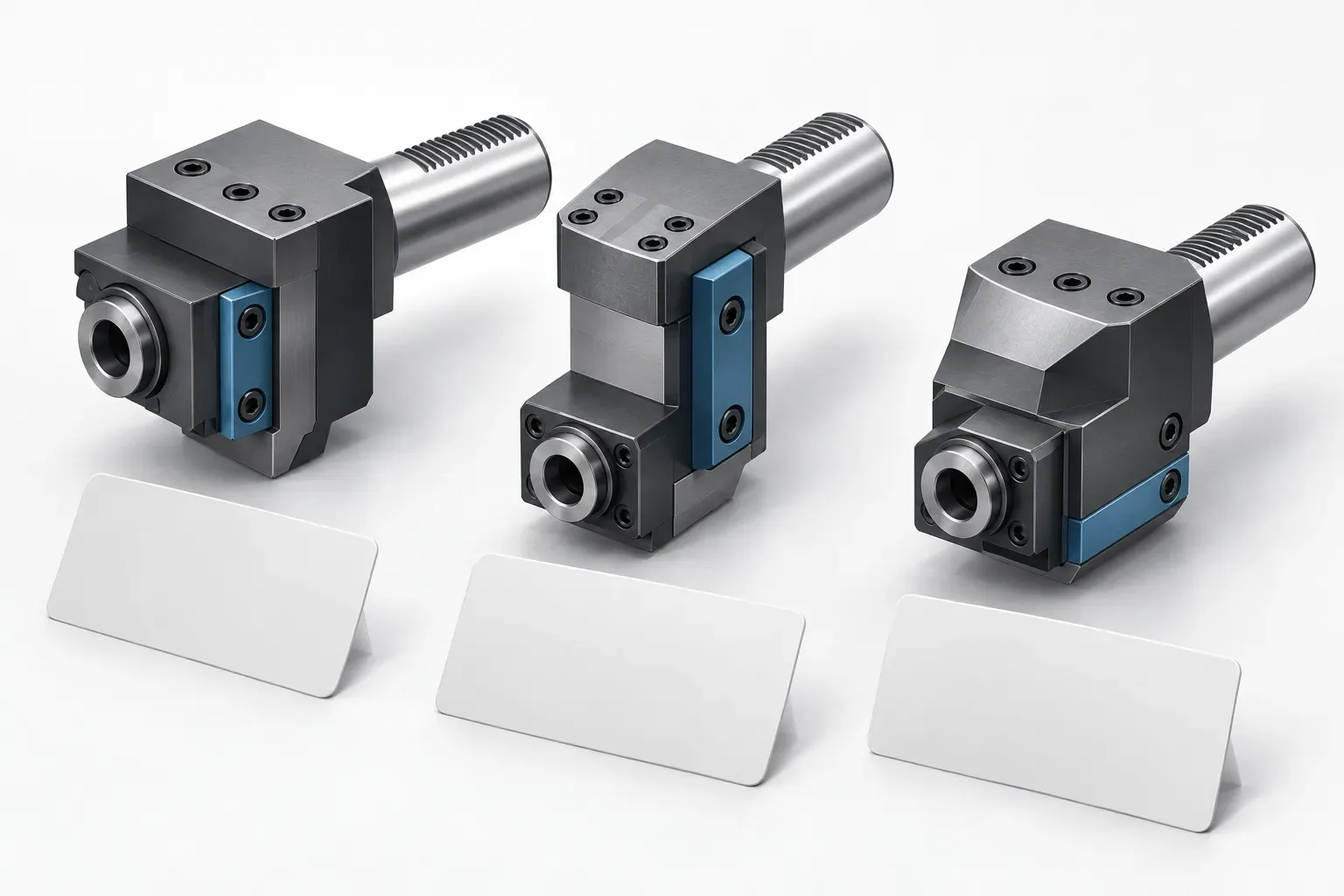
A VDI radial tool holder must be selected by its actual form and orientation, not by diameter alone. The documented range includes right-hand short, inverted right-hand short and right-hand long radial configurations. Their descriptions and drawing fields must stay together throughout selection and quotation.
This guide compares three named examples to show how a similar-looking model can conceal a different arrangement. It does not claim that these forms can be exchanged in a machine, and it does not assign a universal meaning to another manufacturer's model system.
Distinguish the recorded radial forms
The B1-16x12x24 holder is identified as right-hand and short. The B3-16x12x24 holder is identified as inverted, right-hand and short. The B5-16x12x24 holder is identified as right-hand and long.
Those labels establish the identity of the listed configurations. They should not be reduced to a single generic request for a radial holder. In particular, an inverted form needs to be considered as an arrangement question, even where several recorded dimensions agree with another example.
Use the actual drawing and installed orientation to explain what is required. A model string or product photograph can identify a candidate, but neither supplies the complete setup context.
Compare the fields that actually change
The following selected values are recorded for these specific examples. The original drawing must be used to locate each field physically.
| Recorded field | B1 example | B3 example | B5 example |
|---|---|---|---|
| Diameter d1 | 16 mm | 16 mm | 16 mm |
| Width b1 | 42 mm | 42 mm | 58 mm |
| Width b2 | 23 mm | 23 mm | 39 mm |
| Width b3 | 5 mm | 5 mm | 5 mm |
| Height h1 | 12 mm | 12 mm | 12 mm |
| Length l1 | 13 mm | 13 mm | 13 mm |
| Length l2 | 24 mm | 24 mm | 24 mm |
The B5 example has different recorded b1 and b2 values despite sharing the listed d1, h1, l1 and l2 values. The B3 example retains the inverted description even though the selected table values agree with B1. Numerical agreement in a shortened table therefore does not resolve every configuration question.
Establish the required working orientation
Show the turret, the intended cutting tool and the part feature on a sketch. Identify the tool's working position and the direction from which it must approach. Use a photograph of the old holder in its installed condition if one is available.
Keep the holder's direction description separate from the cutting tool's own identity. A tool and a holder form an assembly; a familiar direction word does not prove that the assembled cutting edge will occupy the required position.
If the required orientation is uncertain, resolve that question before selecting a short, long or inverted form. Asking the supplier to infer it from an uninstalled product photograph risks comparing different arrangements without noticing.
Check the wider envelope around the tool
A radial holder's listed dimensions do not describe every clearance condition in a machine. Review the cutting tool's projection and clamping region, the workpiece, the chuck and adjacent tooling. The space needed depends on the actual setup and intended motions.
Do not interpret the long form as automatically preferable. The task is to obtain the required position while satisfying the documented installation conditions. The comparison table does not establish allowable loads, accuracy or cutting performance for any of the examples.
The same evidence boundary applies to coolant and fastening. Obtain the applicable instructions for the exact configuration. An opening or fastener visible in a family image does not supply a connection specification or tightening value.
Preserve the selected form in the enquiry
Record the full model designation, radial form, direction, machine and turret information, quantity and drawing reference. Include the actual tool dimensions and identify unresolved fit questions explicitly. Keep any proposed alternative in a separate comparison row.
A quotation should identify which configuration is being offered and what items are included. Include the drawing revision when a revised specification is supplied. A shared diameter or similar photograph is not sufficient to conclude that two quotations cover the same assembly.
For a repeat order, retain the reviewed drawing and orientation information with the purchase record. This makes a future replacement traceable to the actual selected form rather than a shortened name that has lost the distinction between standard, inverted and long radial arrangements.
Frequently asked questions
Can B1 and B3 be treated as the same form because dimensions match?
No. The cited B3 record identifies an inverted form. The corresponding drawing and working orientation must remain part of selection.
Which selected values differ in the B5 example?
The cited B5 record lists b1 as 58 mm and b2 as 39 mm, compared with 42 mm and 23 mm in the B1 example.
Does a long radial holder guarantee more useful reach?
No. Check the physical drawing and required tool position. The form description does not supply an application-specific clearance or performance approval.