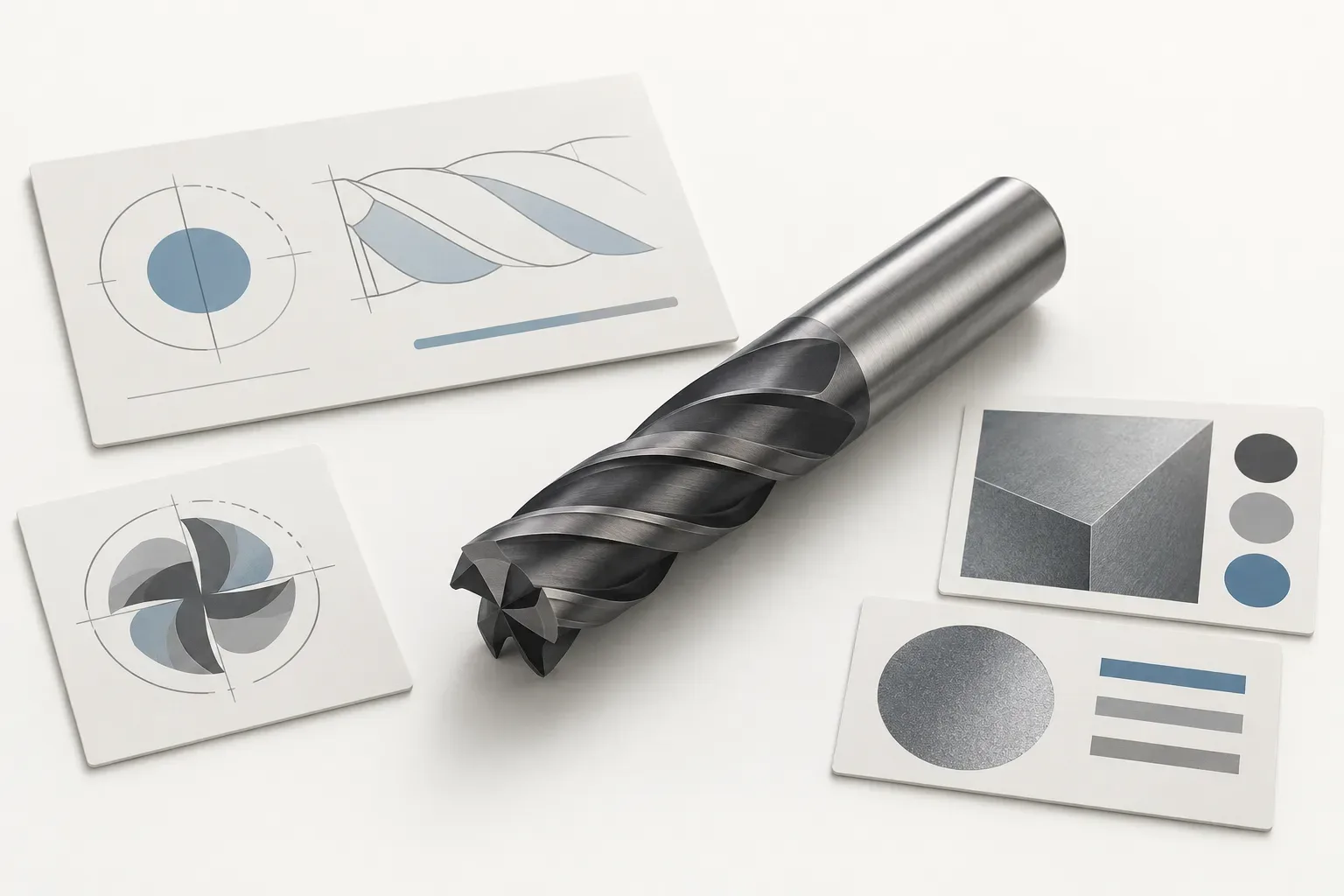
An uncoated carbide end mill is a defined product configuration, not an unfinished specification waiting for a coating to be added. Verify the recorded uncoated description alongside end geometry, dimensions, shank and application. Do not assume that the absence of a coating label supplies missing facts about carbide composition, edge preparation or machining performance.
This guide focuses on reviewing uncoated cutters accurately during purchasing. Two documented three-flute examples show how an uncoated range can include different end forms and unit systems. Their shared coating description does not establish that they perform the same task or may be substituted without application review.
Keep uncoated as an explicit purchase attribute
If an enquiry requires an uncoated cutter, say so in the specification table. Do not leave the field blank and expect every offer to interpret the omission identically. Conversely, do not change an uncoated requirement to a coated option simply because the proposed product has a similar photograph.
Explain the workpiece, feature and intended operation so any suggested alternative can be reviewed in context. The commercial choice and the application decision should identify the same cutter. A preference for an uncoated configuration is not, by itself, evidence of a particular surface outcome or tool-life advantage.
Read a metric square-end example
The uncoated 8 mm square-end cutter has the following recorded specification:
| Recorded field | Value |
|---|---|
| Coating | Uncoated |
| Tool material | Carbide |
| Cutting diameter (DC, mm) | 8 |
| Shank diameter (DMM, mm) | 8 |
| Length of cut (LOC, mm) | 20 |
| Overall length (OAL, mm) | 63 |
| Number of flutes (NOF) | 3 |
| Corner type | Square |
The record identifies a smooth shank and aluminum as its primary workpiece group. Center cutting is yes, variable pitch is no and no through-spindle coolant is listed. These are attributes of this configuration, not general rules for every uncoated end mill.
The square profile does not establish a numerical edge-radius tolerance. If a drawing or qualified process requires a specific edge preparation, request the applicable documentation. Leaving that information unresolved is more accurate than assigning an assumed zero-radius value.
Compare a radius configuration separately
The uncoated half-inch radius cutter also has three flutes and a smooth shank, with aluminum listed as primary group. Its cutting and shank diameters are 0.5 inch, cutting length is 1.25 inch, overall length is 3 inch and corner radius is 0.12 inch.
The metric square example and inch radius example share some descriptive attributes but differ in geometry and size. They are not evidence that one uncoated cutter represents an entire family. Read the selected row and drawing rather than carrying a radius, length or nominal diameter across product descriptions.
Do not infer substrate details from the coating field
The cited records identify the tool material as carbide. They do not supply a complete substrate grade, grain structure, material composition or manufacturing specification. An uncoated description cannot fill those gaps. If procurement requires additional material information, ask for documentation attached to the actual product.
The same discipline applies to performance. These listings do not establish a comparative trial against coated cutters, a maximum speed or a tool-life ratio. A recommendation for a specific job should address the actual workpiece and operation, with the basis for the advice kept distinct from the catalogue geometry.
Check holding and access with the actual configuration
Match the recorded shank diameter and form to the selected holder and its installation instructions. Compare cutting length with the feature and review the full tool-and-holder arrangement around the workpiece and fixtures. Overall length does not publish an allowable projection or guarantee that every obstruction will clear.
If a cooling or entry question is relevant, describe it explicitly. The product's center-cutting or coolant field is not a complete operating procedure. Obtain the applicable recommendation instead of assuming that the uncoated label determines the correct method.
Review an offer without adding unsupported equivalence
A useful quotation request includes the uncoated requirement, end profile, diameter, cutting length, overall length, shank, flute count and quantity. Add the workpiece designation and feature drawing. Identify which attributes are mandatory and which proposed changes may be considered after technical review.
When comparing offers, keep any missing qualification detail visible rather than copying it from another cutter. Confirm that the supplied product and application discussion concern the same configuration. This allows uncoated carbide tooling to be specified precisely while avoiding claims about substrate quality, performance or compatibility that the available records do not establish.
Frequently asked questions
Does uncoated identify a complete carbide grade?
No. The cited material field is carbide; additional substrate details need applicable documentation.
Does uncoated mean the coating field can be left blank?
It is clearer to state uncoated explicitly so the requirement is not mistaken for missing information.
Does this guide prove uncoated is better than coated?
No. It compares recorded configurations and does not establish comparative cutting performance.