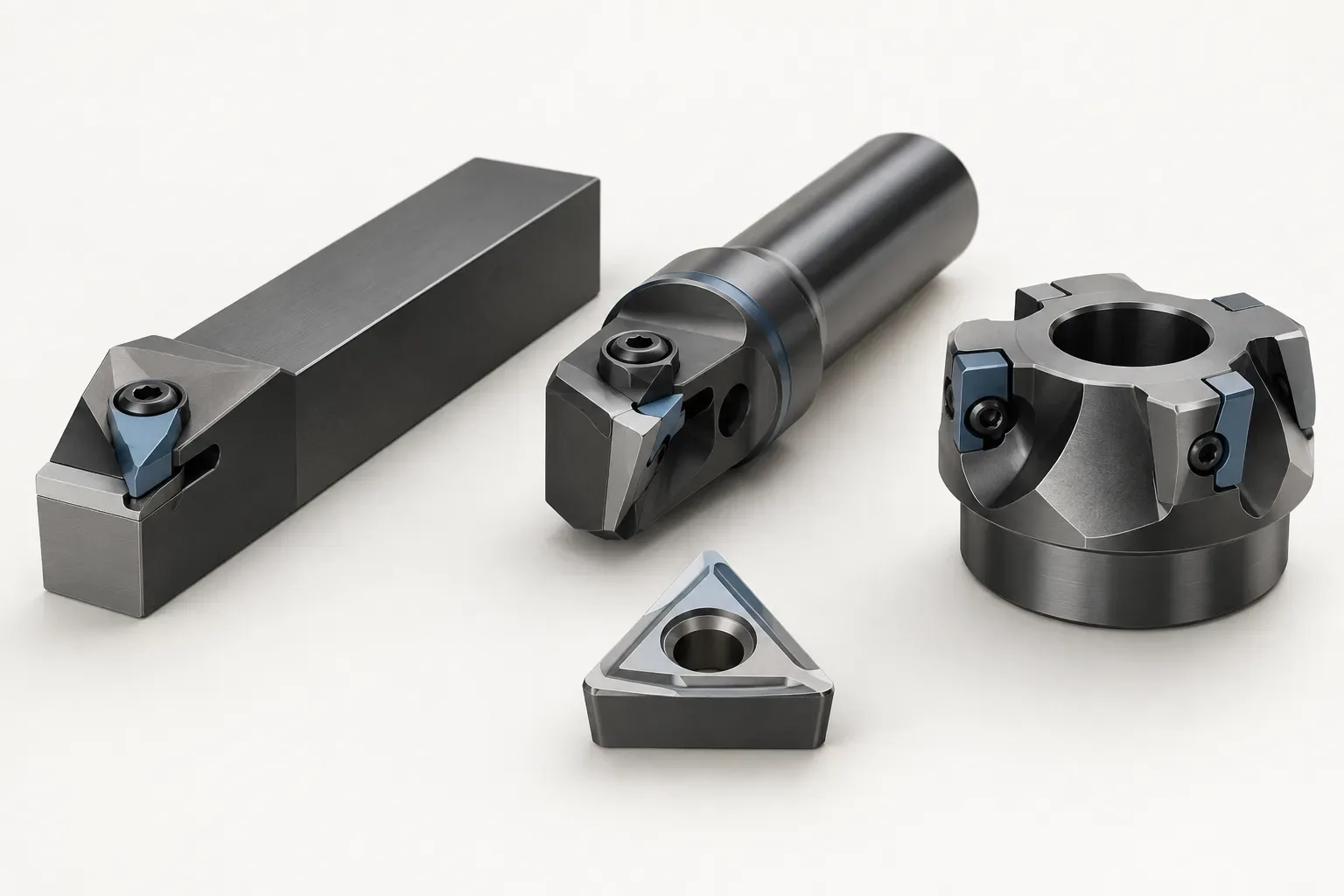
A TPGH1103 boring cartridge is not a single universal component. The insert-family field can appear on cartridges with different connection designations, working ranges and lengths. Use that code as one identification clue, then select the actual cartridge from its complete configuration and mating-head documentation.
This guide focuses on avoiding a parts-identification error: ordering a cartridge solely because it uses the insert family already stocked in the workshop. That approach can leave mounting geometry and range unresolved even when the insert-family characters match the existing tool.
Establish the cartridge identity before discussing insert stock
Record the mating head and its identification, then identify the cartridge range and connection designation. If replacing an existing component, provide clear photographs of its mounting surfaces, orientation and readable markings. Include the intended bore diameter and the part drawing.
Keeping this information separate from the insert-stock record is useful. The workshop may wish to use a familiar insert family, but that preference does not prove that a candidate cartridge fits the existing head. The complete insert selection also needs to satisfy the applicable cartridge requirements and the actual workpiece material.
Compare three documented TPGH1103 configurations
The 39.9–51.1 mm cartridge lists connection designation 22 and 26.9 mm overall length. The 50.9–67.1 mm cartridge lists connection designation 28 and 32.14 mm overall length. The 66.9–87.1 mm cartridge lists connection designation 36 and 41.14 mm overall length.
| Working diameter range | Connection designation | Overall length |
|---|---|---|
| 39.9–51.1 mm | 22 | 26.9 mm |
| 50.9–67.1 mm | 28 | 32.14 mm |
| 66.9–87.1 mm | 36 | 41.14 mm |
All three records list TPGH1103, but they are different cartridge configurations. Do not combine their ranges into the specification of one product or copy one overall length into another row. A connection designation is a system code, not a measured mounting diameter.
The small overlaps between listed ranges can help identify candidates for review. They do not prove that cartridges are interchangeable or that the supporting heads, fastening geometry and instructions are identical. Preserve the specific product identity throughout the selection process.
Keep the full insert specification distinct from the family
The example records list an insert inscribed-circle diameter of 6.35 mm, a 3.4 mm insert-hole diameter and an 11.0 mm cutting-edge length. They identify a triangular insert family and screw-on clamping. These listed fields help describe the documented seat, but they are not a complete application-specific cutting-insert order.
The grade and nose-radius suffix are not supplied. Do not infer them from the initial family characters or from a picture of an installed insert. A missing suffix should remain an identified selection question until the applicable tooling information resolves it.
Similarly, the family does not establish material suitability or recommended cutting conditions by itself. State the actual workpiece material, bore requirement and intended finishing task. Obtain a complete insert designation and application instructions rather than treating a stocked insert as automatically suitable.
Verify the head, seat and fastening arrangement
Compare the cartridge drawing with the mating head, including its locating surfaces, orientation and fastener requirements. Overall length is one component dimension; it is not an installation standard or a maximum depth rating. The full assembly must place the cutting edge correctly within the available space.
If the original cartridge is damaged, distinguish measured undamaged features from estimates made at the damaged area. A photograph can document the condition, but it should not become a source for an invented nominal dimension. Ask for a drawing-based identification where the available evidence is incomplete.
Do not borrow a tightening value, adjustment increment or permissible speed from another TPGH1103 cartridge. Shared insert-family characters do not establish common installation or operating limits. Use the documents that apply to the exact components being assembled.
Make the quotation reproduce the checked configuration
Send the candidate cartridge identity, mating head information, required range, feature depth, material and quantity. State whether the enquiry is for a cartridge only or includes inserts and other items. Ask the quotation to identify each supplied component rather than relying on an assembly illustration.
Retain the agreed record for repeat orders, including any verified full insert designation and applicable instructions. A good parts record allows another buyer to select the same cartridge without assuming that every product carrying TPGH1103 is equivalent. That is the useful distinction between searching by an insert family and ordering a verified configuration.
Frequently asked questions
Are all TPGH1103 boring cartridges interchangeable?
No such interchangeability is established. The examples have different ranges, system designations and lengths; the complete mating geometry must match.
Does TPGH1103 specify the full insert grade?
No. The records do not provide the complete grade and nose-radius suffix. Select the full designation for the actual cartridge and application.
Can connection designation 28 be treated as a measured mounting diameter?
No. The cartridge record identifies it as a system designation. Use the applicable drawing for measured interface features.