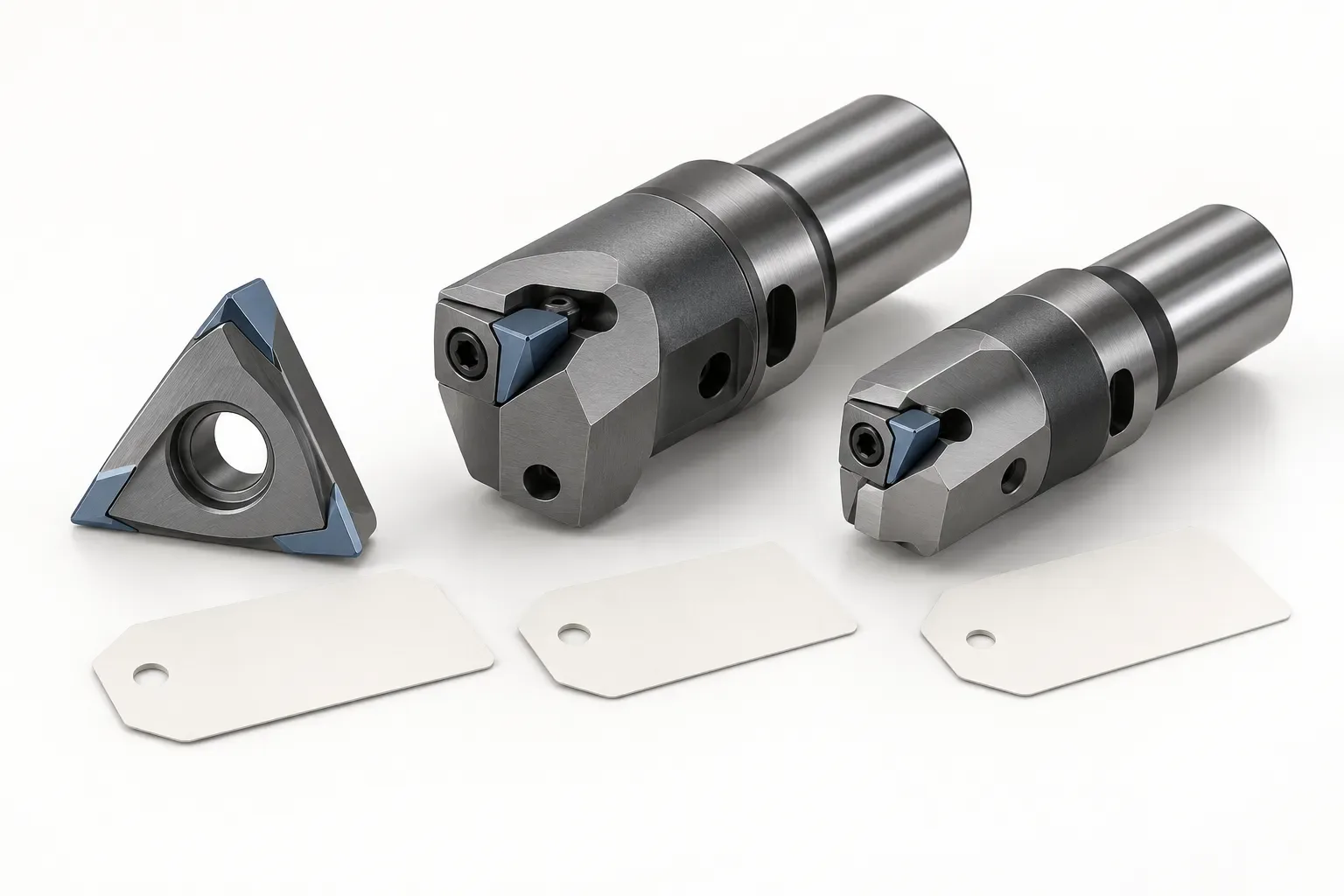
A TPGH0802 boring cartridge enquiry needs more than an insert-family code. The code identifies a listed insert family, while the cartridge has its own working range, connection designation, length and mating geometry. Two cartridges can use the same insert family without being the same replacement component.
This guide is intended for buyers who know the insert family but still need to identify the cartridge. It uses two documented fine-boring configurations to show which information the family code can support and which details must come from the complete component record.
Start with the part that actually needs replacing
Determine whether the requirement is a cutting insert, one cartridge or a complete boring assembly. An insert code on a workshop note can be useful identification evidence, but it should not silently define the item being purchased. Write the required supply scope in plain language before comparing catalogue records.
If the cartridge is a replacement, retain the head identity and photograph the installed component and mating surfaces. Record the intended bore range and any readable cartridge identification. If only the insert family is known, state that limitation rather than creating a complete cartridge designation from it.
Compare the two TPGH0802 cartridge records
The 20.0–24.0 mm fine boring cartridge lists connection designation 11 and an overall length of 16.84 mm. The 30.9–40.1 mm fine boring cartridge lists connection designation 18 and an overall length of 21.73 mm.
Both records identify TPGH0802 as the insert family. That common field does not erase their different cartridge ranges, system designations or lengths.
| Recorded cartridge field | First configuration | Second configuration |
|---|---|---|
| Boring diameter range | 20.0–24.0 mm | 30.9–40.1 mm |
| Connection designation | 11 | 18 |
| Overall length | 16.84 mm | 21.73 mm |
| Insert family | TPGH0802 | TPGH0802 |
The connection designations are system codes, not measured mounting diameters. Match the complete cartridge and head drawings, including orientation and fastening geometry. The shared insert family alone is not evidence that either cartridge can replace the other.
Preserve the insert measurements without inventing a full code
Both example records list an insert inscribed-circle diameter of 4.76 mm, an insert-hole diameter of 2.5 mm and an 8.0 mm cutting-edge length. Their listed insert shape is triangular and their clamping type is screw-on. These are attributes of the documented configurations, not a universal compatibility declaration for every similarly named seat.
The full grade and nose-radius suffix are not specified. Do not supply a plausible suffix merely to make a quotation request look complete. Material suitability and the appropriate complete insert designation require a separate selection supported by the applicable tooling information.
A photograph of an insert can help distinguish visible features, but it cannot establish an unreadable grade or hidden seat requirement. Retain readable packaging or tool documentation where available. If the source does not identify an insert as included, keep inclusion open as a supply-scope question.
Match the cartridge to its own working range
Select the cartridge record whose range supports the intended bore as part of the correct assembly. Do not apply the smaller record's length to the larger configuration or describe the combined ranges as continuous coverage of a single cartridge. The two examples are separate products.
Also distinguish cartridge overall length from bore depth. The head, shank, cutting-edge position and access path need an assembly-level review. A cartridge that accepts a familiar insert family may still have unsuitable locating geometry or an unresolved envelope for the proposed setup.
Obtain the installation instructions for the exact cartridge. The records used here do not establish universal screw torque, adjustment resolution, maximum speed or achievable tolerance. Do not borrow these values from another tool using the same insert family.
Send a configuration-specific request
Use the boring tools catalogue to locate candidate records. Send the selected cartridge identity, mating head, required range, part drawing, material, bore depth and quantity. Add the full readable insert identification if it is available, and distinguish known facts from unresolved selection questions.
Ask the quotation to identify one cartridge and to state insert, fastener and accessory scope separately. If a complete assembly is required, request its head and shank explicitly. Preserve the final agreed configuration so that the next order does not have to restart from the partial clue TPGH0802.
Frequently asked questions
Does TPGH0802 uniquely identify a cartridge?
No. Two documented cartridges use that family but have different ranges, connection designations and overall lengths.
What insert dimensions are listed for these examples?
Both list a 4.76 mm inscribed circle, 2.5 mm insert-hole diameter and 8.0 mm cutting-edge length. These values do not supply the missing full grade and nose-radius suffix.
Does the cartridge listing establish that inserts are included?
No. Insert inclusion must be stated separately in the quotation, along with any fasteners or accessories.