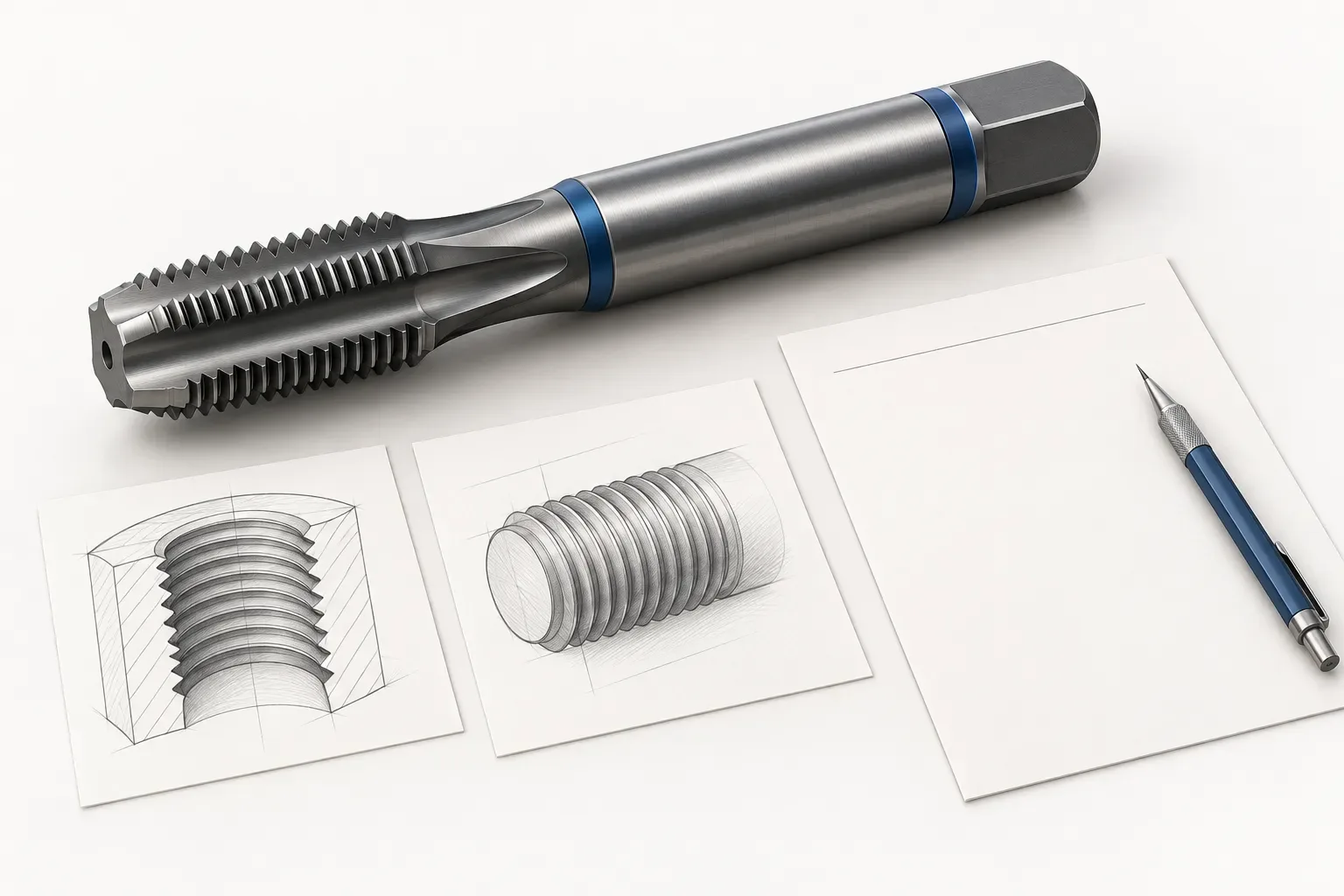
A threading-tool enquiry needs the complete thread requirement and the intended process. Nominal diameter alone does not define the thread, and the general category name does not identify a complete cutting assembly. Begin with the part drawing, then describe how the feature is intended to be produced and which components the purchase must supply.
This is a general requirement-preparation guide. It does not establish that a particular tap, die, thread mill, threading insert or holder is available on this site. Any proposed product needs its own verified specification and a separate check against the actual part and machine setup.
Copy the full thread designation from the drawing
Retain the complete drawing designation and the applicable standard or specification where known. Identify whether the thread is internal or external, its required handedness and the acceptance requirements. Include the depth or length relevant to the feature and show any shoulder, runout or access restriction.
Keep pitch and threads-per-inch information in their stated form rather than treating the two descriptions as interchangeable labels. If the source drawing is unclear, ask the drawing owner to resolve it. Do not create a likely designation from a measured diameter and a photograph.
A shortened workshop description can be useful for a conversation, but it should not replace the controlled requirement on the purchasing record. If the full thread callout is missing, state that the tool cannot yet be evaluated against a complete feature definition.
State the intended threading process
Identify whether the requirement concerns a turning tool, tap, die, thread mill or another specifically documented process. These names describe different tooling choices; the broad phrase threading tools should not be used to hide which one is actually requested.
The appropriate process depends on the actual part, machine and manufacturing requirement. This guide does not recommend one method universally or claim that a tool from one process can substitute for another. State the chosen process where it has already been established, and identify an unresolved process choice as a question for the responsible review.
Keep any pre-existing feature condition visible. Describe the starting hole or external surface and identify which operation prepares it. A final thread requirement alone does not tell a supplier the complete condition that reaches the cutting tool.
Separate the cutting element from its supporting tool
A threading-tool enquiry can concern an entire tool, a holder, a replaceable cutting element or a spare. Name the required item before discussing a product code. If the system uses separate components, identify the holder and cutting element independently.
A familiar insert-family code does not establish the full thread profile, grade or application. Retain the complete verified designation where available and match it to the supporting tool documentation. Do not infer a missing suffix or an included insert package from a representative image.
Likewise, a holder designation should not be rewritten as a claim that it produces a particular thread specification. The complete assembly and application information must resolve the proposed use. Keep any accessory or fastener requirement separate from the main product identity.
Describe the machine and feature access
Provide the machine-side interface, toolholding arrangement and installation constraints needed to evaluate the candidate. Include the workpiece material and its known condition. Do not substitute a general material label or a visually estimated dimension for the actual available specification.
For an internal feature, show the relevant depth and obstructions on the drawing. For an external feature, identify the shoulder and available approach space. These are requirement descriptions, not a universal clearance rule or a machining program.
Request the instructions and limits for the exact selected tooling. This guide supplies no cutting speed, feed, torque, coolant pressure or tool-life value. Values taken from a different thread form, material or tool system are not automatically applicable.
Use a clear enquiry checklist
| Requirement area | Information to retain |
|---|---|
| Thread | Full drawing designation and standard where known |
| Feature | Internal or external, handedness, depth or length |
| Acceptance | Drawing and inspection requirements |
| Process | Intended tooling method and starting condition |
| Assembly | Holder, cutting element, interface and access |
| Scope | Complete tool, components, accessories and quantity |
The threading tools category is a navigation route, not evidence that every process listed in this guide has a verified product there. Use the tooling catalogue only to identify records that can actually be checked against the requirement.
Send the completed information through the contact page and ask the quotation to identify the proposed configuration and included components. Preserve the full thread requirement and any unresolved questions with the purchase record. This prevents a generic category name, partial model or nominal diameter from becoming an unsupported assertion that a tool matches the required thread.
Frequently asked questions
Is nominal diameter enough to specify a threading tool?
No. Retain the complete thread designation, process and feature requirements from the applicable drawing.
Does a threading-tools category prove that taps and dies are stocked?
No. Category navigation does not establish the availability of every tool type mentioned in a general guide.
Can a partial insert code determine the full threading application?
No. Match the complete cutting-element specification, supporting tool and part requirement using applicable documentation.