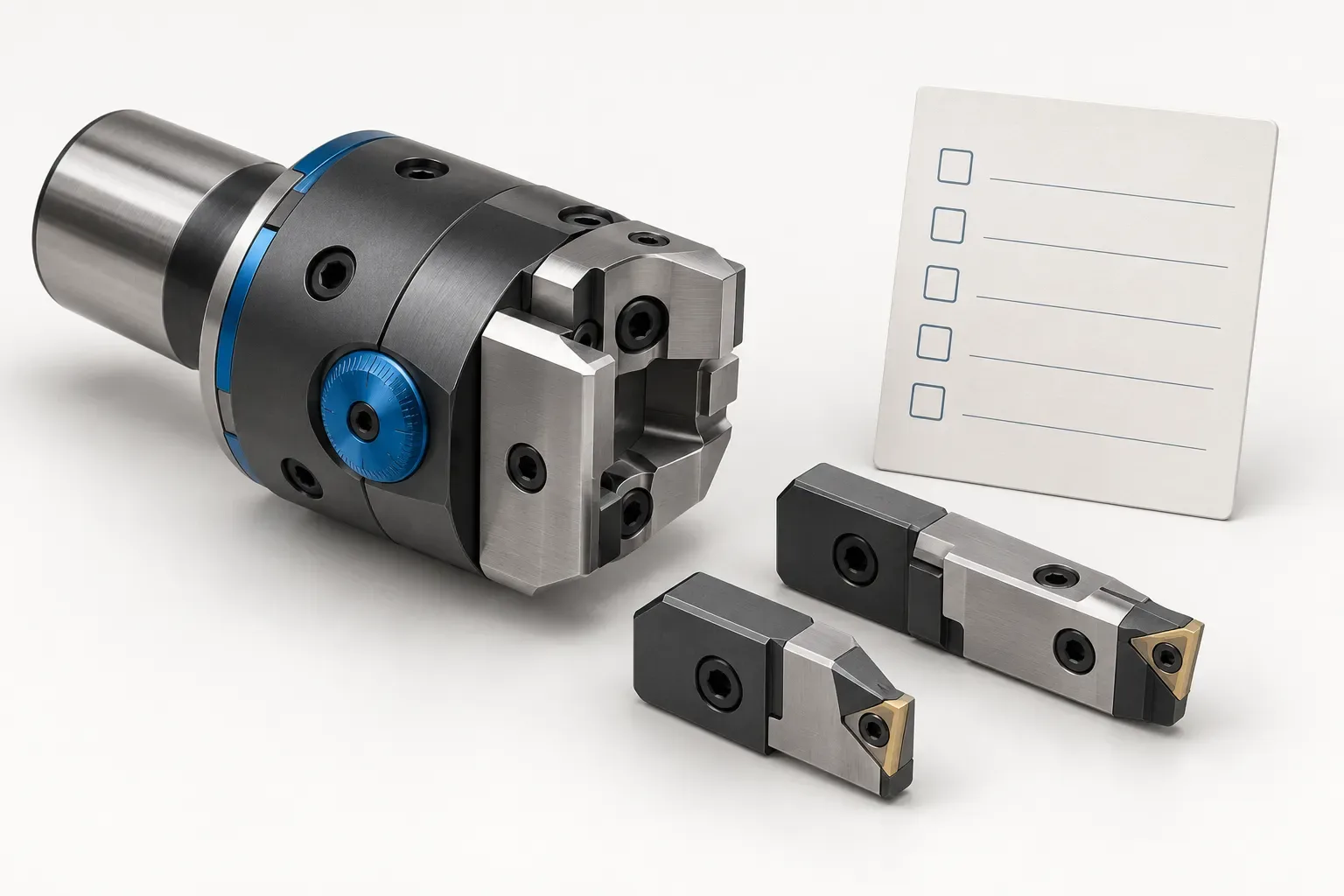
Rough boring heads are selected for enlarging an existing bore within a defined assembly range. Begin with the incoming hole, the required condition before finishing and the machine interface. Then specify the head and cartridge arrangement together. A range printed beside the head is not a substitute for identifying the actual cutting components.
The useful purchasing question is therefore not simply which head reaches a nominal diameter. It is which documented configuration fits the setup, covers the planned working diameter and has a clearly defined supply scope. The examples below show how to keep those checks separate without assuming cutting performance from catalogue geometry.
Describe the incoming bore and the next operation
State the existing hole size and condition, the required rough-bored size and the later operation, if any. Provide a drawing showing depth, interruptions, shoulders and access restrictions. Identify the workpiece material and any relevant variation in the incoming feature. These facts explain the task more precisely than calling it a heavy roughing application.
Do not select an unverified allowance or cutting parameter merely because the tool is called a rough boring head. The amount removed, insert choice and operating limits depend on the actual assembly and application. If the following process is fine boring, keep its required incoming condition separate from the finished-part tolerance.
Read the head dimensions as an installation envelope
The 25.0–34.0 mm rough boring head provides a compact configuration example. Its published dimensions distinguish the cutting coverage from the body and mounting geometry.
| Recorded feature | Value |
|---|---|
| Boring diameter range | 25.0–34.0 mm |
| Pilot / shank diameter | 11.0 mm |
| Body diameter | 22.0 mm |
| Body length | 50.0 mm |
| Overall length | 50.1 mm |
| Connection designation | 11 |
The system designation 11 and measured pilot diameter 11.0 mm are related fields in this record, but they are not interchangeable descriptions. Match the mating drawing, locating features and installation instructions. Neither number alone proves that the head fits a particular spindle or adapter.
Also avoid treating the 50.0 mm body length as a guaranteed bore depth. The installed assembly, cutting-edge position and approach path need their own drawing review. A component can satisfy the diameter requirement while the complete setup lacks the necessary access or clearance.
Identify the cartridge range behind broader coverage
A larger example, the 50.0–77.0 mm rough boring head, lists a 22.0 mm pilot, 42.0 mm body diameter, 80.0 mm body length and 83.9 mm overall length. Its coverage is divided into working ranges of 50.0–64.0 mm and 63.0–77.0 mm using corresponding cartridges.
A request for the broad range therefore leaves a configuration question unresolved. Identify the working diameter and the relevant cartridge range. The overlap does not prove that the two arrangements have identical envelopes or can be substituted without checking the head and cartridge drawings.
Keep the selected cartridge identity on the same enquiry record as the head. If several bores are involved, list their required sizes separately and ask which configurations cover them. Do not assume one setting, one cartridge set or one accessory package covers every feature in the job.
Separate set quantity from cutting-tool inclusion
Rough boring cartridge listings can specify a set of two cartridges. That quantity describes the cartridge package; it does not establish that inserts, a head, a shank or mounting accessories are included. An illustration showing an assembled tool is not a bill of materials.
Request the complete supplied-item list. Where an insert family is specified, obtain the full designation needed for the actual material and operation. A family code without its grade and geometry suffix cannot establish cutting conditions or application performance. The supplier should also identify any assembly-specific setting and installation instructions.
Through-tool coolant is listed for both example heads. Record this feature when discussing the setup, but do not infer coolant pressure, flow rate or connection compatibility. Verify the complete coolant path and applicable limits against the actual machine and tooling documentation.
Make the quotation reflect the planned assembly
Use the boring tools catalogue to shortlist a head, then send its identity together with the incoming bore details, required output size, depth, material, machine interface and quantity. Include a marked drawing where the approach path or surrounding features create a fit question.
Ask the quotation to state the selected head, cartridge range, insert specification, supplied quantity and accessories individually. Keep installation questions open until the applicable instructions answer them. Published body dimensions do not establish tightening values, maximum speed, allowable loads or a machining guarantee.
The resulting record should let another person identify the same configuration without relying on a photograph or informal description. That traceability is especially useful when the roughing tool and the following finishing tool are ordered separately: both purchases can refer to the same part requirement while retaining their own component specifications.
Frequently asked questions
Is a rough boring head range enough to choose a cartridge set?
No. Some heads list separate working ranges using corresponding cartridges. Specify the target bore and the cartridge configuration that supports it.
Does a set of two cartridges include two inserts?
Not necessarily. Cartridge quantity and insert inclusion are different scope items. The quotation must identify what is supplied.
Can body length be used as the maximum bore depth?
No. Check the installed assembly, cutting-edge position, approach path and clearance. A component length is not a bore-depth rating.