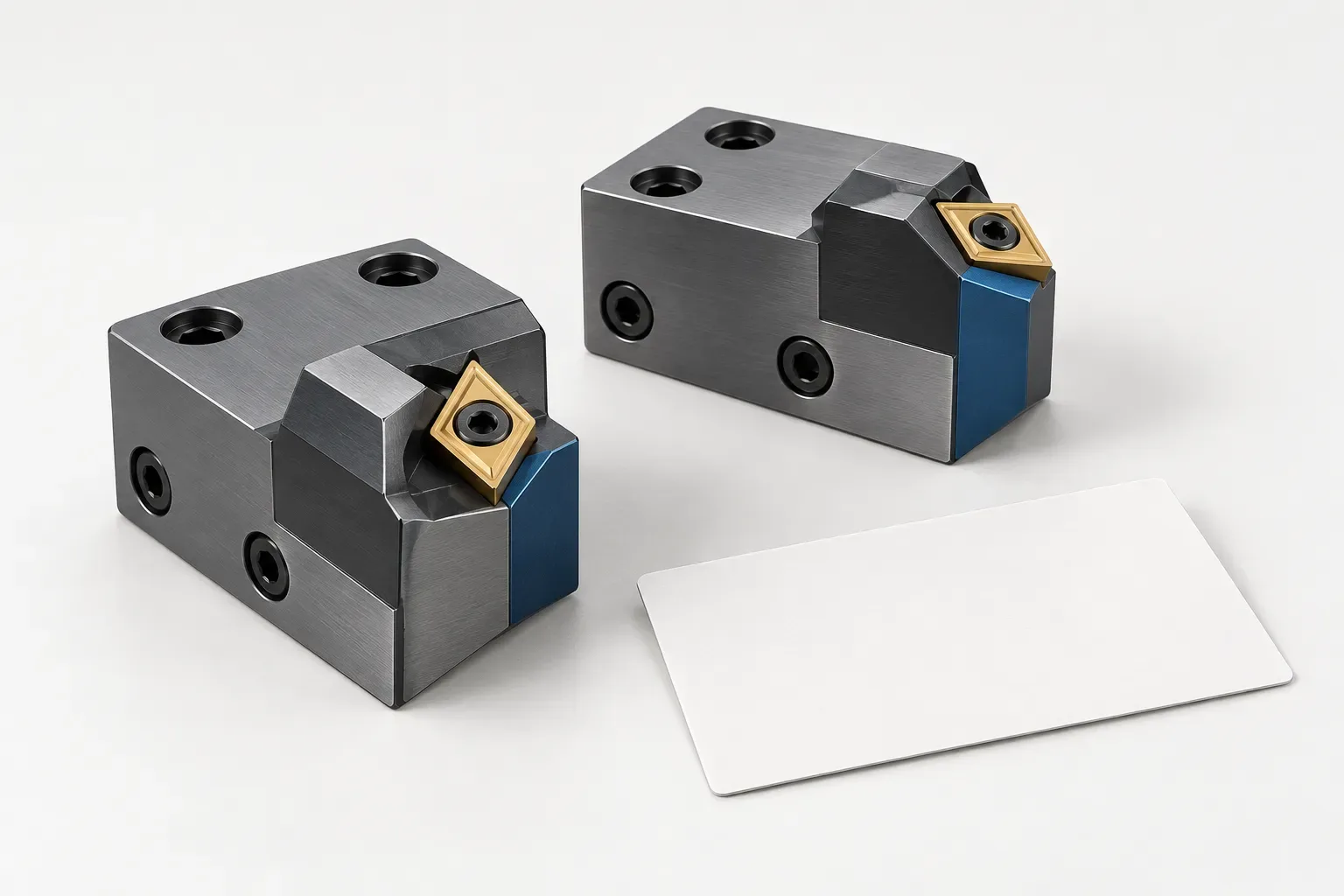
Rough boring cartridge sets should be ordered from a defined bill of materials, not from an assembled-tool photograph. The set quantity, working diameter range, connection designation and insert family describe different parts of the purchase. Keeping them separate prevents a request for cartridges from being mistaken for an order that includes a head, shank and inserts.
This guide focuses on that purchasing task. It compares two documented sets and explains how to communicate configuration and supply scope. It does not establish universal cartridge interchangeability, cutting parameters or a machining-performance guarantee.
Write down exactly what the set is meant to supply
Start by naming the required item: a cartridge set for an existing head, or components for a new boring assembly. If replacing a set, provide the head identification, photographs of the installed arrangement and any available component drawing. Note whether the old set's identification remains readable.
A record stating two cartridges per set answers a package-quantity question. It does not prove that both inserts, replacement screws, a complete head or an adapter are supplied. Ask for each of those items to be identified separately. This matters even when a marketing illustration shows an assembled tool with cutting inserts installed.
Describe the intended working diameter and bore feature alongside the package requirement. The range has to suit the actual assembly, while the supplied-item list has to suit the purchase. One cannot be used to fill gaps in the other.
Compare two sets without mixing their specifications
The 50.0–64.0 mm rough boring cartridge set lists connection designation 22, overall length 42.3 mm and insert family CCMT09T3. It records two cartridges per set.
The 95.0–116.0 mm rough boring cartridge set instead lists connection designation 36, overall length 74.0 mm and insert family CCMT1204. It also records two cartridges per set.
| Field | First set | Second set |
|---|---|---|
| Working diameter range | 50.0–64.0 mm | 95.0–116.0 mm |
| Connection designation | 22 | 36 |
| Overall length | 42.3 mm | 74.0 mm |
| Insert family | CCMT09T3 | CCMT1204 |
| Cartridges per set | 2 | 2 |
The connection numbers identify system sizes. They should not be rewritten as measured interface diameters without a supporting dimension field. Likewise, the shared set quantity does not imply that the two products have the same locating geometry, fastening arrangement or accessory package.
Match the set to the head and its working configuration
Compare the mating-head drawing, cartridge orientation and fastener geometry before accepting a replacement. A range that contains the required bore diameter is a useful screening condition, but it does not prove that the selected cartridges mount to the head already on the machine.
When a head offers broad coverage through several cartridge ranges, identify which range is required for the job. Keep the head and set identities on the same configuration sheet. An overlap between working ranges can produce more than one candidate, but it does not remove the need to check each candidate's actual drawing.
Also review the installed envelope. Overall cartridge length is not a bore-depth rating or the length of the complete tool. Tool position, approach clearance and the rest of the assembly must be assessed together against the feature and setup.
Resolve the full insert requirement separately
For the first set, the listed insert inscribed-circle diameter is 9.53 mm and the insert-hole diameter is 4.4 mm. For the second, those fields are 12.7 mm and 5.5 mm. These measurements are part of the specific records, not general values to apply to every cartridge carrying a similar family code.
Neither record provides the full grade and nose-radius suffix. Obtain the complete insert designation for the material and operation, then confirm that it satisfies the applicable cartridge requirements. A family label alone cannot determine material suitability, surface finish, cutting speed or tool life.
State whether the enquiry includes inserts or only the cartridge set. If inserts are required, identify their quantity and complete specification separately. That keeps package scope clear without assuming that a set count equals a cutting-insert count.
Use an auditable quotation checklist
The boring tools catalogue can help shortlist configurations. For the enquiry, provide the mating head, required bore range and depth, material, part drawing, selected set identity and order quantity. Add the installation questions that the available record does not answer.
Request a quotation listing the number of sets, cartridges per set, inserts and accessories as separate lines or clearly separated scope items. Obtain applicable installation instructions rather than borrowing tightening or setting values from another tool. Keep the final agreed configuration with the purchase record so that a later spare-part request can reproduce the same assembly accurately.
Frequently asked questions
What does two cartridges per set establish?
It establishes the listed cartridge quantity. It does not by itself establish insert, head, shank or accessory inclusion.
Can two sets with overlapping ranges be interchanged?
Not from range overlap alone. Check the mating head, locating geometry, orientation and fastener requirements.
Does an insert family code specify the full cutting insert?
No. The examples do not specify the complete grade and nose-radius suffix. Those details require a separate application-specific selection.