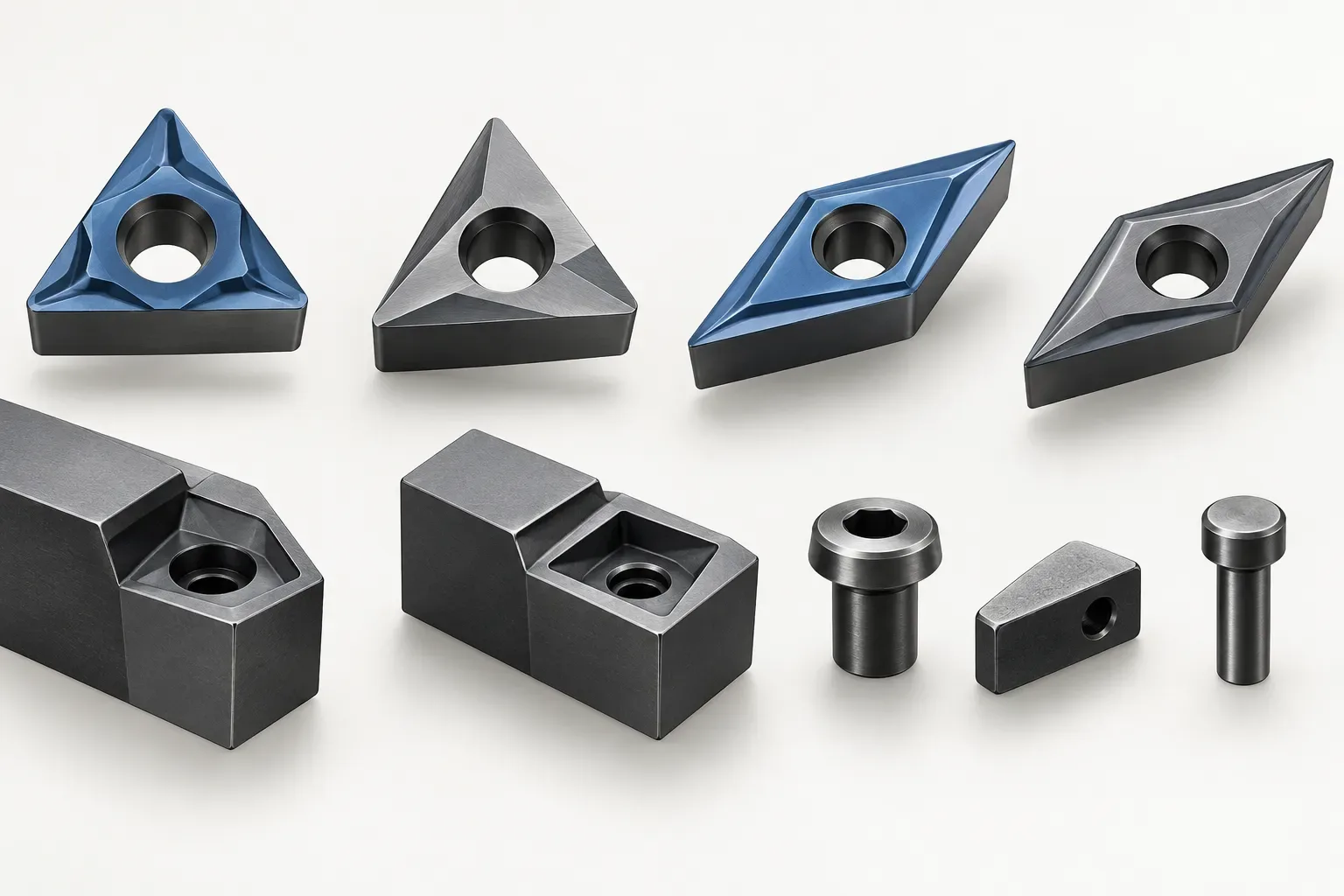
An enquiry about indexable inserts should identify the cutting element and the assembly that holds it. A short insert-family code is useful evidence, but it is not a complete purchasing specification. Geometry, grade, edge preparation, seat requirements and retaining components need their own records before a proposed replacement can be assessed.
This guide explains how to prepare that record. It does not establish that separate inserts are stocked or that an insert mentioned in a boring-tool specification is included with that tool. PRECIMILL acts as a sales contact; any proposed item must be matched to its documented configuration rather than represented as an independently manufactured product.
Start with the complete existing identification
Copy the full marking from the insert packaging and the tool documentation where available. Preserve letters, numbers, suffixes and the stated manufacturer reference in the private enquiry record. Include clear photographs of the packaging and the installed assembly if they are available to you.
Keep the insert identification separate from the body or cartridge identification. A body number may identify a holder without fully specifying its cutting component. Equally, a family designation printed on a product page may omit the grade or edge details needed for a replacement order.
If the original marking cannot be read, describe the identification gap explicitly. A photograph can support a dimensional review, but visual resemblance alone should not become a claim that two products are interchangeable.
Separate the geometric record from the grade
Record the available geometry fields exactly as documented, with their units. Depending on the source record, these may include shape, inscribed circle, thickness, hole information and edge details. Do not silently convert a drawing label into a different physical dimension because the resulting number looks familiar.
Grade and coating information belong in separate fields. The local records used for the examples below do not establish a grade, coating or complete nose-radius specification. Those missing details cannot be reconstructed from the family code alone or borrowed from a visually similar insert elsewhere.
Describe the workpiece material and the operation as requirements for the supplier to evaluate. This helps frame a recommendation without asserting that an undocumented grade already suits the application. Keep any eventual recommendation traceable to the proposed cutting element and its supporting documentation.
Use local family references within their limits
The local fine boring cartridge record lists TPGH0802 as its insert-family reference. That field identifies a component requirement associated with the documented cartridge. It does not make every insert carrying that family label an approved replacement, and it does not establish that a separate insert is supplied in the package.
A local rough boring cartridge set record instead lists CCMT09T3. The two records illustrate why the cutting component must be checked against its own cartridge rather than chosen from the broad phrase boring insert. They are examples of documented family references, not a standalone inventory of cutting grades.
For either example, request the complete proposed insert specification and the assembly documentation before approving the purchase. A shared family label should remain one part of the check rather than its final conclusion.
Check the seat and retaining components
Identify the exact body or cartridge that will receive the insert. Request the applicable parts information for the seat and the retaining arrangement. Where screws, clamps, seats or other components are involved, record their identities and whether they are included or ordered separately.
Do not substitute a fastener on the basis of appearance. The available cartridge records do not establish a universal screw, installation torque or common spare-parts kit. Those details require instructions for the actual assembly; this guide supplies no numerical installation setting.
Keep replacement cutting elements and replacement hardware as separate enquiry lines. This prevents a quote for an insert from being mistaken for a complete repair package and makes missing supply details visible before ordering.
Describe the application without inventing cutting data
State the intended operation, the workpiece material specification where known, and the feature requirements from the drawing. Provide the actual setup constraints and any documented issue with the existing assembly. Distinguish an observed problem from an assumed cause.
Do not use this information to invent cutting speed, feed, tool life or a guaranteed finish. Such claims need evidence for the actual combination of insert, body, material and operation. A general guide can help assemble the questions while leaving unsupported performance numbers out of the product record.
Send a traceable replacement request
Prepare one enquiry containing the complete insert reference, holder or cartridge identity, available geometry documentation, application requirements and requested supply quantities. Mark unknown fields clearly in the purchasing record instead of filling them with probable values.
Use the contact page to discuss the documented requirement with PRECIMILL. Request a proposed specification and an explicit supply scope. Approval should follow a review of that proposal against the existing assembly and application, with unresolved compatibility questions settled before an order is placed.
Frequently asked questions
Is an insert-family code a complete replacement specification?
No. The available family reference must be checked alongside the complete proposed designation, grade and assembly documentation. It does not establish every replacement requirement.
Are the inserts mentioned on cartridge pages included?
The referenced local cartridge fields identify an insert family but do not establish package inclusion. Request an explicit supply scope for the proposed configuration.
Can a similar-looking insert or retaining screw be substituted?
Appearance alone does not establish interchangeability. Identify the receiving body or cartridge and use its applicable component and installation documentation.