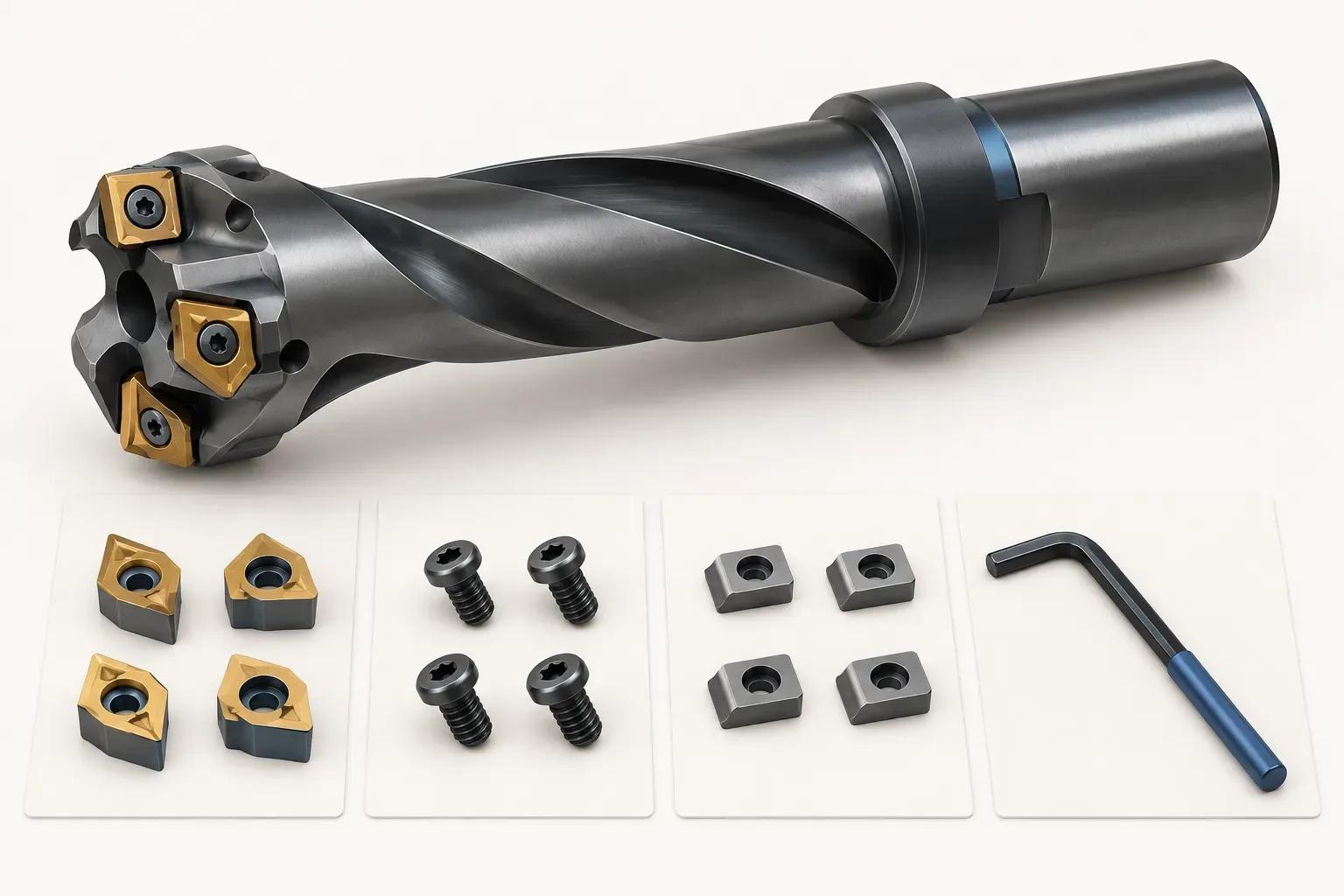
When ordering replacement parts for indexable drills, begin with the body identity and its component documentation. An insert-family name by itself is not a complete spare-parts record. The correct enquiry must distinguish cutting elements, position-specific requirements, fasteners and other accessories from the drilling body itself.
This guide concerns replacement and repeat purchasing rather than choosing a new body. It does not assign a universal insert count, grade, geometry or installation value to all indexable drills. Each configuration must be checked against the applicable documentation.
Recover the identity of the installed drilling system
Record the body designation and any readable suffix or revision. Include photographs of its identification and the assembly as installed. If the original paperwork is available, retain the drawing and supplied-item list with the enquiry rather than relying on a workshop nickname.
Where a marking is unreadable, state that limitation. Describe the known tool and provide measurements that the process owner can verify, but do not manufacture a model designation from visual resemblance. An accurate partial record is more useful than a complete-looking code that points to the wrong body.
Keep body identity separate from nominal hole size. A cutting-size requirement can help screen candidates, but it does not establish which spare parts belong to a specific system or whether a component from another family is interchangeable.
Build a replacement-parts list by function
Separate the cutting components from the parts that locate, clamp or install them. State which item is being replaced and why the identification is uncertain, if applicable. Do not treat a photograph of an assembled drill as evidence that every visible part is supplied in one package.
| Spare-parts field | Information to retain |
|---|---|
| Body identity | Complete readable designation and documentation |
| Cutting element | Full code and body-specific requirement |
| Component position | Position identified by the applicable instructions |
| Fastener | Exact approved part or documented specification |
| Installation accessory | Required item identified separately |
| Purchase scope | Quantities and included items stated explicitly |
A position field is important wherever the actual system distinguishes different component roles. This guide does not assume that all bodies use the same arrangement. Use the labels and component count shown in the verified documentation instead of extending one system's layout to another.
Preserve the full cutting-element designation
Read the complete designation from reliable packaging, a tool record or the applicable component list. Keep any grade, geometry and other required suffix with the initial family characters. If only a short family code is known, identify the missing details rather than choosing a plausible completion.
Do not infer material suitability or cutting conditions from a familiar shape alone. The actual workpiece material, operation and body requirements matter to the cutting-element selection. A component that appears to sit in a pocket is not thereby established as an approved replacement.
If an existing insert is worn or damaged, distinguish readable identification from assumptions made about the original geometry. Photographs can support the request but cannot establish an unreadable grade or an original edge condition that is no longer visible.
Treat fasteners and installation values as part-specific
A replacement screw or accessory needs its own verified identity or specification. Similar-looking fasteners should not be selected solely by appearance. The correct component and applicable installation instruction must resolve the requirement before assembly.
Do not borrow a tightening value from another insert or drill family. Likewise, a generic description of a clamping method does not establish the complete fastener specification. Ask for the instructions that correspond to the identified body and component rather than assuming a shared procedure.
Record any unresolved seat or body-condition question. If a locating or clamping surface may be damaged, the enquiry should describe that condition separately from the request for fresh cutting components. Replacing consumables does not establish that the supporting body has been evaluated or accepted for use.
Keep operating information attached to the actual setup
For repeat orders, retain the current application record as context: workpiece material, relevant feature, installed assembly and the observed process condition. Do not turn a repeat purchase into an unsupported guarantee that the same cutting result will occur in another setup.
Where application data is needed, obtain it for the actual configuration and conditions. This guide does not supply speed, feed, coolant pressure, tool-life or accuracy values. A spare-parts code and an installation document answer different questions, and both should be retained where relevant.
Make the quotation auditable
Use the drilling tools category to navigate the site and the contact page to submit the component record. These links do not establish the availability or compatibility of a particular spare. Ask for a verified match and a clear supplied-item list.
The quotation should identify each replacement component, its relationship to the specified body and the required quantity. Preserve the accepted list with the body record so that a later buyer can reproduce the same verified selection. That is more reliable than ordering an unspecified insert or screw for an indexable drill from a photograph.
Frequently asked questions
Is an insert family enough to identify a spare for an indexable drill?
No. Match the complete cutting-element requirement to the actual body and any documented component position.
Can tightening values be copied from another insert family?
No. Use the installation instruction for the identified body, cutting component and fastener.
Does replacing an insert prove that the drill body is suitable for use?
No. Any concern about damaged locating or clamping surfaces requires a separate condition review by the responsible party.