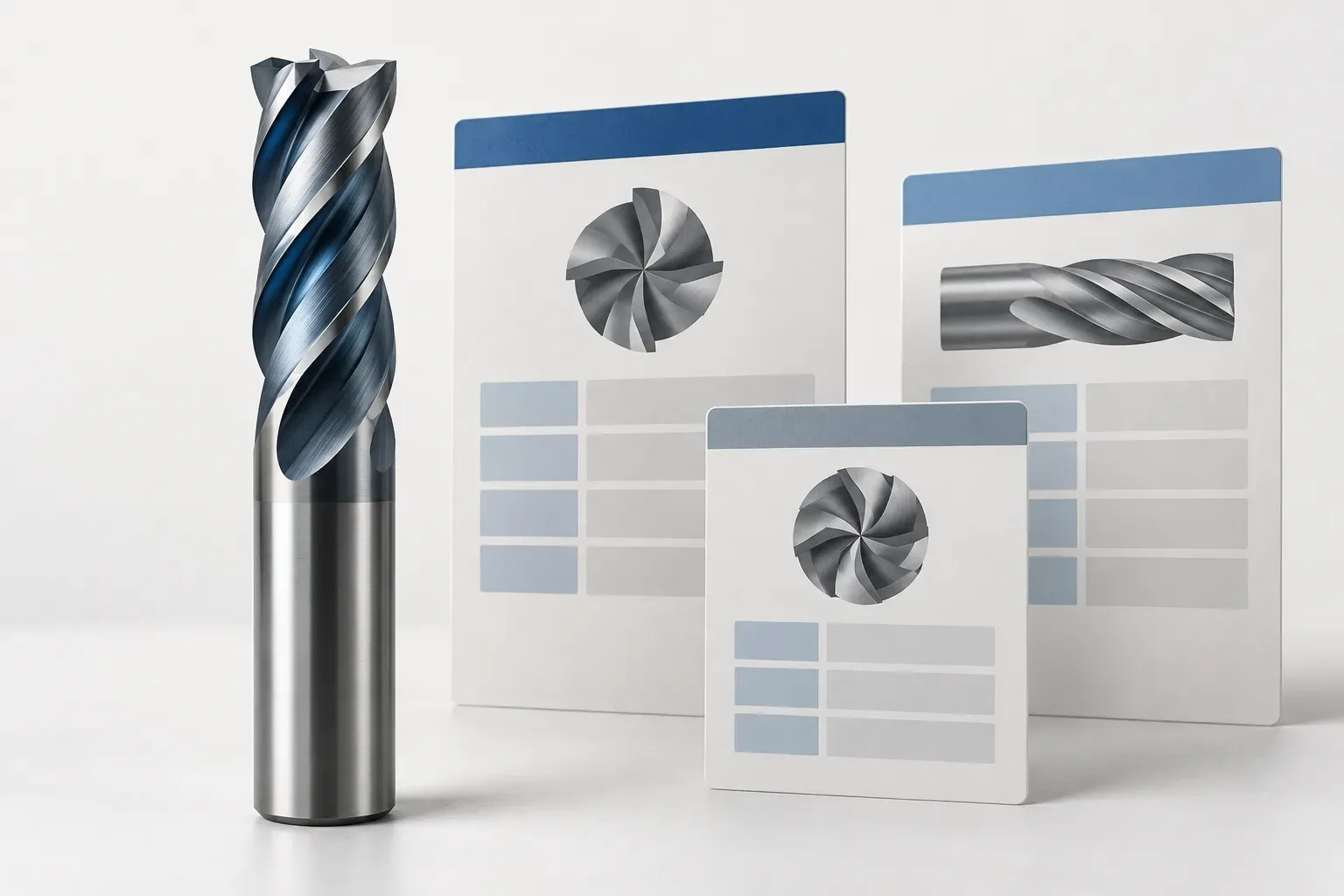
Inch carbide end mills should be ordered with their original nominal dimensions and complete configuration preserved. A familiar fractional diameter can hide a different shank size, cutting length or corner profile. Read the labelled fields before copying a short description into a tool list or requesting a replacement.
This guide focuses on inch-format purchasing records: how to keep decimal values, fractions and feature meanings aligned without silently substituting a nearby size. Its examples are documented cutters in the current catalogue. They do not establish fit with an unspecified holder or define dimensional tolerances that are not present in the records.
Keep fractions and decimal fields tied to one configuration
An inch product may be described by a fraction in its title and a decimal in its specification table. Retain the product identity and the labelled dimensions together so that the two representations can be checked. Do not shorten a record until important fields disappear from the buying decision.
When transferring a specification, identify the unit system for every length column. A decimal such as a cutting diameter or radius is not meaningful without its feature and unit. The same care applies when a drawing uses one notation and a quotation uses another: preserve the source record rather than relying on visual familiarity.
Check an inch cutter with unequal diameters
The 3/16 inch square-end configuration records these dimensions and attributes:
| Recorded field | Value |
|---|---|
| Cutting diameter (DC, in) | 0.1875 |
| Shank diameter (DMM, in) | 0.25 |
| Length of cut (LOC, in) | 0.375 |
| Overall length (OAL, in) | 2 |
| Number of flutes (NOF) | 2 |
| Corner type | Square |
The 0.1875 inch cutting diameter and 0.25 inch shank must not be merged into one diameter entry. A holder selection based only on the nominal cutting size would fail to describe the toolholding interface accurately. Keep both fields visible even when a shorter commercial title mentions just one.
The record identifies Hybrid AlCrN coating and steel as its primary workpiece group. Those details do not follow from the fact that it is an inch tool. Another inch cutter can have a different coating and a different application statement, so neither should be inherited during a spreadsheet conversion.
Keep radius information when describing larger sizes
The half-inch three-flute radius cutter lists a 0.5 inch cutting diameter and matching 0.5 inch smooth shank. It has 1.25 inch cutting length, 3 inch overall length and a 0.12 inch corner radius. Its coating is DLC and its primary material group is aluminum.
A description such as half-inch end mill would omit several facts needed to identify that configuration. In particular, the numerical radius and cutting length are independent selection attributes. Do not assume that another half-inch cutter is square end, has the same length or is intended for the same documented material group.
Avoid silent conversion and nominal-size substitutions
If a metric tool is proposed as an alternative, request its actual nominal dimensions and compare them explicitly with the original requirements. A mathematical unit conversion does not itself establish an available product size or make two configurations equivalent. Rounding should not become an undocumented change to a shank or cutting diameter.
Maintain a record of which dimensions are mandatory and which can be reviewed. If the feature or holder requires a particular tolerance, obtain that information from the applicable documentation. Do not add a tolerance solely because a decimal is written with several places; the written precision of a catalogue value is not an independent tolerance statement.
Review lengths in the installed setup
Compare cutting length with the feature that requires cutting-edge access, and overall length with the full assembly layout. These checks answer different questions. Neither length independently establishes allowable projection, grip length or a safe tool path around every obstruction.
The quotation request should identify the actual holder and any restricted space around the workpiece. If a technical recommendation is needed, include the workpiece designation and operation. Inch dimensions are geometry facts; they are not a substitute for application-specific cutting conditions or installation instructions.
Make an inch-tool order easy to audit
A useful order record contains the full cutter identity, original nominal dimensions, unit system, shank form, corner profile, flute count and coating. Add the documented application context and required quantity. Keep proposed changes in a separate note rather than editing the original fields without explanation.
Before approval, compare the offer with that record line by line. A dimensional match does not establish identical unlisted details, and a family illustration cannot resolve an omitted specification. Clear inch notation allows the buyer and supplier to discuss the same tool while leaving unsupported claims out of the purchase description.
Frequently asked questions
Does the fractional title contain every dimension?
No. Read the labelled specification fields for shank, cutting length, overall length and corner geometry.
Does a decimal’s number of places establish tolerance?
No. Obtain an applicable tolerance statement rather than inferring one from written decimal precision.
Is a nearby metric size automatically equivalent?
No. Compare actual nominal dimensions and the application and holder requirements before approving a substitution.