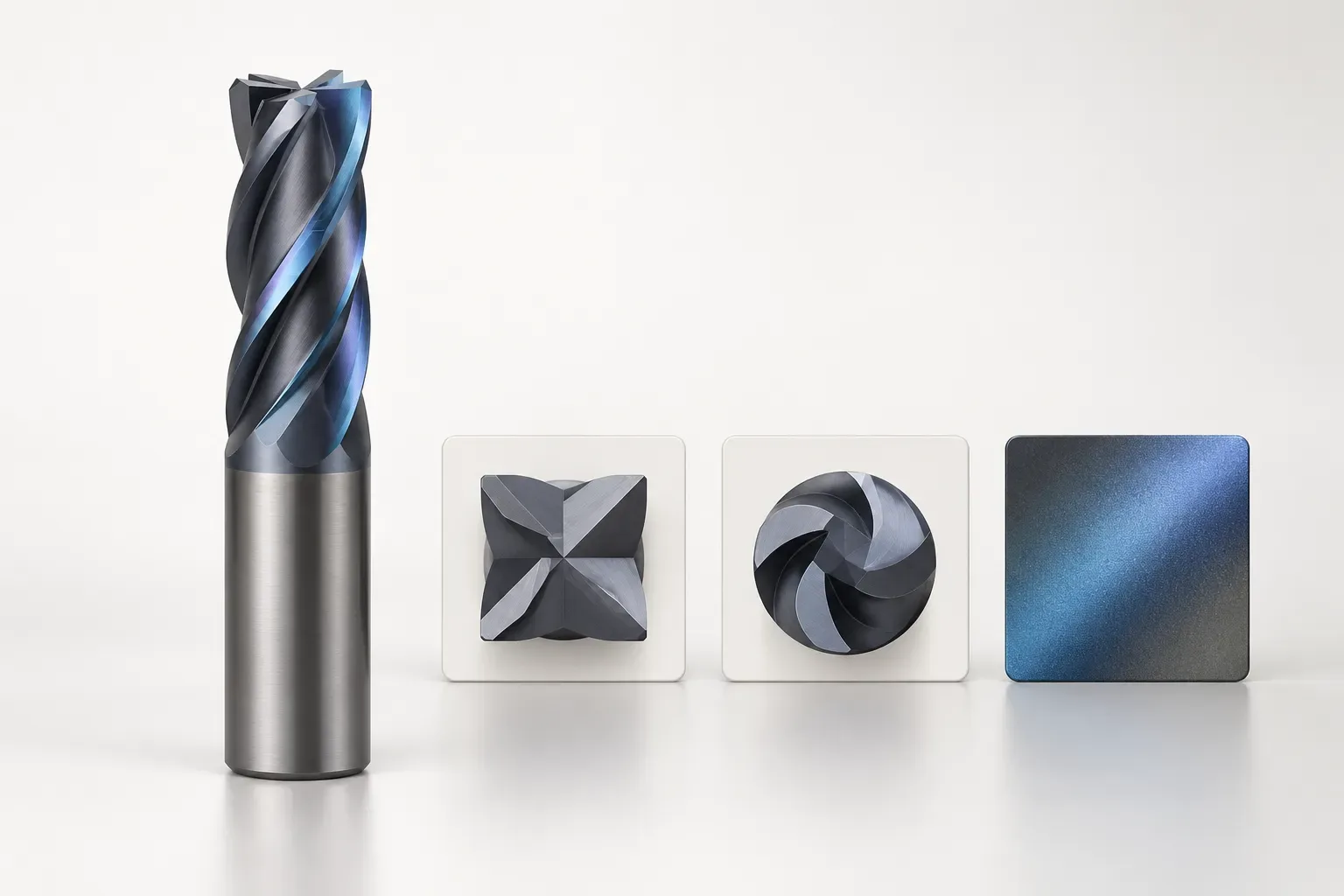
A Hybrid AlCrN carbide end mill should be identified by the exact coating description together with its geometry and application fields. The coating name is not a substitute for the product specification. It does not independently establish a layer structure, temperature rating or performance guarantee, and it should not be expanded into such claims without supporting documentation.
This guide addresses a practical catalogue problem: the same recorded coating appears on cutters with different diameters, end forms, lengths and flute counts. Two documented examples illustrate why a coating-based enquiry needs a complete configuration record before an offer can be compared or a tool approved for an application.
Retain the recorded coating wording
Use the coating description given for the selected product rather than replacing it with a broader or more familiar label. If an existing specification requires a particular coating system, ask whether the supplied documentation supports that requirement. Similar wording does not prove that unlisted coating details or production methods are identical.
Do not use an image's color to verify coating identity. A family photograph or AI illustration may help explain the subject but cannot establish chemistry, thickness or a supplier-specific coating specification. Keep any required technical documentation attached to the configuration under review.
Examine a metric four-flute radius record
The 8 mm Hybrid AlCrN corner-radius cutter has these confirmed fields:
| Recorded field | Value |
|---|---|
| Coating | Hybrid AlCrN |
| Cutting diameter (DC, mm) | 8 |
| Shank diameter (DMM, mm) | 8 |
| Length of cut (LOC, mm) | 12 |
| Overall length (OAL, mm) | 58 |
| Corner radius (RE, mm) | 0.5 |
| Number of flutes (NOF) | 4 |
| Shank type | Weldon |
Its record identifies steel, stainless steel and cast iron as primary workpiece groups. Variable pitch is listed as yes and center cutting as yes. These facts describe the cited product; they do not establish a numerical vibration benefit, entry limit or cutting condition for every material in those groups.
The 0.5 mm radius belongs to that configuration. Do not treat the coating as evidence that another cutter has the same end form or corner dimension. Geometry needs to remain an explicit part of the selection even when the coating requirement has already been fixed.
Compare an inch six-flute configuration
The quarter-inch six-flute Hybrid AlCrN cutter records a square end, 0.25 inch cutting and shank diameters, 0.625 inch cutting length and 2.375 inch overall length. Its shank is smooth, variable pitch is no and steel is the primary workpiece group.
The two examples share a recorded coating name while differing in flute count, end geometry, unit system, size and shank form. A coating match is therefore not enough to approve a substitute. It also does not establish that unlisted substrate or edge-preparation details are the same.
Keep coating claims separate from application advice
Neither product record supplies a comparative cutting trial, coating-thickness value or maximum operating temperature. Do not add one based on the name alone. If the application needs a qualified coating specification, request documentation tied to the exact product rather than a generic statement about coatings.
For cutting recommendations, provide the actual workpiece designation, relevant condition, feature and intended operation. A primary material-group listing is a starting point, not a complete recommendation. Any proposed settings or performance expectation must be supported for the particular tool and setup rather than derived from a broad coating label.
Confirm the shank and working geometry
Match the actual shank diameter and form with the holder and its instructions. The metric example's Weldon shank and the inch example's smooth shank are different recorded holding attributes. Do not assume that a shared coating means both require the same installation arrangement.
Compare cutting length with the feature and check the complete tool-and-holder envelope around the part and fixtures. Overall length is not unrestricted usable reach, and the catalogue cutting length does not prescribe the engagement for a specific cut. Identify unresolved installation questions before making the selection final.
Request a configuration-specific quotation
A clear request lists the exact coating wording, cutter identity, end profile, radius where supplied, diameter, cutting length, overall length, shank and flute count. Include the workpiece, application and quantity, plus any documentation requirement. State which changes are permitted for review rather than leaving substitution implicit.
When the quotation arrives, check that the coating and geometry refer to the same selected configuration. Keep unsupported manufacturing or performance statements outside the purchase description. This makes a Hybrid AlCrN requirement traceable without turning a recorded coating label into technical evidence it does not provide.
Frequently asked questions
Does Hybrid AlCrN identify a coating thickness?
The cited records do not supply a thickness. Request applicable product documentation if it is required.
Are tools with the same coating interchangeable?
No. The examples differ in geometry, size, flute count and shank, and no general equivalence is established.
Can coating color verify the supplied product?
No. Photographic or illustrative color is not coating certification or a dimensional specification.