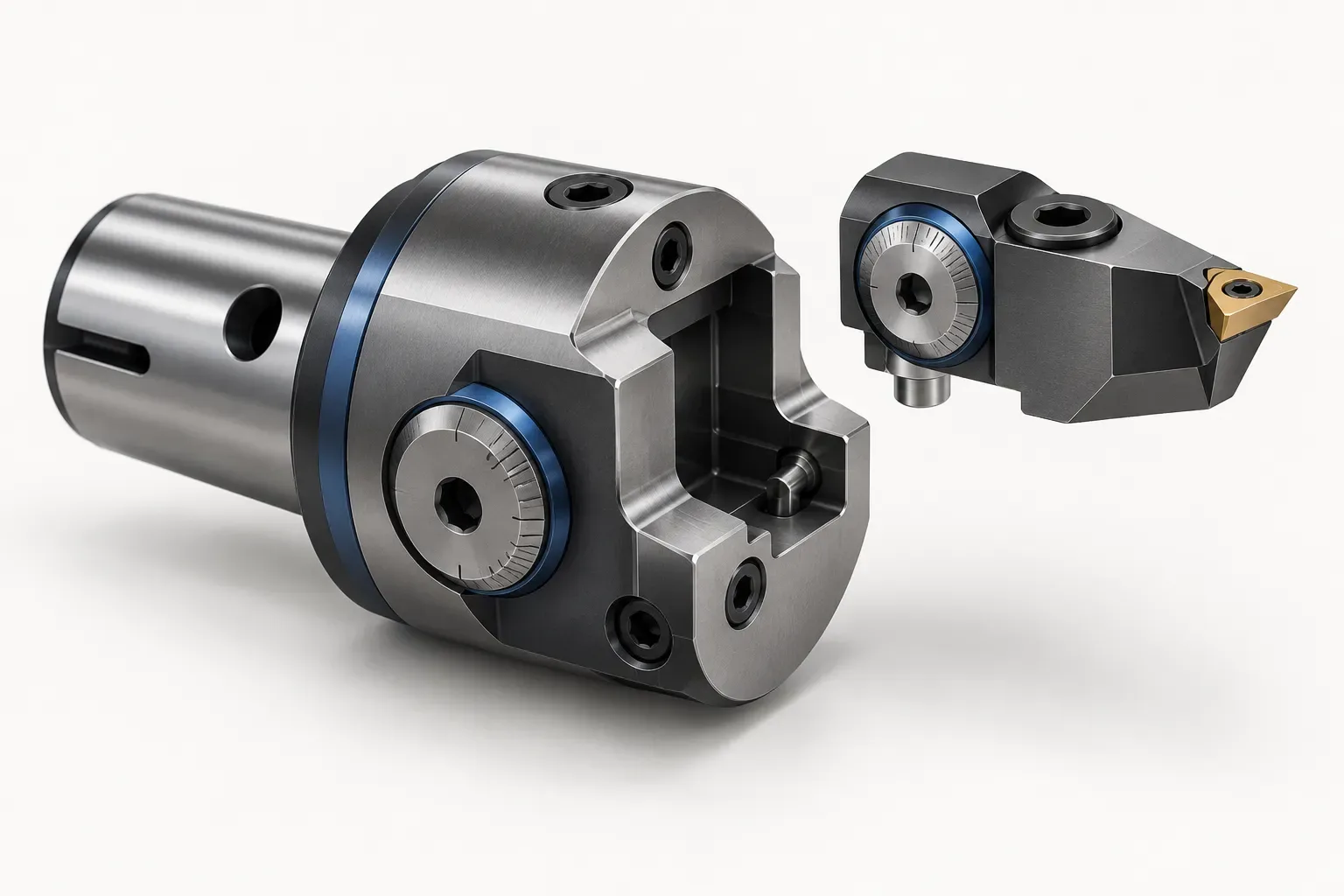
Fine boring cartridges are components of a finishing assembly, not complete boring heads. When replacing or selecting one, identify the mating head, the cartridge's connection designation, its working diameter range and the insert family together. A shared insert code or connection number alone does not establish that another cartridge is an interchangeable replacement.
This distinction is particularly important for spare-part enquiries. A buyer may know the required bore diameter or the insert currently fitted, while the original cartridge identification is unreadable. Those clues help organize the search, but the component drawing and complete configuration remain necessary to resolve fit.
Establish whether the requirement is a spare or a new assembly
For a spare cartridge, record the existing head's identification and the installed cartridge position. Provide photographs showing the mating surfaces and orientation, and include any available dimensional drawing. Explain which component is being replaced rather than sending only a photograph of the complete tool.
For a new assembly, start with the bore requirement and identify the head and cartridge as separate selections. State the final diameter, tolerance, depth, material and access restrictions. The cartridge's listed range can then be compared with the intended feature without implying that the record establishes a machining result.
Keep the scope explicit in both cases. A request for a cartridge should not become an order for a complete head by assumption, and an image of an assembled boring tool should not be used as evidence that a shank, insert or accessories are included.
Use range, connection and length as separate identifiers
The 30.9–40.1 mm fine boring cartridge lists connection designation 18, a 21.73 mm overall length and insert family TPGH0802. Its connection number is a system designation, not a measured mounting diameter.
A second example, the 66.9–87.1 mm fine boring cartridge, uses connection designation 36, a 41.14 mm overall length and insert family TPGH1103. The difference is not limited to the range printed in the product title.
| Configuration field | Smaller example | Larger example |
|---|---|---|
| Boring diameter range | 30.9–40.1 mm | 66.9–87.1 mm |
| Connection designation | 18 | 36 |
| Overall length | 21.73 mm | 41.14 mm |
| Insert family | TPGH0802 | TPGH1103 |
Use this comparison as a reading method, not a conversion table. A system number does not describe all the locating, fastening or orientation features on the mating parts. The applicable drawings must show how the cartridge interfaces with the selected head.
Do not use the insert family as a complete ordering code
The smaller example lists an insert inscribed-circle diameter of 4.76 mm, a 2.5 mm insert-hole diameter and an 8.0 mm cutting-edge length. The larger example lists 6.35 mm, 3.4 mm and 11.0 mm respectively for those same named insert fields.
Those values help distinguish the documented seats, but they do not supply the missing grade and nose-radius suffix. Nor do they prove that every insert carrying the same initial family characters is suitable for the workpiece. The complete insert designation and the cartridge manufacturer's requirements must resolve the actual selection.
If an existing insert is available, retain its full readable code and packaging details. Avoid replacing an unreadable suffix with a plausible value. An accurate enquiry can state which identification is known and which information still needs to be established, without inventing a specification.
Check orientation, fasteners and the installed envelope
Compare the cartridge's locating and fastening geometry, its orientation in the head and the space around the insert seat. A matching overall length is only one part of this check. An unverified fastener or mating surface can leave an important assembly question unanswered even when the main dimensions appear similar.
Obtain the installation and adjustment instructions for the exact component. The available records do not establish universal tightening values, adjustment resolution, permissible speed or accuracy. These cannot be transferred from another cartridge merely because it looks similar or accepts a related insert family.
The completed cutting assembly also needs an envelope review against the part and machine setup. Keep the cartridge length distinct from bore depth and from the length of the complete tool. Include the approach and withdrawal space where the drawing makes them relevant.
Write a spare-part request that can be checked
The boring tools catalogue provides candidate records to compare. Send the candidate identity, mating head details, working range, drawings, complete insert information and required quantity as one package. Add clear photographs of any damaged or unreadable identification.
Ask the quotation to state whether it covers one cartridge and to list inserts, fasteners and other accessories separately. Preserve the agreed configuration record for future replacements. It is a more reliable reference than a generic product photograph, a short connection number or an assumed relationship between two catalogue families.
Frequently asked questions
Is a fine boring cartridge a complete boring head?
No. It is a component used with a compatible head. Head, shank, inserts and accessories need their own quotation scope.
Does connection designation 36 mean a 36 mm cartridge mounting diameter?
No. The cartridge record identifies 36 as a system designation, not a measured mounting diameter. Match the complete mating drawing.
Is TPGH0802 enough to choose an insert grade?
No. The family code does not supply the full grade, nose-radius or other required suffix. Obtain the complete designation for the actual application.