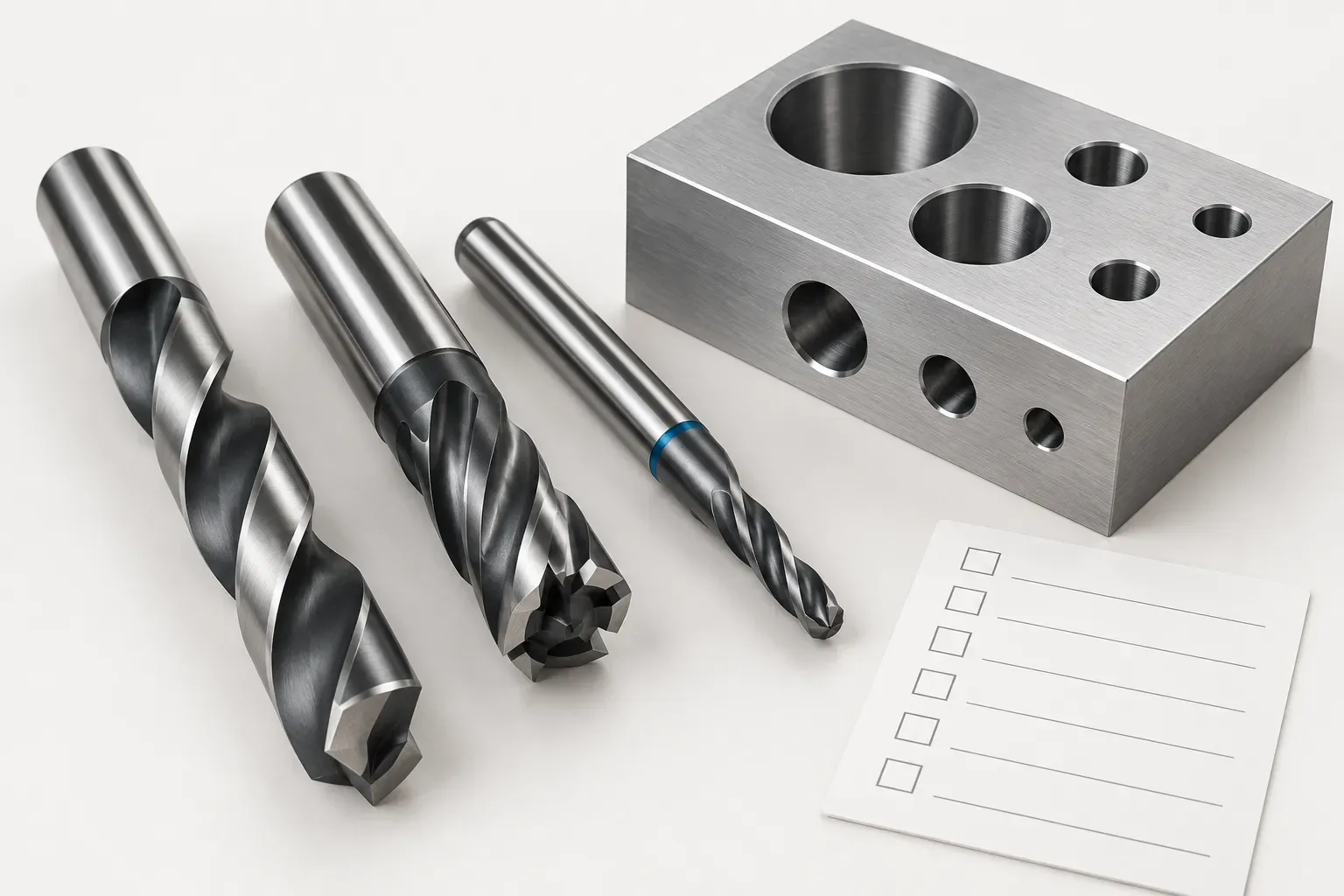
Choosing drilling tools starts with defining the hole and the process, not with selecting a tool from a familiar photograph. A supplier needs the feature requirements, workpiece material, machine interface and intended operation before a meaningful configuration can be discussed. Missing information should remain an open question rather than being replaced with a plausible drill specification.
This is a general enquiry guide. It does not establish the diameter, material capability, cutting conditions or available stock of a particular drilling product. Its purpose is to make the requirement precise enough for a configuration-specific response.
Describe the complete hole feature
Provide the part drawing with the required diameter, depth and acceptance requirements. Identify whether the hole is blind or through and show any entrance, exit or internal obstruction that affects access. Keep the final feature requirement distinct from any intermediate size used in the process.
Include information about the surface where the operation begins and the condition of any existing hole. A request for a drill is incomplete if the supplier cannot tell whether the operation begins in solid material, follows another tool or enlarges an existing feature. Describe the actual sequence rather than assuming that a product title explains it.
If several holes differ, give each feature its own requirement line. A general statement that they are similar can hide a change in depth, access or inspection requirement that matters to tool selection.
Specify the material rather than a broad marketing category
Identify the workpiece material from the information available to the process owner. Include its condition or specification where relevant and known. Do not substitute a generic phrase such as difficult material for an actual description that can be checked.
If the material is not yet confirmed, state what is known and leave the remaining question open. A tool's appearance or a short catalogue family name cannot supply the missing material data. The final tool and cutting-element selection must be supported by documentation applicable to the actual application.
Keep any required finish or dimensional tolerance separate from claims about the tool. The drawing describes the part to be accepted; it does not prove that an unspecified drill configuration can achieve that result.
Identify the machine-side and tool-side interfaces
Send the machine and holder information needed to evaluate the proposed assembly. A shank description and a photograph may help identification, but a drawing is needed where the mating geometry or installation position is uncertain. Distinguish the tool's nominal cutting size from the dimensions used to hold it.
Record available space around the workpiece, neighboring tooling and any approach restriction. Usable reach is an assembly question. A component's catalogue length cannot automatically be used as a depth rating or as the length available beyond the holder.
State the available coolant arrangement as a requirement to be checked. Do not infer pressure, flow, internal delivery or connection compatibility from a generic product image. The machine and tooling instructions must establish the applicable limits.
Keep complete tools and cutting components separate
A drilling-tool enquiry may concern a complete tool, a body, a replaceable cutting component or a spare part. State which item is required. If a system uses replaceable components, identify the body and cutting-element records separately instead of mixing their codes into an invented configuration.
| Enquiry field | Information to provide |
|---|---|
| Feature | Drawing, diameter, depth and access |
| Material | Known specification and condition |
| Assembly | Machine interface, holder and installation position |
| Cutting components | Full verified identities, where applicable |
| Supply scope | Complete tool, component, spares and quantity |
| Unresolved items | Specific questions requiring documentation |
This table organizes information rather than recommending a universal tool type. It does not establish that a particular product is available or that components from different systems can be combined.
Request application data without inventing operating values
Ask for the installation instructions, operating limits and application information for the actual configuration. Do not fill missing speed, feed, tightening or coolant values with numbers taken from an unrelated drill. Even a correct-looking value is not an applicable instruction unless the relevant tool and conditions are established.
If the enquiry arises from an existing machining problem, provide the current assembly and a factual description of the observed condition. Keep observations separate from a diagnosis or a promised improvement. A photograph of the hole can support the discussion but does not establish the cause of the problem.
Make the quotation answer the same requirement
The drilling tools category can help organize browsing, while the tooling catalogue provides the broader site context. Neither should replace the configuration review described here. Use only a product record with sufficient verified information when a specific tool is proposed.
Send the completed requirement through the contact page and ask the quotation to identify the selected configuration, included components and quantity. Keep unresolved technical questions visible until reliable documentation answers them. This creates a usable purchasing record without turning an incomplete catalogue description into an unsupported product recommendation.
Frequently asked questions
Can a generic drill photograph identify a usable configuration?
No. It may help identification, but dimensions, interfaces, cutting components and application requirements need verified records.
Should missing cutting parameters be copied from another drill?
No. Obtain applicable information for the actual tool, material and assembly rather than transferring unrelated operating values.
Does this guide confirm that a specific drill is available?
No. It is a general requirement-preparation guide. Availability and a complete configuration require a separate quotation.