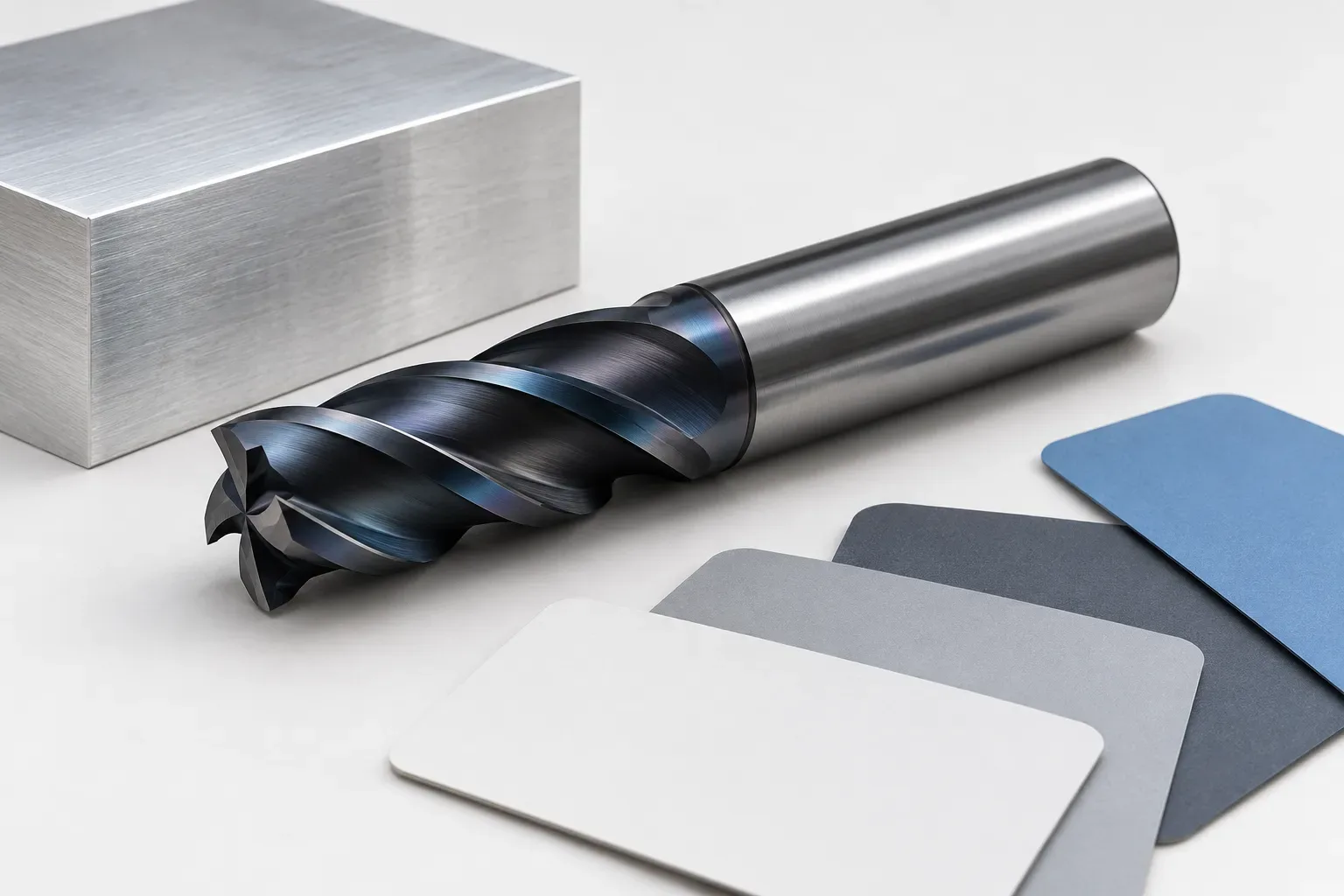
A DLC coated carbide end mill should be specified by the complete product record, with coating kept separate from size, end geometry and application. The DLC label in a listing is useful purchase evidence, but it is not a universal claim about friction, tool life or performance in every aluminum operation. Verify the actual configuration before ordering.
This guide compares two recorded DLC cutters with different cutting and overall lengths. Both are listed for aluminum as a primary workpiece group. The comparison is intended to support a traceable enquiry, not to rank DLC products or create performance data that the catalogue does not contain.
State the reason for a DLC requirement
If a process or specification requests DLC, explain whether the requirement comes from an approved tool list, a material application or a supplier recommendation. Keep the coating requirement linked to the exact candidate rather than to a family image. A generated or representative image cannot verify coating identity.
Provide the alloy, feature, operation and holder information. A coating name does not resolve the application by itself. The person reviewing the enquiry needs to know what part of the configuration must remain fixed and which dimensions may be considered as alternatives.
Read the shorter DLC example
The half-inch three-flute DLC cutter records:
| Recorded field | Value |
|---|---|
| Coating | DLC |
| Cutting diameter (DC, in) | 0.5 |
| Shank diameter (DMM, in) | 0.5 |
| Length of cut (LOC, in) | 1.25 |
| Overall length (OAL, in) | 3 |
| Corner radius (RE, in) | 0.12 |
| Number of flutes (NOF) | 3 |
| Primary workpiece material groups | N - Aluminum |
Its shank is smooth, center cutting is listed as yes, and variable pitch is no. These are configuration attributes. They do not prescribe the cutting speed, entry path, cooling arrangement or permitted overhang for a particular aluminum alloy.
The listing identifies a 0.12 inch corner radius, so the candidate is not simply a generic half-inch end mill. Keep radius and length in the purchase description so the quotation cannot be interpreted as a square or differently proportioned tool.
Compare the longer DLC configuration
The half-inch three-flute DLC cutter with longer listed lengths also lists a 0.5 inch cutting diameter, 0.5 inch smooth shank, 0.12 inch corner radius and aluminum as primary group. It differs in cutting length at 2 inches and overall length at 4 inches.
The shared coating and principal diameters do not make the cutters interchangeable. The longer cutting and overall lengths change the configuration and require a separate review of access, holder position and feature depth. Do not copy the shorter tool's length into the longer order or assume a longer cutter is automatically appropriate for the part.
Keep DLC evidence within the record
The product records establish that DLC is the listed coating, but they do not provide coating thickness, friction values, temperature limits or comparative tool-life data. If any of those facts are required, request documentation tied to the selected product. Avoid turning a coating name into a universal statement about surface quality or productivity.
Likewise, the aluminum primary group is a documented application context, not a complete cutting recommendation. State the exact alloy and condition and obtain application-specific advice. A coating comparison should remain a factual configuration discussion unless supporting evidence addresses the actual process.
Check the holder, feature and length together
Compare the smooth shank with the actual holder and its installation instructions. Review the cutting region against the feature and the full assembly around fixtures and workpiece. Overall length is not unrestricted working reach, while the listed cutting length is not a recommended engagement for every operation.
Include the available cooling arrangement and any clearance concern in the enquiry. The listings do not establish a universal cooling method. If the tool is intended for a special entry or restricted-access operation, identify that requirement directly instead of relying on the coating to answer it.
Prepare a coating-specific quotation request
List the exact DLC configuration, diameter, corner radius, cutting length, overall length, shank and flute count. Add the alloy, feature drawing, operation, holder and quantity. State whether the two length variants are alternatives or whether one is mandatory.
When the offer arrives, compare the coating and all dimensional fields with the selected record. Resolve any requested documentation or qualification before approval. This keeps the DLC attribute traceable to a real cutter while leaving untested performance and compatibility claims out of the commercial description.
Frequently asked questions
Are the two DLC examples interchangeable?
No. They share coating and principal diameters but differ in cutting and overall length and need separate installation review.
Does DLC prove a friction or tool-life value?
No. The records verify the coating label but not comparative performance data.
What aluminum information should accompany a DLC enquiry?
Provide the exact alloy or condition, feature, operation, holder and quantity for application review.