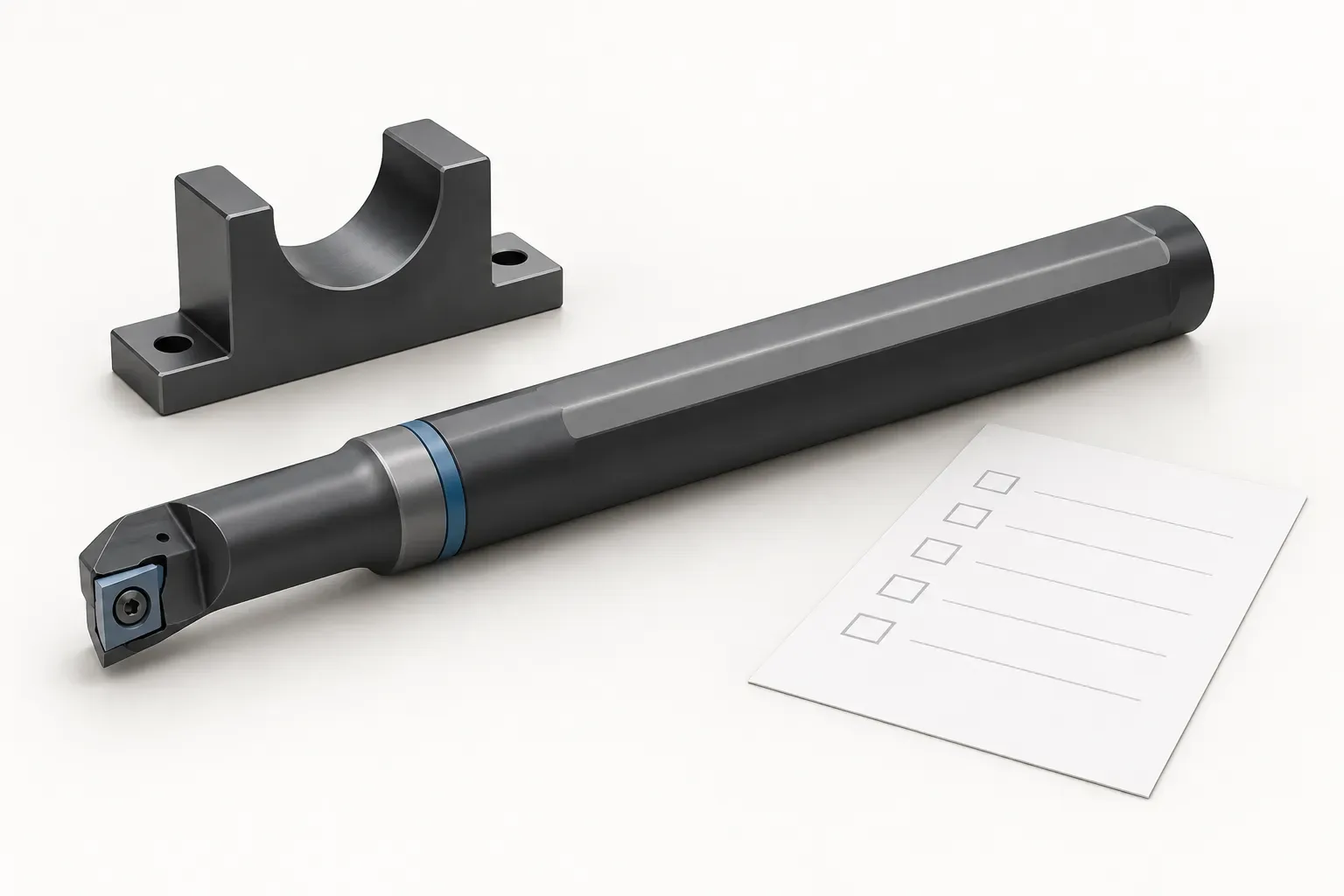
A damped turning bar should be evaluated from its documented geometry, compatible head and installation requirements, not from a promise that the word damped will solve a machining problem. Start by defining the operation and the existing setup. Then separate the specifications that identify the bar from any performance claim that would need additional evidence.
This guide uses one documented bar as an example of that distinction. Its record provides dimensions, a connection field, a head designation and a clamping note. It does not establish a vibration-reduction percentage, a permitted cutting condition or a guaranteed finish on a particular part.
Describe the machining requirement without choosing a solution first
Record the workpiece material, feature dimensions, required operation and the available machine-side holder. Include the intended working position and any access constraints. If the enquiry concerns a problem in an existing process, provide a factual account of the condition being observed and identify the current assembly.
Keep observation separate from diagnosis. A photograph of a finished surface or an informal description of vibration is useful context, but it does not establish the cause or prove that a particular replacement bar is the correct response. The responsible process review needs the actual setup and relevant operating information.
Avoid replacing missing application data with a generic claim about long reach or stability. A bar can have a documented diameter and length while still lacking the information needed to evaluate the proposed operation. State the open questions before interpreting an unfamiliar product label as a performance specification.
Read the documented bar identity
The WT16 C16-156 damped turning bar has a listed bar diameter of 16 mm and catalogue length of 156 mm. Its connection field is G1/8, and its compatible head designation is WT16.
| Recorded field | Listed value |
|---|---|
| Bar diameter d | 16 mm |
| Catalogue length L | 156 mm |
| Connection G | G1/8 |
| Compatible head designation | WT16 |
| Catalogue clamping note | Clamping section length = 4 × bar diameter |
Retain the field names with their values. Catalogue length is not a guaranteed usable reach. The head designation is not a universal interface claim, and the connection field should not be rewritten into an unsupported statement about coolant pressure or system compatibility.
These values describe this named configuration. They must not be copied into another damped-bar record because the photographs look similar or the nominal diameter appears to match. The actual installation drawing remains necessary to establish locating surfaces and assembly details.
Treat the clamping note as an instruction to interpret correctly
The record explicitly states a clamping-section relationship. That note should remain attached to the documented bar, rather than becoming a universal rule for all damped turning tools. It also should not be relabelled as a maximum overhang ratio or a cutting-depth capability.
Compare the required clamping region with the intended holder and obtain the applicable installation instructions. The record does not establish tightening values, approved clamping contact or every restriction affecting the assembly. A matching diameter alone cannot answer those questions.
The mounting review should also distinguish the portion held in the holder from the portion needed for the operation. Do not calculate usable working length from the catalogue length without the correct datums, head geometry and installation requirements. An arithmetic result based on incomplete geometry can create a misleading claim of reach.
Keep damping and performance evidence separate
The product identity supports describing the item as a damped turning bar. It does not reveal a verified internal damping mechanism, quantify the reduction of vibration or establish a tool-life improvement. Do not add such details from the appearance of the bar or from descriptions of another product.
If a performance requirement matters to the purchase, define how it would be evaluated on the actual application. Request applicable documentation or a clearly scoped validation proposal. Do not present a generated illustration, a family name or an isolated catalogue dimension as test evidence.
The cutting-head and insert requirements must be specified independently. A WT16 designation does not establish the included head, complete insert grade or suitability for an unnamed material. Ask what components are supplied and which still need to be selected.
Build an evidence-based enquiry
Use the turning tools catalogue to identify candidates, then send the bar identity, holder details, feature drawing, material and quantity. Add the required head, installation questions and any process observations relevant to the enquiry.
The contact page provides the enquiry route. Request a quotation that identifies the selected bar and lists heads, inserts and accessories separately. Keep the final agreed configuration with its installation documents. This makes the purchase traceable without turning a damping label into an unsupported guarantee about the customer's process.
Frequently asked questions
Does a damped-bar label prove a specific vibration reduction?
No. The example record identifies a damped bar but provides no verified reduction percentage or application-specific performance guarantee.
Is catalogue length the same as usable cutting reach?
No. The holder, clamping requirement, head geometry and installed assembly must establish the available working position.
Does the clamping note establish a maximum overhang ratio?
No. The record describes clamping-section length for the named bar. It should not be converted into a different operating limit or generalized to other bars.