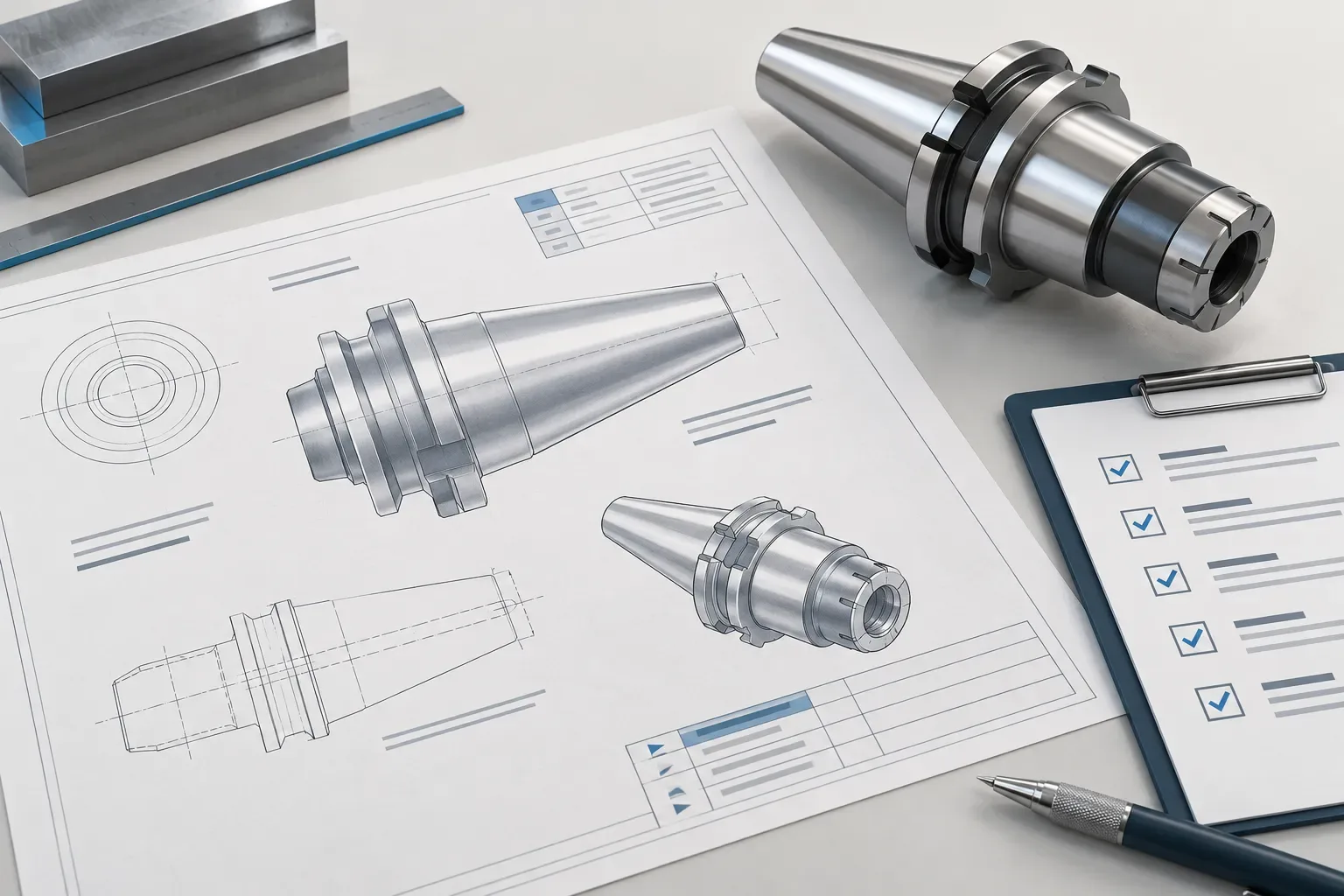
A custom CNC tooling enquiry should make the drawing, revision and acceptance questions explicit before a supplier proposes a configuration. “Custom” describes the need for a defined project; it does not prove that a sales company is a manufacturer or that an engineering service is included. The enquiry must state who owns each decision and what evidence is required.
This guide concentrates on controlling a drawing-based request from first sketch to quotation. It is not a promise of custom manufacturing, design capability, tolerance achievement or delivery. Use it to separate the requirement, the supplier response and the buyer's acceptance decision.
Start with the part requirement, not a presumed tool
Describe the feature, operation, workpiece, machine interface and quantity. Include the dimensional requirement with feature meanings and units. If an image or sketch is preliminary, label it as such and identify which dimensions are fixed, estimated or still being measured.
State what the custom element is expected to change: an interface, a reach condition, a mounting feature, a geometry or another documented requirement. Do not ask a supplier to “make it fit” without defining which surfaces and constraints determine fit. A vague custom request makes later revision control difficult because there is no agreed baseline.
Give every drawing a revision identity
Use a clear revision marker and date on each drawing or dimension sheet. Record the files sent with the enquiry and the features changed between versions. If a late change affects a bore, shank, mounting hole, cutting geometry or component scope, call it out in the RFQ rather than relying on the new filename alone.
Ask the supplier to confirm which revision its response addresses. Keep an earlier version in the project record as superseded rather than deleting it from the audit trail. This makes it possible to explain why an earlier quote or drawing no longer applies without pretending that the earlier requirement never existed.
Separate geometry from acceptance criteria
A drawing can define geometry while the acceptance record defines how the buyer will decide whether the supplied item matches it. Identify the inspection method, reference surfaces, units and any required documentation only when those requirements are actually agreed. Do not invent a tolerance or inspection method to make a custom brief look complete.
When a proposed solution changes the geometry, list the change and its reason. A supplier's suggestion is a proposal until the buyer accepts it against the revised requirement. Product images and generic catalogue dimensions cannot replace the drawing features controlling the custom request.
Use known catalogue records as references, not promises
The BMT holder record shows how a configuration can retain feature meanings such as tool bore, centre height and mounting pitches. It is a reference for structured specification, not evidence that a custom holder can be produced to any new dimension.
The VDI radial holder record similarly keeps its d1, b1, h1 and length fields tied to a specific drawing. Do not transfer those labels to a custom design without an agreed drawing definition. A known catalogue item can clarify the type of information to exchange while leaving custom responsibility and acceptance open.
State responsibility and supply boundaries
Ask whether the supplier is quoting an existing item, arranging a sourced item or discussing a custom project with another party. Record who owns the drawing, who approves revisions and who is responsible for any required documentation. This does not assume a manufacturing role or guarantee a particular supply route.
If marking, confidentiality, ownership or use restrictions matter, state those commercial requirements separately and seek agreement before sharing sensitive design details. Do not rely on an informal statement that a drawing will be handled in a particular way. Keep the approved scope and any exclusions with the quotation.
Define a review and acceptance path
Request a response that identifies the drawing revision, proposed dimensions, included components, unresolved questions and any evidence the supplier can provide. Decide who reviews the technical response and who accepts the commercial scope. If a trial or first-article review is needed, identify it as a separate stage instead of treating the quotation as proof of final compliance.
A practical acceptance record can list each critical feature, its source drawing reference and the evidence received. The record should also state what remains pending. Avoid claiming a custom result is approved until the responsible buyer has made that decision against the agreed requirements.
Submit a controlled enquiry
Use the OEM / ODM project page and the tooling enquiry page to outline the project, drawing revision, application and quantity. Keep the submitted files and the response linked to the same project reference. Before proceeding, resolve whether the proposed scope concerns an existing catalogue item, a sourced alternative or a custom discussion.
Clear revision control does not guarantee a contractual outcome, but it reduces ambiguity about what was requested and reviewed. The value of the enquiry is a traceable decision path, not an unsupported promise that any custom geometry, tolerance or supply arrangement will be delivered.
Frequently asked questions
Does a custom enquiry prove the supplier is a manufacturer?
No. Record the actual business and supply role, and ask for evidence relevant to the requested scope.
What should change between drawing revisions?
Identify changed features, revision marker, date and the quotation or response that each revision addresses.
Does a quotation prove final compliance?
No. Acceptance needs an agreed requirement, review responsibility and appropriate supporting evidence.