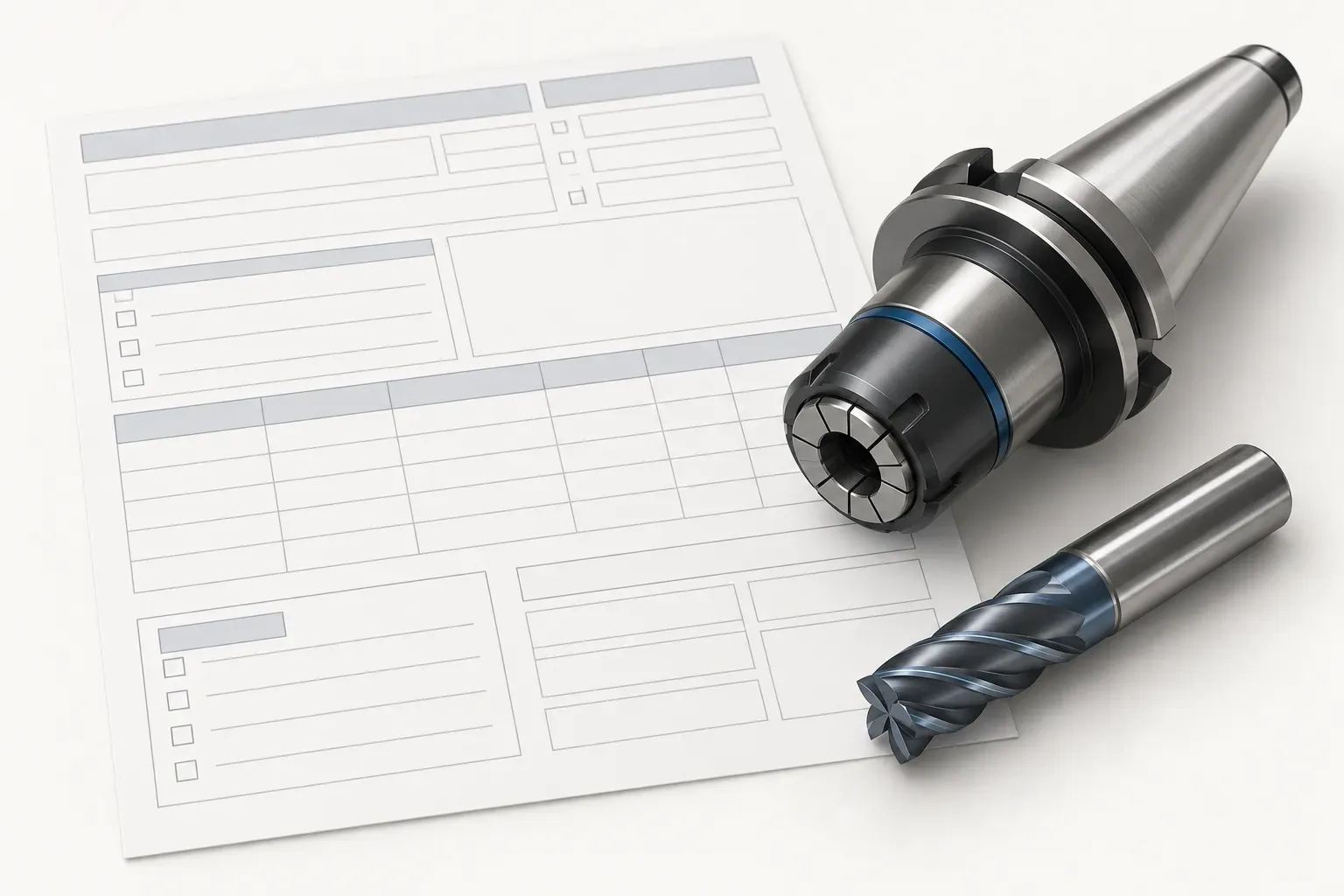
A useful CNC tooling quotation starts with an RFQ that identifies the requested configuration, application, quantity and included scope. The supplier should not have to guess whether a model describes a complete assembly or a single component. Keep the technical requirement and the commercial questions together, while making clear which details remain unresolved.
This guide explains how to structure a request for quotation across tooling categories. It does not provide default prices, minimum quantities, delivery dates or contractual terms. The suggested fields are a practical way to organize information; the final offer and acceptance requirements must be agreed for the actual transaction.
Begin with the buying decision you need to make
State whether the request concerns an exact replacement, a comparison of documented alternatives or help identifying a candidate. Those tasks require different responses. An exact replacement needs a clear baseline, while an identification enquiry needs the machine, feature and available evidence without an invented model.
Add a contact and a reference that allows later responses to be connected to the same enquiry. If the drawing changes, identify the revised information explicitly rather than sending an unmarked attachment. A price discussed for an earlier configuration should not be treated as a quotation for a materially different requirement.
Use a short configuration table
Separate the following information rather than placing it in one free-text sentence:
| RFQ field | Information to provide |
|---|---|
| Item identity | Exact model or a clear description of the identification task |
| Operation | The feature and the intended machining task |
| Workpiece | Actual material designation and relevant known condition |
| Dimensions | Feature meanings, numerical values and units |
| Interface | Machine-side and cutting-tool-side requirements |
| Quantity | Requested amount for each configuration |
| Scope | Required components, accessories and documentation |
Mark unknown information as a question in the RFQ. Do not fill a missing diameter, insert grade or connection detail with a common value simply to complete the table. A clearly stated uncertainty is something a supplier can address; a plausible but incorrect value can redirect the entire offer.
Tailor the dimensional fields to the category
For the BMT40-B25-H60 holder, the 25 mm tool bore and 60 mm bore centre height describe different features. An RFQ that copies one value as a generic holder size would lose important meaning. Include the relevant mounting and location information with the matching drawing when those features determine selection.
For the 8 mm four-flute radius cutter, the record includes 12 mm cutting length, 58 mm overall length, 8 mm Weldon shank and 0.5 mm corner radius. A request for an 8 mm cutter alone would not preserve those attributes. Each category needs fields that identify its actual configuration rather than a universal list of letters.
Ask what the quoted item includes
State whether you need a cutter only, holder only, or a specified assembly. List required sleeves, inserts, cartridges or fasteners separately where relevant. A compatibility reference in a catalogue does not establish that the compatible item is included in the price.
Request the quantity basis and currency for the offer, together with any applicable order conditions. If packaging, freight or documentation affects the comparison, ask how it is treated. Do not turn an unspecified package amount into a per-component cost or assume that a general website statement fixes delivery for the actual order.
Keep alternatives separate from the baseline
Invite alternatives only within the review scope you intend. Ask the supplier to identify every changed field and explain which configuration its technical advice concerns. A different length, coating, interface or accessory package should remain visible as a separate proposal.
If the application requires a performance result, provide the requirement and ask what supporting information is available. The RFQ itself should not claim the proposed tool achieves that result. Any process trial, installation approval or qualification remains a distinct decision rather than a fact established by receiving a quotation.
Close the enquiry with an auditable response
Use the tooling enquiry page to submit the configuration, drawing, application and quantity. Save the final response with the version of the requirement that it addresses. Check that the item identity, dimensions, included scope and commercial conditions can be read without reconstructing an informal conversation.
Before issuing an order, resolve or explicitly handle outstanding questions with the responsible parties. A useful RFQ narrows ambiguity around one purchasing decision. It does not need a guessed model, an assumed minimum quantity or an unsupported claim of performance to appear complete.
Frequently asked questions
Should I invent a model to complete the RFQ?
No. Describe the identification task and provide the available machine, feature, drawing and dimensional information.
Does a compatible insert reference mean it is included?
No. Ask the supplier to itemize components and inclusions in the actual offer.
Does requesting a quote establish technical approval?
No. A quotation, application recommendation and installation or process approval are different records.