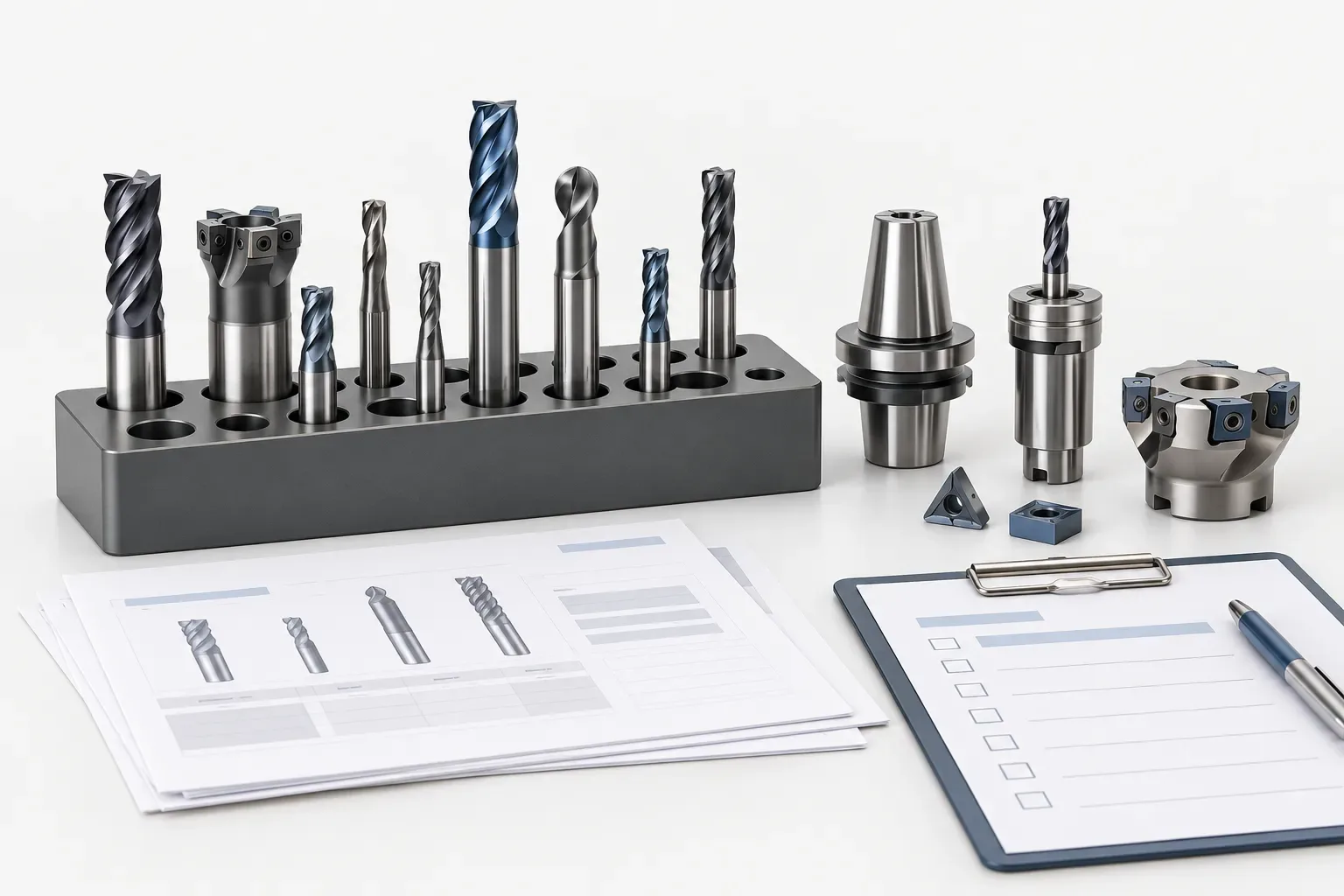
Choose a CNC cutting tools supplier by checking whether its business identity, product information and quotation describe the same transaction. A large catalogue does not establish that every configuration is suitable for your machine. Before comparing commercial terms, identify the actual item, the party supplying it and the evidence available for the application.
This guide is a purchasing checklist rather than a ranking of suppliers. It does not treat a sales company as a manufacturer, infer certification from a photograph or recommend a tool based on an unverified performance claim. Use it to decide what information is still needed before an order can be approved.
Establish who will supply the order
Record the legal or trading identity used in the quotation and compare it with the payment and order documents. Ask whether the business is selling stocked tooling, arranging supply or providing a separately agreed custom project. These activities should not be described as interchangeable capabilities.
A supplier can provide useful selection information without owning the factory that makes a tool. The important point is that the stated role remains consistent. If an enquiry requires manufacturing responsibility, engineering approval or brand authorization, ask for evidence relevant to that particular requirement instead of assuming it from a website's appearance.
Company and warehouse images can provide context. They do not establish a product's specification, a manufacturing process or an independently verified certificate. For any credential central to the purchase, identify the holder, scope and verification route before using it in your own approval record.
Compare complete product identities
Separate a product family from an orderable configuration. A page headed with a broad tool type may be useful for discovery but insufficient for ordering. The record should identify the applicable dimensions, units, interfaces and included components for the item being discussed.
For example, the BMT40-B25-H60 boring holder has a specific configuration record. Its 25 mm tool bore and 60 mm bore centre height describe different features. A supplier response that repeats only the family name would not resolve those details for your assembly.
Retain the drawing alongside the specification table. A numerical value copied without its feature definition can become misleading when compared with another holder family. Keep a short list of unresolved features rather than treating a similar product photograph as confirmation.
Ask what supports application advice
Describe the operation, workpiece material, required geometry and machine interface before asking whether a tool is suitable. Distinguish a supplier's documented configuration facts from recommendations that depend on your setup. If a performance statement matters to acceptance, request the applicable evidence and conditions.
Do not interpret a list of material groups as a complete machining recommendation. Toolholding, engagement, coolant and the operation remain relevant questions. Likewise, a nominal dimension does not establish accuracy, allowable load or tool life. These are separate claims requiring their own support.
When evidence is unavailable, narrow the decision. It may be possible to identify a candidate geometry while leaving the final application approval open. That is more useful than accepting an unconditional statement that a tool works for every machine or material.
Make commercial comparisons configuration-specific
Request a quotation that names the selected item and distinguishes tools, holders, inserts, sleeves and accessories. State quantity and identify which items are required together. Do not compare a complete assembly with an unqualified component price.
Ask for the currency, quantity basis and any order conditions in the quotation. Delivery information should describe the proposed order rather than a general website promise. This checklist supplies no assumed price, minimum quantity or lead time because those terms have not been approved for a particular transaction.
Where alternatives are proposed, keep each one in its own configuration row. A changed interface or cutting geometry may require a different approval, even if the alternative is presented as part of the same family. Do not allow a substitution to silently change the specification under comparison.
Keep a clear approval record
Use the CNC tooling enquiry checklist to assemble the model, drawing, quantity and application requirements. Save the final supplier response with the agreed configuration and identify any outstanding technical or commercial conditions before issuing an order.
The approval record should make later changes visible. If the supplier proposes another size, connection or accessory package, compare the revised record rather than relying on the original conversation. Keep commercial acceptance separate from machine installation approval, which must follow the relevant documentation and your own operating procedures.
A useful supplier assessment ends with a specific decision: a documented configuration can proceed, further evidence is required, or the proposed item does not match the requirement. It does not need a broad claim that one supplier is universally best.
Frequently asked questions
Does a supplier need to be the manufacturer?
That depends on the purchasing requirement. Record the actual business role and request manufacturing or authorization evidence only where the order requires it.
Can catalogue size prove technical suitability?
No. Suitability must be assessed for the selected configuration and application, using the relevant dimensions and documentation.
What should be saved before ordering?
Keep the final configuration, drawings, included items, quotation terms and any unresolved approval conditions together.