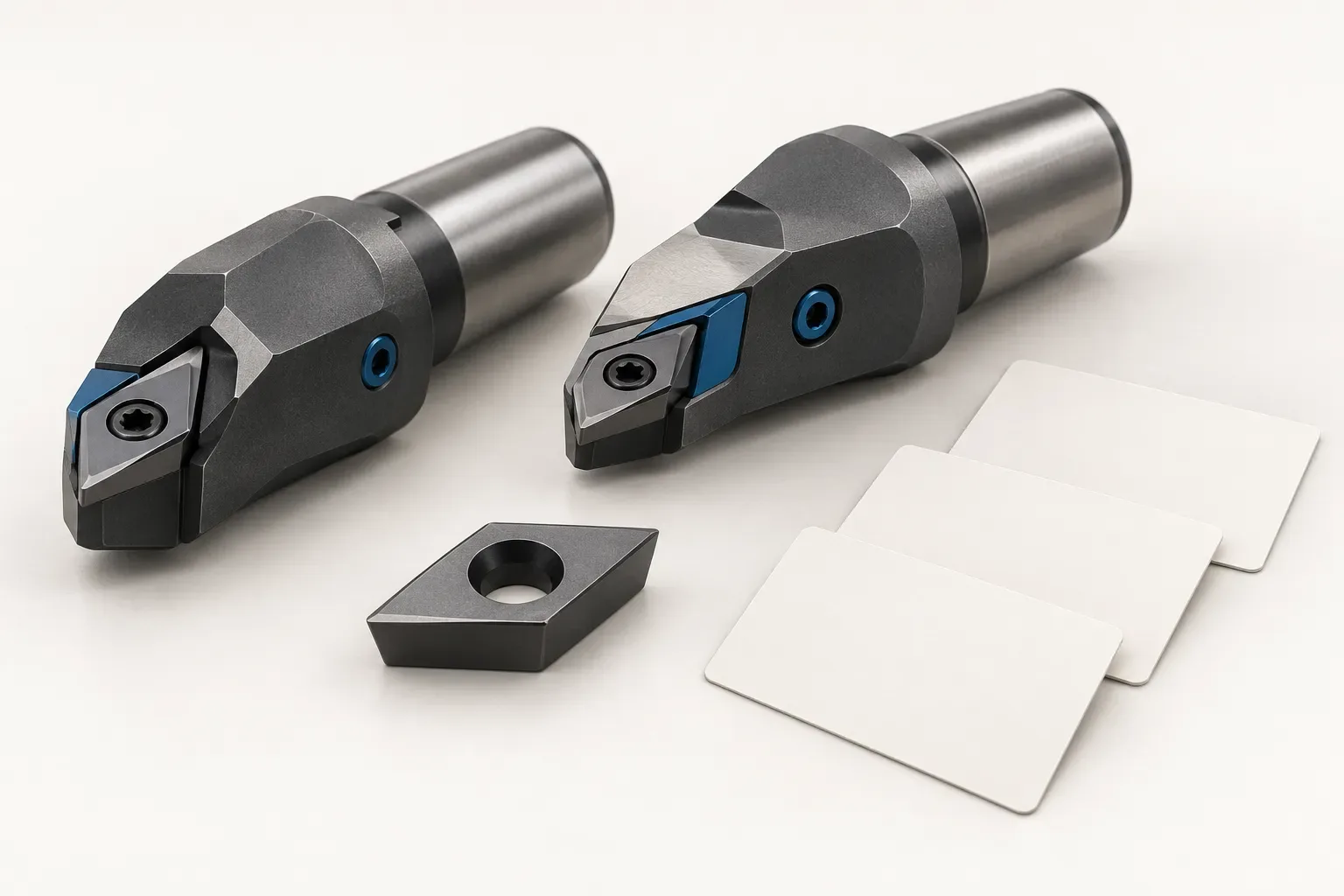
A CCMT0602 rough boring cartridge enquiry must identify the cartridge set as well as the insert family. The same family appears on several documented sets with different working ranges, connection designations and lengths. Even two sets sharing a connection designation can represent different range configurations.
The selection task is therefore to identify the set that matches the intended head and bore, rather than to find any cartridge carrying CCMT0602. The following comparison uses three published configurations and keeps package quantity separate from the question of which inserts and accessories are supplied.
Identify the required set rather than an isolated code
Begin with the head already installed or proposed for the job. Record its identity, the intended boring range and the relevant mating drawing. If replacing worn or damaged cartridges, include photographs showing their orientation and locating surfaces, plus any readable product identification.
State that the enquiry concerns a rough boring cartridge set if that is what is required. A workshop note containing only CCMT0602 may identify an insert family, not the complete spare part. Distinguishing the two avoids a quotation for cutting inserts when the actual requirement is a set of supporting cartridges.
Compare the three documented configurations
The 25.0–34.0 mm set lists connection designation 11 and 21.0 mm overall length. The 34.0–43.0 mm set lists connection designation 18 and 29.3 mm overall length. The 42.0–51.0 mm set also lists connection designation 18, but its overall length is 33.3 mm.
| Set working range | Connection designation | Overall length | Cartridges per set |
|---|---|---|---|
| 25.0–34.0 mm | 11 | 21.0 mm | 2 |
| 34.0–43.0 mm | 18 | 29.3 mm | 2 |
| 42.0–51.0 mm | 18 | 33.3 mm | 2 |
All three list CCMT0602. The last two rows are particularly useful identification examples: a shared system designation and insert family still do not identify a unique range or component length. Keep the selected row attached to the actual product identity.
The connection numbers are system designations, not measured mounting diameters. Do not describe the connection-18 set as having an 18 mm mounting diameter unless a separate verified drawing field establishes that measurement. The same caution applies when comparing an existing head to a replacement candidate.
Understand what the insert-family fields establish
Each example lists a 6.35 mm insert inscribed-circle diameter, a 2.8 mm insert-hole diameter and a 6.45 mm cutting-edge length. The records identify screw-on clamping. These are specific listed attributes, not proof that every insert with a similar short code will satisfy the actual seat and application requirements.
The complete insert grade and nose-radius suffix are not given. Request the full designation for the actual workpiece material and operation. Do not infer a material recommendation, cutting speed or tool life from the family code or from the fact that the set is designated for roughing.
Inserts are also a supply-scope question. Two cartridges per set does not establish that two inserts are supplied, nor that spare screws or other accessories are included. Ask the quotation to separate those items from the set itself.
Select the working interval and verify the head
Use the intended bore diameter to identify candidate intervals, then check each candidate against the mating head and drawing. The overlap between 34.0–43.0 mm and 42.0–51.0 mm does not establish interchangeable sets or identical envelopes. The correct configuration must still resolve orientation, locating geometry and fastener requirements.
Check the complete installed tool against the part feature and approach path. Overall cartridge length is not usable bore depth. A supporting head, shank or other component can affect the installed arrangement, so a cartridge table alone cannot finish the access review.
Obtain installation and setting instructions for the exact assembly. Do not transfer fastening values, adjustment procedures or operating limits from another set simply because it uses CCMT0602. Any missing application-critical information should be resolved before the purchase is treated as a checked replacement.
Preserve the configuration for repeat orders
Send the selected set identity, head details, intended range, feature depth, material, drawings and quantity as one enquiry. Specify whether the requirement includes inserts and identify any full insert designation already established by the process owner.
Ask the quotation to retain the same configuration and supplied-item scope. Save that record with the purchase so that a future order can reproduce the checked set. A family code is a useful search clue, but the range, connection, length and mating evidence identify the component that is actually being bought.
Frequently asked questions
Does CCMT0602 uniquely identify a rough boring cartridge set?
No. The three documented sets use that insert family but have different ranges, connections or lengths.
Are the two connection-18 sets identical?
No. Their listed ranges are 34.0–43.0 mm and 42.0–51.0 mm, with overall lengths of 29.3 mm and 33.3 mm respectively.
Does a two-cartridge set include two inserts?
That is not established by the set quantity. Insert and accessory inclusion must be specified separately in the quotation.