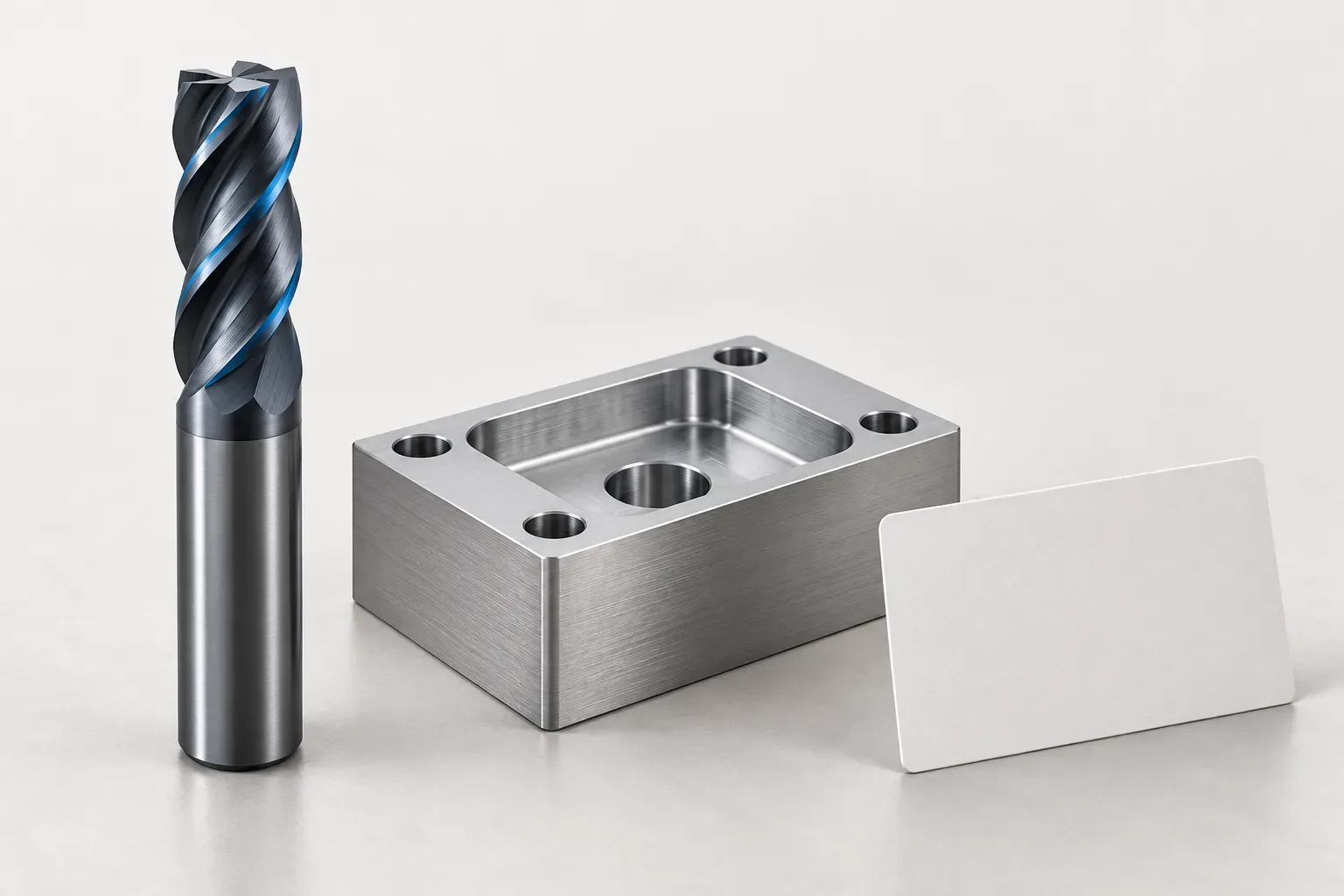
Carbide end mills for steel should be shortlisted using the exact workpiece designation and the complete cutter configuration. A product that lists steel as a primary material group is a starting point for application discussion, not proof that it suits every grade, condition or operation. Keep the material requirement connected to the feature and the actual assembly.
This guide shows how to build a steel-cutting enquiry from documented product facts without turning a broad application group into a machining guarantee. It compares a two-flute square-end record with a metric four-flute radius record. The examples are not ranked by performance, because no comparative test is established by their catalogue fields.
Describe the steel rather than relying on its broad group
Provide the workpiece designation and any relevant known condition when requesting a recommendation. Include the feature drawing, the intended operation and any existing process constraints. If an important material detail is not known, identify the missing information instead of expecting the word steel to resolve the technical question.
Separate required results from the candidate tool description. A surface requirement, dimensional target or production objective belongs in the application brief, but it is not evidence that a particular cutter achieves it. The technical response should identify the configuration and conditions considered rather than make a claim about every steel application.
Read a steel-primary square-end example
The two-flute square-end inch cutter lists steel as its primary workpiece group. Its recorded configuration includes:
| Recorded field | Value |
|---|---|
| Cutting diameter (DC, in) | 0.1875 |
| Shank diameter (DMM, in) | 0.25 |
| Length of cut (LOC, in) | 0.375 |
| Overall length (OAL, in) | 2 |
| Number of flutes (NOF) | 2 |
| Corner type | Square |
| Coating | Hybrid AlCrN |
The shank is smooth, and its 0.25 inch diameter differs from the 0.1875 inch cutting diameter. This is an important purchasing distinction even before cutting conditions are discussed. A steel application label cannot compensate for a holder interface that has not been specified correctly.
The square profile does not supply a numerical corner-tolerance guarantee. If the feature requires a precisely defined edge geometry, request the applicable drawing or specification. Do not treat an omitted radius value as an independently verified zero.
Compare a different documented steel candidate
The 8 mm four-flute radius cutter lists steel, stainless steel and cast iron as primary groups. It records an 8 mm cutting diameter and Weldon shank, 12 mm cutting length, 58 mm overall length and 0.5 mm corner radius. Its coating is also Hybrid AlCrN.
The shared coating and steel application group do not establish that these examples perform the same task or accept the same settings. Their end form, dimensions, shank and flute count differ. Use the part geometry and actual setup to decide what should be reviewed, rather than treating a material-group match as a complete selection.
Do not infer hardness coverage or cutting data
A broad steel designation does not publish a hardness limit for every candidate. If the application involves a specific grade or condition, state it explicitly and obtain advice supported by appropriate documentation. Do not add a maximum hardness, cutting speed or feed based on a coating name or a similar-looking tool.
The same limitation applies to life and finish claims. Catalogue dimensions identify geometry; they are not test data. A recommendation should be tied to the actual cutter, workpiece and operation, with any required qualification or trial handled as a separate process decision.
Check the assembly around the steel feature
Compare the cutting length with the feature depth and review the overall tool-and-holder arrangement for access. The amount of tool outside the holder and the surrounding clearance must be assessed using the actual installation information. Overall length does not independently establish unrestricted reach.
Record the available cooling arrangement and other application constraints when seeking guidance. The cited product facts do not prescribe a cooling procedure. If a candidate has no through-spindle coolant in its record, do not reinterpret that field as an instruction to use or avoid another cooling method.
Put the purchasing and technical records together
A clear enquiry includes the workpiece designation, feature and operation, exact candidate configuration, holder details and quantity. Show required corner form, cutting diameter, cutting length, overall length, shank and coating in separate fields. Make any alternative explicitly conditional on the application review.
When a quote arrives, ensure that its product identity matches the configuration used in the technical response. Keep unresolved material, installation or cutting-condition questions visible. This approach supports a practical steel-tooling decision while avoiding the unsupported assumption that a familiar material label or coating is itself a guarantee of a successful process.
Frequently asked questions
Does a steel-primary listing cover every steel condition?
It does not establish that claim. Provide the actual material designation and relevant condition for application review.
Can the coating determine cutting speed?
Not by itself. Obtain recommendations for the exact cutter, workpiece, operation and assembly.
Are the two examples direct substitutes?
No equivalence is established. Their dimensions, end geometry, shanks and flute counts differ.