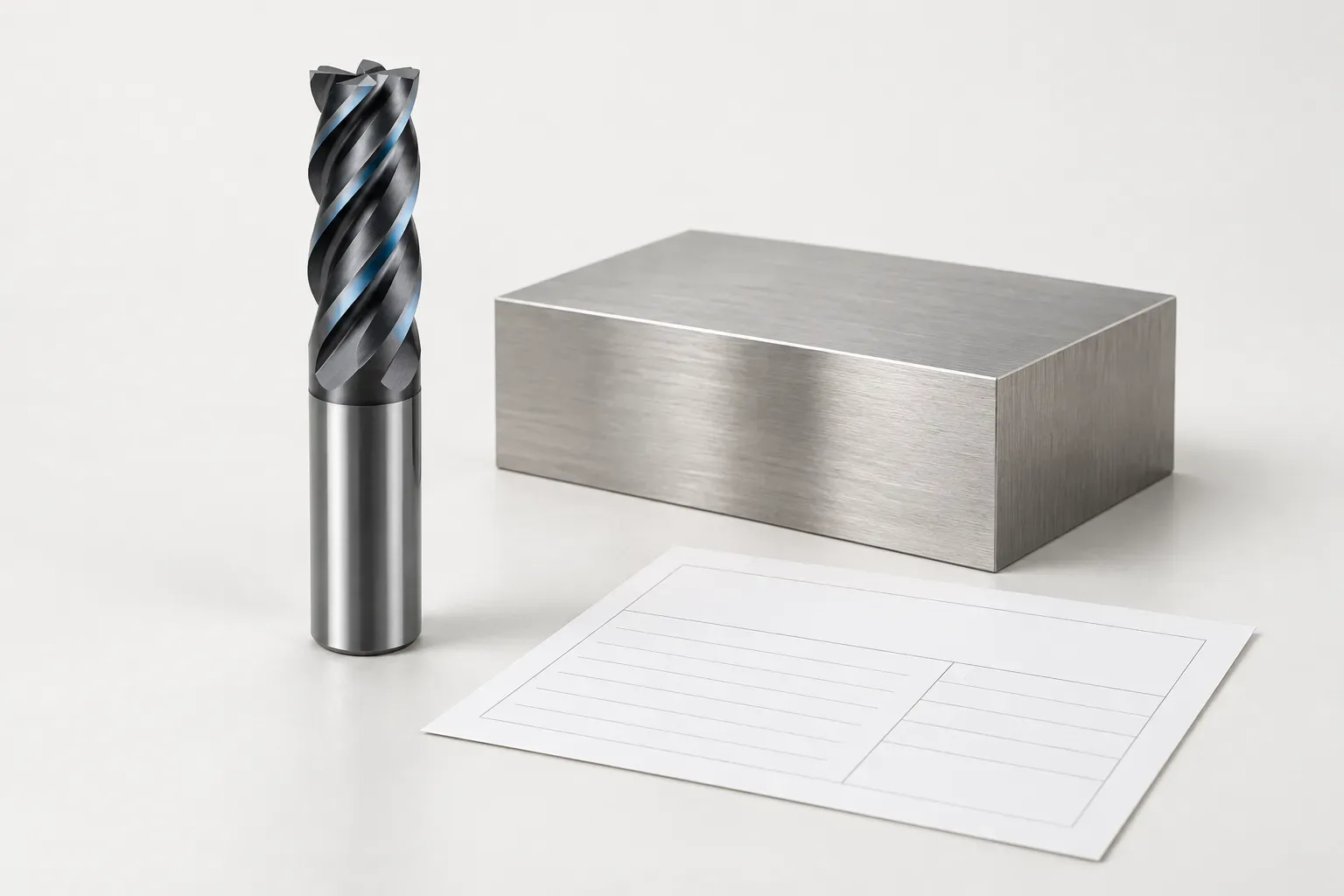
Carbide end mills for stainless steel should be selected with the exact material and operation in view. A listing that includes stainless steel in its primary workpiece groups is useful evidence for a shortlist, but it does not establish one geometry or set of conditions for every grade. Keep the product facts and the application recommendation separate.
This guide compares two metric corner-radius configurations with documented stainless-steel application groups. They differ in flute count, coating and dimensions. The aim is to help a buyer prepare a useful technical enquiry, not to rank the coatings or claim that a particular cutter will deliver an unverified machining result.
Identify the material and the operation precisely
Supply the stainless designation and any relevant known condition. Describe the feature, its dimensions and the intended operation, together with access restrictions and the holder. If an important material detail is unavailable, identify the gap so it can be resolved instead of relying on a broad category label.
State required surface or dimensional outcomes as application requirements. Do not assume that a product description already proves those outcomes. The technical discussion should establish which cutter and setup are under consideration before anyone proposes cutting conditions or treats a tool as approved for the job.
Examine a five-flute AlTiN configuration
The 3 mm five-flute radius cutter lists stainless steel and high-temperature alloys as primary groups. Its configuration includes:
| Recorded field | Value |
|---|---|
| Cutting diameter (DC, mm) | 3 |
| Shank diameter (DMM, mm) | 3 |
| Length of cut (LOC, mm) | 7 |
| Overall length (OAL, mm) | 54 |
| Corner radius (RE, mm) | 0.25 |
| Number of flutes (NOF) | 5 |
| Coating | AlTiN |
The shank is smooth, and the record identifies center cutting as yes and variable pitch as no. No through-spindle coolant is listed. These are product attributes, not a complete operating procedure. They do not provide a plunge program, feed, speed or cooling instruction for a specific stainless alloy.
Read a different stainless-primary candidate
The 8 mm four-flute Hybrid AlCrN cutter lists steel, stainless steel and cast iron as primary groups. It records an 8 mm cutting diameter and Weldon shank, 12 mm cutting length, 58 mm overall length and 0.5 mm corner radius. Its variable-pitch field is yes.
The two examples share a broad material-group context, but they are not dimensionally equivalent options. A proposed change between them would alter diameter, corner radius, lengths, shank form, flute count and coating. Those changes need to be reviewed against the feature and assembly rather than hidden behind the phrase stainless steel end mill.
Do not replace application evidence with coating assumptions
The AlTiN and Hybrid AlCrN descriptions establish which coating is recorded for each product. They do not establish coating thickness, a temperature rating or a comparative tool-life result. If those facts matter to an existing specification, request relevant documentation rather than inferring them from the name.
A recommendation should address the actual operation and material. Avoid universal statements that one flute count or coating is always required for stainless steel. The catalogue examples show that several configuration attributes can vary while stainless steel remains a listed primary workpiece group.
Check the toolholding and working envelope
The cutter shank and holder must be considered together. Match the shank diameter and form to the actual holding system and obtain the applicable installation information. A smooth or Weldon label does not independently specify the entire assembly or a tightening value.
Compare cutting length with the required feature access and review the full holder-and-tool geometry around the workpiece and fixtures. Overall length does not establish allowable projection, while cutting length is not a published engagement recommendation. Mark unresolved clearance or grip questions on a drawing so the technical enquiry can address a precise issue.
Record the candidate and the questions separately
Prepare a configuration sheet containing end profile, diameter, radius, cutting length, overall length, shank, coating and flute count. Add the stainless designation, feature, intended operation, holder and quantity. Identify which fields are fixed requirements and which alternatives may be considered after review.
When a supplier responds, ensure that its recommendation and quotation refer to the same configuration. Keep any required trial, process qualification or installation approval as a separate decision. This produces a traceable stainless-steel tooling enquiry without turning a broad application label or a coating name into unsupported machining advice.
Frequently asked questions
Does stainless steel in a primary group identify all suitable grades?
No. Supply the actual grade and condition so the application can be reviewed.
Are the two cited coatings ranked by performance here?
No. Their descriptions are verified product attributes; no comparative performance data is established.
Can cutting length be used as a recommended engagement?
No. Geometry fields do not by themselves prescribe cutting conditions or application limits.