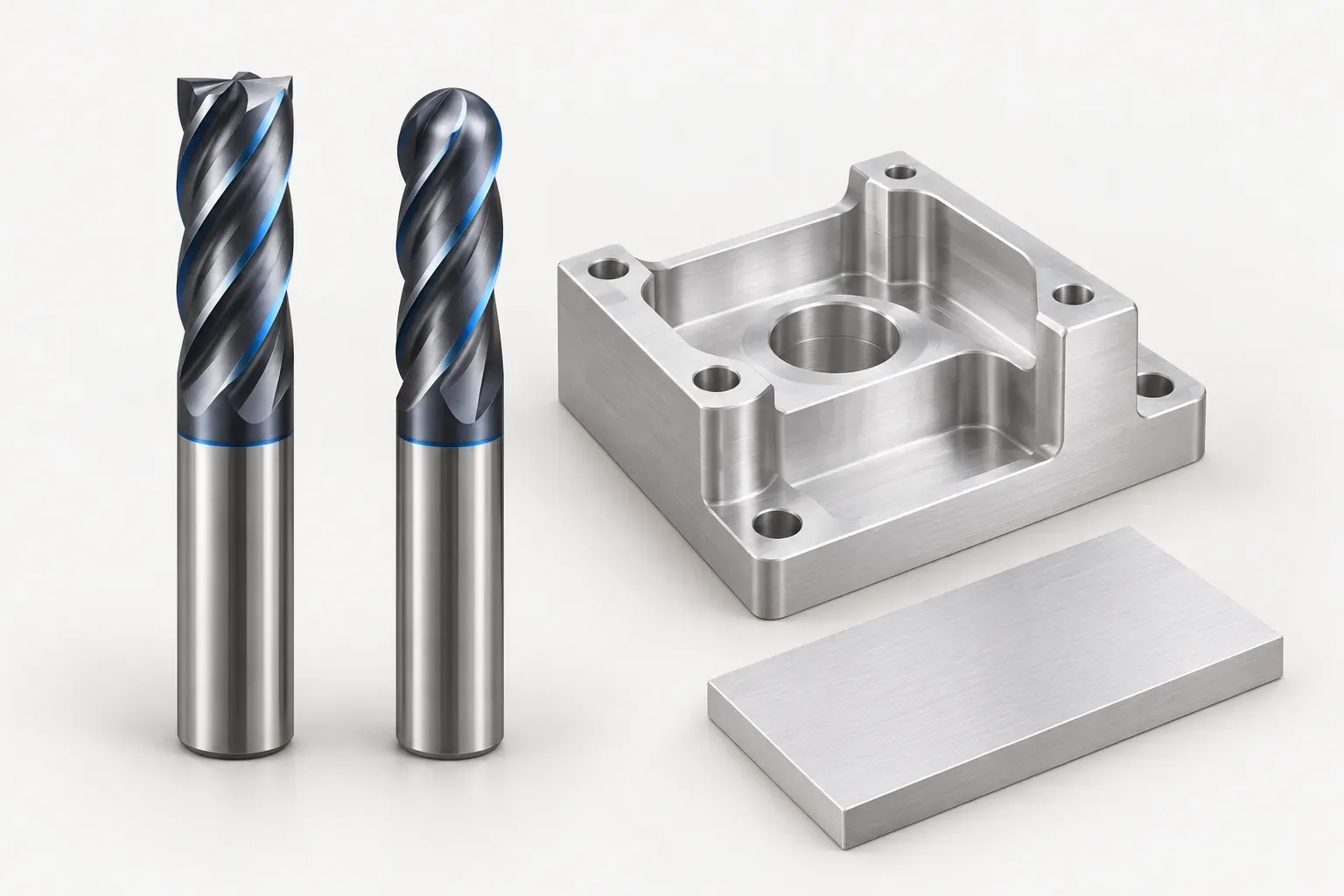
Carbide end mills for aluminum should be selected from configurations whose documented application actually includes the workpiece group, then checked against the part and holder. A coating name or flute count alone does not identify an aluminum-cutting solution. State the alloy and feature so that any recommendation can address the actual job.
This guide compares an uncoated metric square-end example with an inch DLC-coated radius example. Both record aluminum as the primary material group, but they are different configurations. The comparison explains how to shortlist relevant tools without claiming that their coatings, geometry or cutting results are equivalent.
Start with the aluminum workpiece and feature
Provide the material designation and any known condition that affects the application review. Describe whether the tool must reach a pocket, shoulder, profile or another feature, and include the drawing requirements. A broad aluminum label helps organize a catalogue but does not answer every question about a specific workpiece.
Do not turn the desired result into a property already proven by the candidate. If the task needs a particular finish or dimensional outcome, state it as a requirement. The person recommending a tool needs the actual geometry and setup rather than an assumption that every product marketed for aluminum produces that result.
Review a metric uncoated candidate
The 8 mm three-flute square-end cutter records:
| Recorded field | Value |
|---|---|
| Cutting diameter (DC, mm) | 8 |
| Shank diameter (DMM, mm) | 8 |
| Length of cut (LOC, mm) | 20 |
| Overall length (OAL, mm) | 63 |
| Number of flutes (NOF) | 3 |
| Corner type | Square |
| Coating | Uncoated |
| Primary workpiece material groups | N - Aluminum |
Its shank form is smooth. The record identifies center cutting as yes, variable pitch as no and no through-spindle coolant. Those fields describe the selected cutter. They should not be read as a complete entry, cooling or cutting-condition recommendation for every aluminum alloy and operation.
The square-end description does not establish an exact numerical edge-radius tolerance. Where the part requires one, request the relevant specification. Do not create an unsupported edge guarantee to make a general catalogue description look more precise than the evidence allows.
Compare a different aluminum-primary configuration
The DLC-coated half-inch radius cutter also identifies aluminum as primary. It lists a 0.5 inch cutting diameter, 0.5 inch smooth shank, 1.25 inch cutting length, 3 inch overall length and 0.12 inch corner radius. It has three flutes and a DLC coating.
These examples are not like-for-like alternatives. They differ in size, unit system, end geometry, cutting length and coating. If one is proposed for a task initially associated with the other, that proposal needs a fresh review of the part and assembly rather than a shortcut based on the shared material group.
Ask what the coating evidence actually establishes
The product records establish the coating descriptions, but do not provide a comparative aluminum cutting trial. They do not justify a tool-life multiplier, a friction value or a guarantee about surface quality. If a supplier recommends a coating, ask how the proposed configuration relates to the actual alloy and operation.
An uncoated description should not be treated as missing information that can be filled with a coating from another family. It is a recorded configuration attribute. Likewise, DLC should remain attached to the exact cutter whose record supports it, rather than being added broadly to every three-flute aluminum description.
Check reach and holding requirements together
Review cutting length against the feature and examine the complete cutter-and-holder assembly for access. Overall length does not establish how much tool may project from the holder, and a shared smooth-shank description does not determine every installation requirement.
Include fixture and workpiece restrictions in the enquiry. If a cutter reaches the feature but the holder cannot clear an obstruction, its nominal dimensions have not solved the installation problem. Obtain applicable grip and installation information instead of inferring it from a product image or from another size in the range.
Prepare a useful aluminum-tooling quotation request
Send the actual alloy, feature drawing, intended operation, relevant dimensions, holder details and quantity. Identify the candidate's corner form and whether alternative coatings or flute counts may be considered. Keep the product specification and application questions separate so that a quote identifies one clear configuration.
Before approving an offer, compare its dimensions and coating with the record used for the technical discussion. Note any unresolved cutting-condition or installation question. This makes the aluminum application claim traceable to a real product while leaving untested machining outcomes outside the sales description.
Frequently asked questions
Does a three-flute label prove aluminum suitability?
No. Check the selected product’s documented material group and the actual application.
Does the article establish a DLC performance advantage?
No. The cited records verify coating descriptions, not a comparative cutting result.
Can an uncoated square cutter replace the radius example?
No direct equivalence is established. The profiles, dimensions and configurations differ and need application review.