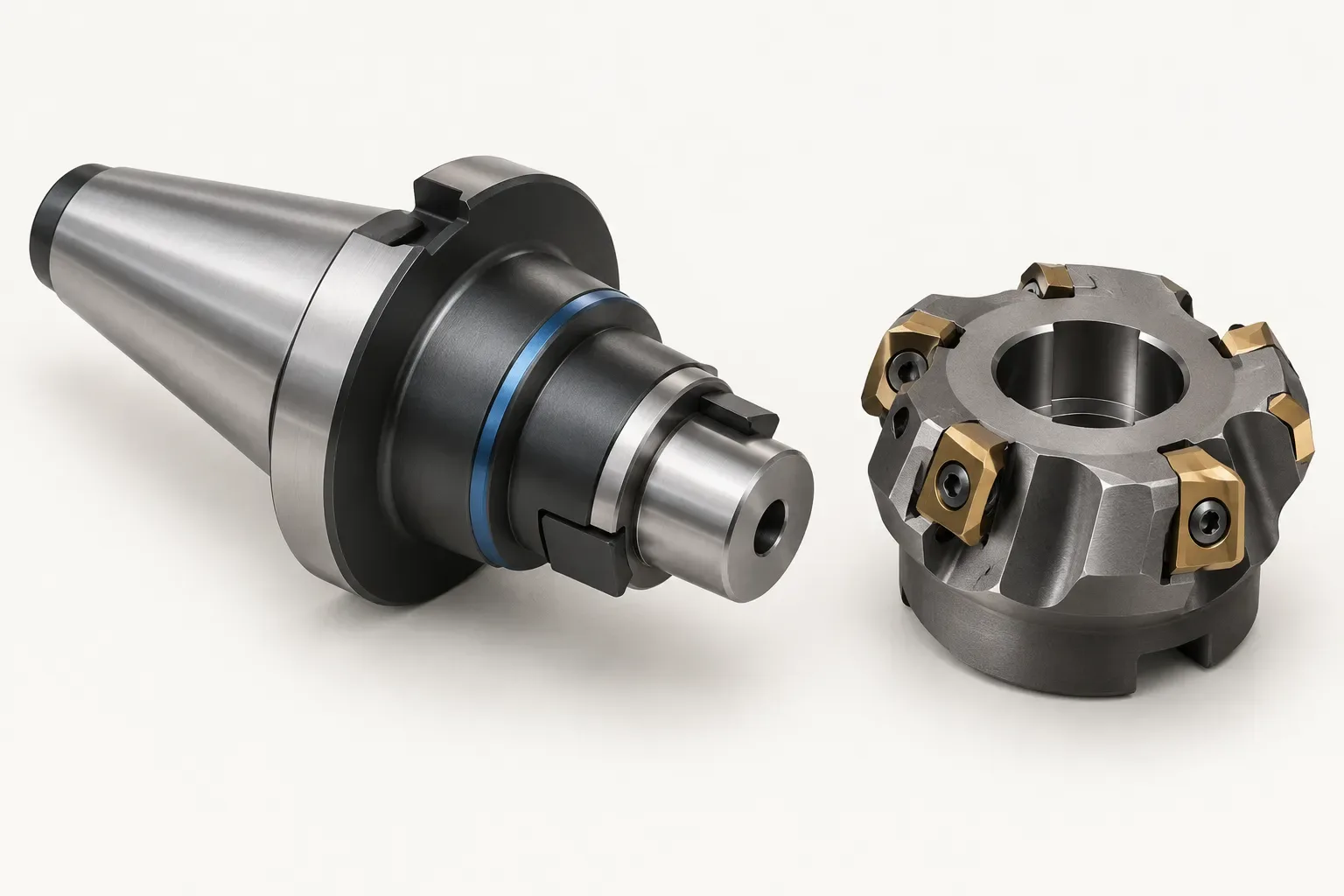
A BT50 face mill arbor enquiry needs to identify both the machine-side arrangement and the cutter-side connection. The BT50 designation does not, by itself, describe the complete arbor, its installed position or the face mill that can be assembled with it. Keep the full configuration and its drawing attached to the request.
This guide uses one documented BT50 arbor configuration to explain that two-sided review. The example is listed as an anti-vibration face mill arbor, but the dimensions discussed here do not establish a damping result, operating limit or machine compatibility.
Start with the complete recorded identity
The BT50 47FMB22XL-250 arbor records BT50 as its taper designation and FMB22XL as its configuration. Keep both entries and the complete product identification when preparing a comparison.
Do not shorten the request to an assumed connection diameter derived from the model string. The selected configuration has separately labelled dimensions that should be read with its drawing. A familiar designation can locate a candidate without providing all the information needed to approve the assembly.
If the arbor is replacing an installed component, record the actual cutter and any connecting hardware as well as the arbor. That makes it possible to distinguish the component being replaced from the rest of the tooling package.
Preserve the catalogue dimension labels
The selected record includes the following fields. Their names are retained because the drawing defines the exact feature measured by each label.
| Recorded field | Value |
|---|---|
| Catalogue length L | 250 mm |
| Catalogue dimension L2 | 210 mm |
| Catalogue dimension D1 | 47 mm |
| Catalogue dimension D2 | 22 mm |
| Catalogue dimension W | 10 mm |
| Thread G | M10 |
| Catalogue dimension L3 | 18 mm |
The record does not justify renaming L as a particular gauge length or L2 as a tool projection without supporting drawing evidence. Likewise, D2 and W should not be assigned new interface functions solely because their values look familiar.
The M10 entry is a thread designation, not an added length dimension. Preserve the field type when transferring the record to a quotation sheet. A comparison that turns every number into millimetres would change the meaning of the source.
Verify the machine-side requirements separately
Use the relevant machine documentation to identify the receiving interface and required retention arrangement. A taper designation alone does not establish that every associated component or installation condition has been matched.
Ask for the applicable installation requirements for the selected arbor. The listed dimensions do not supply a retention component specification, tightening value or allowable operating condition. Those details should not be filled from another BT50 product simply because it has a similar outline.
If an interface question remains unresolved, identify the actual surface or component on a drawing. A precise question is more useful than asking whether the arbor fits a broad machine family without stating the configuration.
Match the actual face mill and assembly
Provide the face mill's identification and drawing, including its documented mating and fastening requirements. Compare those features with the arbor drawing rather than assuming that a shared number in two catalogue descriptions establishes fit.
The quotation should identify which cutter, fastener or accessory is included, if any. A representative family image is not a commercial package list. Keep separately requested items visible so that an arbor-only quotation cannot be mistaken for a complete cutter assembly.
Review the assembled tool position and available space with the actual face mill installed. The component dimensions do not establish a collision-free machine path or a universal clearance allowance around the workpiece and fixtures.
Keep geometry and operating evidence distinct
The selected product description includes anti-vibration wording. That wording should not be converted into a numerical reduction in vibration, a guaranteed surface result or an unverified permitted overhang. The dimensional record supports a geometric comparison only.
Any required speed, balance, load or application condition needs evidence applicable to the actual assembly. Obtain the relevant documentation and keep it with the selected configuration. Installation approval and cutting performance are not supplied by a nominal connection label.
Use the tool holders and adapters catalogue to locate candidates, then send a request with the machine interface, cutter information, required position, quantity and drawings. A complete BT50 arbor enquiry preserves both mating sides and makes any unresolved requirement explicit before a purchase decision.
Frequently asked questions
Does BT50 alone identify the complete arbor assembly?
No. Keep the full arbor configuration, machine-side requirements and actual face mill connection in the selection record.
Can L be relabelled as a gauge length automatically?
No. The source labels it catalogue length L. A more specific interpretation requires the corresponding drawing.
Does the anti-vibration description establish a guaranteed result?
No. The recorded dimensions do not establish a numerical damping result or machining performance guarantee.