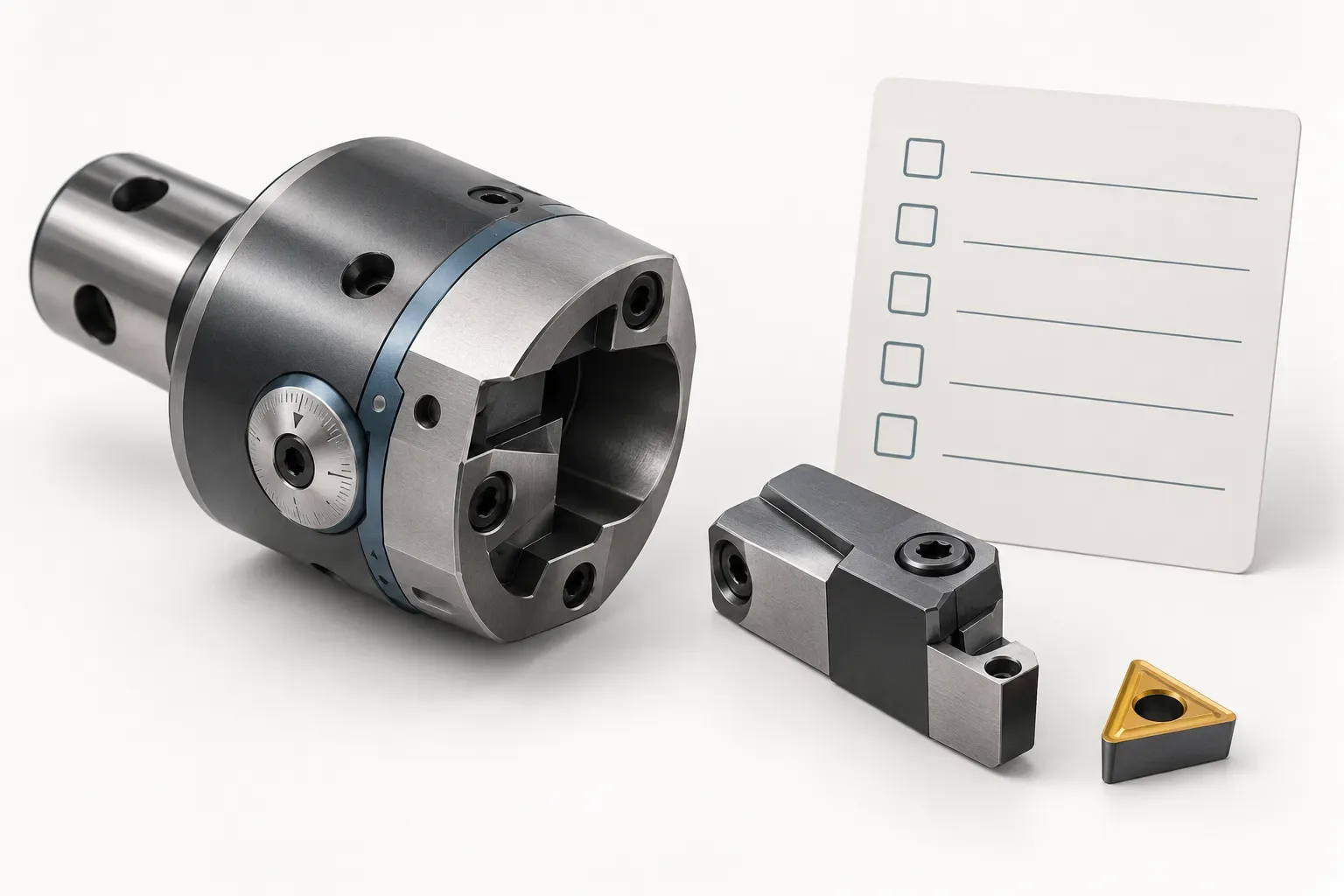
A boring tools supplier enquiry should identify the complete assembly required, not just a head name or a diameter range. A head, cartridge and insert are different items, and a quotation for one does not establish inclusion of the others. Start with the intended bore, then identify every connection and component that needs to be reviewed together.
This guide focuses on assembly scope and compatibility questions. It uses a documented fine-boring head and a documented cartridge as examples, without asserting that a shared system designation alone proves their mating geometry. It does not supply an insert grade, precision guarantee or complete package that the product records do not establish.
Define the bore and the requested assembly
State the required diameter, depth, workpiece designation and operation. Include whether the feature is blind or through and show any access restriction on a drawing. Desired tolerance or finish belongs in the application brief; it is not a performance claim already proven by a candidate product description.
Specify whether the request is for a replacement component, a proposed head-and-cartridge combination or a complete tooling assembly. This distinction controls which interfaces and included items need to be addressed. A supplier cannot resolve an undefined assembly merely by repeating a cutting range.
Read what the fine-boring head record establishes
The fine-boring head covering 20.0–24.0 mm lists an 11.0 mm pilot, 19.0 mm body diameter, 32.5 mm body length and 43.5 mm overall length. Its connection designation is 11, recorded as a system designation, and through-tool coolant is listed as yes.
These fields identify a head configuration. They do not establish that its quotation includes a shank, cartridges, inserts or other accessories. A pilot diameter is a measured field, while the connection designation identifies a system size. Keep those concepts separate rather than treating every connection number as a measured mounting diameter.
Keep the cartridge distinct from the head
The fine-boring cartridge covering 20.0–24.0 mm records connection designation 11 and overall length of 16.84 mm. Its listed insert family is TPGH0802, with the full grade and nose-radius suffix unspecified. The insert-seat data includes a 4.76 mm inscribed circle and a 2.5 mm hole diameter.
This is a cartridge record, not a complete boring-head specification. The shared range and connection designation support a compatibility enquiry but do not prove complete interchangeability. The mating-head geometry, cartridge orientation and actual connection details still require review before a combination is accepted.
Resolve the full insert designation
An insert family identifies part of the selection, not necessarily every application detail. If grade or nose-radius suffix is not supplied, do not invent one or infer material suitability from the cartridge alone. Ask which complete insert designation is proposed for the actual material and feature.
Also clarify whether an insert is included at all. A record describing a compatible insert seat is not evidence that a loose insert is part of the offer. The quotation should distinguish the required cutting components from the holder body and any associated hardware without assuming a package from a representative illustration.
Check every interface in the proposed chain
List the machine-side holder or shank, head, cartridge and insert separately. For each transition, identify the applicable connection geometry and documentation. Record any fastener, sleeve or accessory requirement that remains unresolved. The aim is to prevent a component that matches one interface from being treated as proof that the entire assembly fits.
Review the full assembly against the part and fixture for reach and clearance. A head's overall length is not the same as the assembled working envelope. Through-tool coolant in the head record likewise does not establish continuity or installation details throughout an unspecified combination.
Ask the supplier to itemize its offer
Request an item list identifying the exact configuration and quantity of each component. Distinguish confirmed inclusions, optional items and technical questions. If an alternative component is suggested, give it a separate row rather than allowing its range or interface to overwrite the original requirement.
Use the boring tools catalogue to identify candidates and retain the corresponding records with the enquiry. Before ordering, ensure that the technical response and commercial offer concern the same assembly. Assembly scope should be explicit enough that a component purchase cannot be mistaken for a complete, application-approved boring system.
Frequently asked questions
Does a head listing include every boring component?
Not unless the offer establishes that scope. Identify shank, cartridges, inserts and accessories separately.
Does connection 11 mean a measured 11 mm interface?
It is recorded as a system designation. The head separately lists an 11.0 mm pilot, and complete mating geometry still needs review.
Does TPGH0802 identify a complete insert grade?
The cited cartridge gives the family but does not specify the full grade or nose-radius suffix.