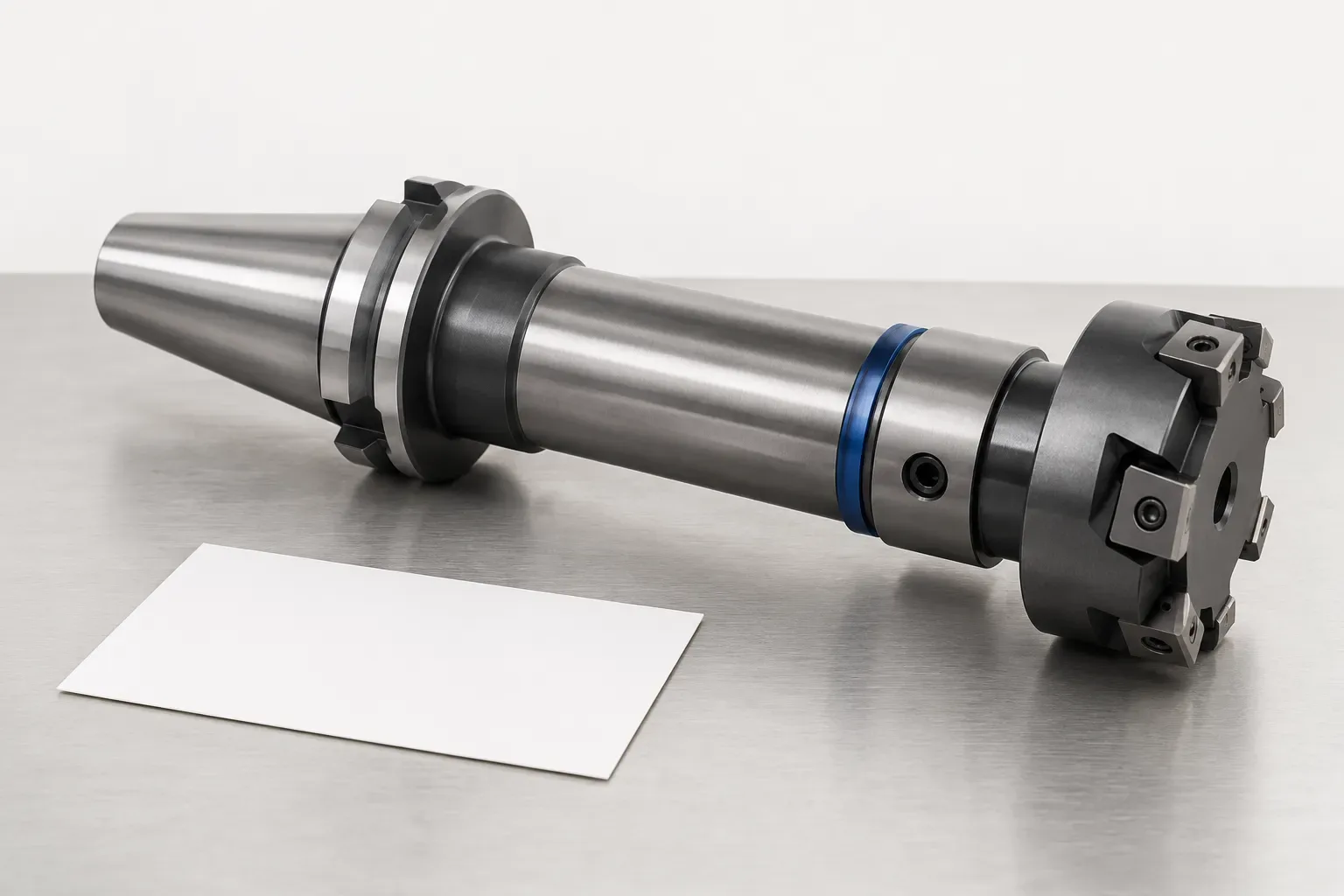
An anti vibration face mill arbor should be evaluated using evidence for the actual tool assembly and application. The product description can identify a candidate for enquiry, but it does not establish how much vibration will be reduced or what machining result will follow. A useful purchasing process separates the geometric fit review from the operating evidence.
This guide explains how to prepare that evidence request and a meaningful comparison record. It does not diagnose a machine problem, prescribe cutting conditions or claim that a named arbor will solve every unstable milling operation.
Define the problem before choosing the proposed remedy
Describe the observed issue in the actual operation. Record the workpiece material, part feature, machine, cutter, holder arrangement and the conditions under which the issue appears. Include the relevant tool projection and the configuration of the assembled cutter.
Distinguish an observed result from an assumed cause. A poor surface, noise or visible movement alone does not identify which component is responsible. Record what was observed without presenting an unverified explanation as a confirmed failure mechanism.
Keep the required outcome specific. The enquiry should explain which application requirement is not being met and what evidence would demonstrate an acceptable improvement. Do not begin by assuming a particular percentage gain or a universal tool-life benefit.
Establish geometric suitability independently
The documented BT50 47FMB22XL-250 arbor is listed with a BT50 taper designation and FMB22XL configuration. Its recorded dimensions identify the particular product being discussed; they do not provide a complete operating approval.
Selected fields include catalogue length L of 250 mm, catalogue dimension L2 of 210 mm, D1 of 47 mm and D2 of 22 mm. Retain those catalogue labels with the drawing rather than renaming them as verified projection or connection functions without supporting evidence.
The actual face mill and machine-side requirements must still be checked. A damping-related product description does not resolve a missing interface dimension, an unknown fastening requirement or an incompatible assembly.
Ask what the performance evidence represents
Request any available technical information for the exact proposed configuration and intended assembly. If a result is provided, identify the tested machine, cutter, workpiece, tool position and operating conditions before applying it to a different job.
A performance statement should explain what was measured and how the comparison was made. A photograph of a finished surface or an unqualified sales phrase cannot, by itself, establish the contribution of the arbor to that result.
Keep the limits of the evidence visible. If the documentation does not establish a relevant speed, load, balance or overhang condition, obtain the applicable information rather than transferring a limit from another product.
Prepare a controlled comparison record
If an application evaluation is planned, define the information that will be recorded before comparing outcomes. Keep the configuration and process descriptions complete enough to show whether the comparison actually concerns the same task.
| Record item | Purpose in the comparison |
|---|---|
| Exact arbor and cutter identity | Keeps the tested assembly identifiable |
| Machine and mounting arrangement | Describes the receiving setup |
| Tool position and projection | Records the physical arrangement being compared |
| Workpiece and operation | Defines the task and its requirements |
| Observed result and method | Separates measured evidence from impression |
| Changed conditions | Makes differences between comparisons visible |
This is an information checklist, not a prescribed test standard. Appropriate evaluation methods and operating conditions depend on the machine, tooling and application requirements. Applicable instructions and safety limits remain controlling.
Avoid conclusions from an uncontrolled change
If several components or process settings change at once, the result cannot be attributed to the arbor alone without additional evidence. Keep those changes in the record instead of describing the outcome as proof of a single product's performance.
Do not generalize one application result into a guarantee for other cutters, materials or setups. A successful comparison may support a decision within its stated conditions while leaving other applications unresolved.
The same caution applies when the proposed configuration has not yet been evaluated. Present it as a candidate for review, not as a proven remedy or a substitute for identifying the actual setup requirements.
Keep the commercial request evidence-led
Use the tool holders and adapters catalogue to locate the relevant configuration, then provide the problem description, assembly details, required outcome and quantity. Ask the quotation to identify the exact product and included items.
Retain the technical response, installation instructions and any application evidence with the purchase record. An effective enquiry makes clear what is known, what the proposed product must fit and what performance question still needs evidence. That gives the anti-vibration description a defined role without turning it into an unsupported machining promise.
Frequently asked questions
Does an anti-vibration label guarantee a particular improvement?
No. Relevant results need evidence for the identified assembly, application and stated comparison conditions.
Why keep the fit review separate from performance?
A damping-related description cannot resolve missing interface, fastening or installation requirements. Geometric suitability must be established independently.
Can a result be attributed to the arbor if several conditions changed?
Not without further evidence. Record all changed conditions and avoid assigning an outcome to one component by assumption.