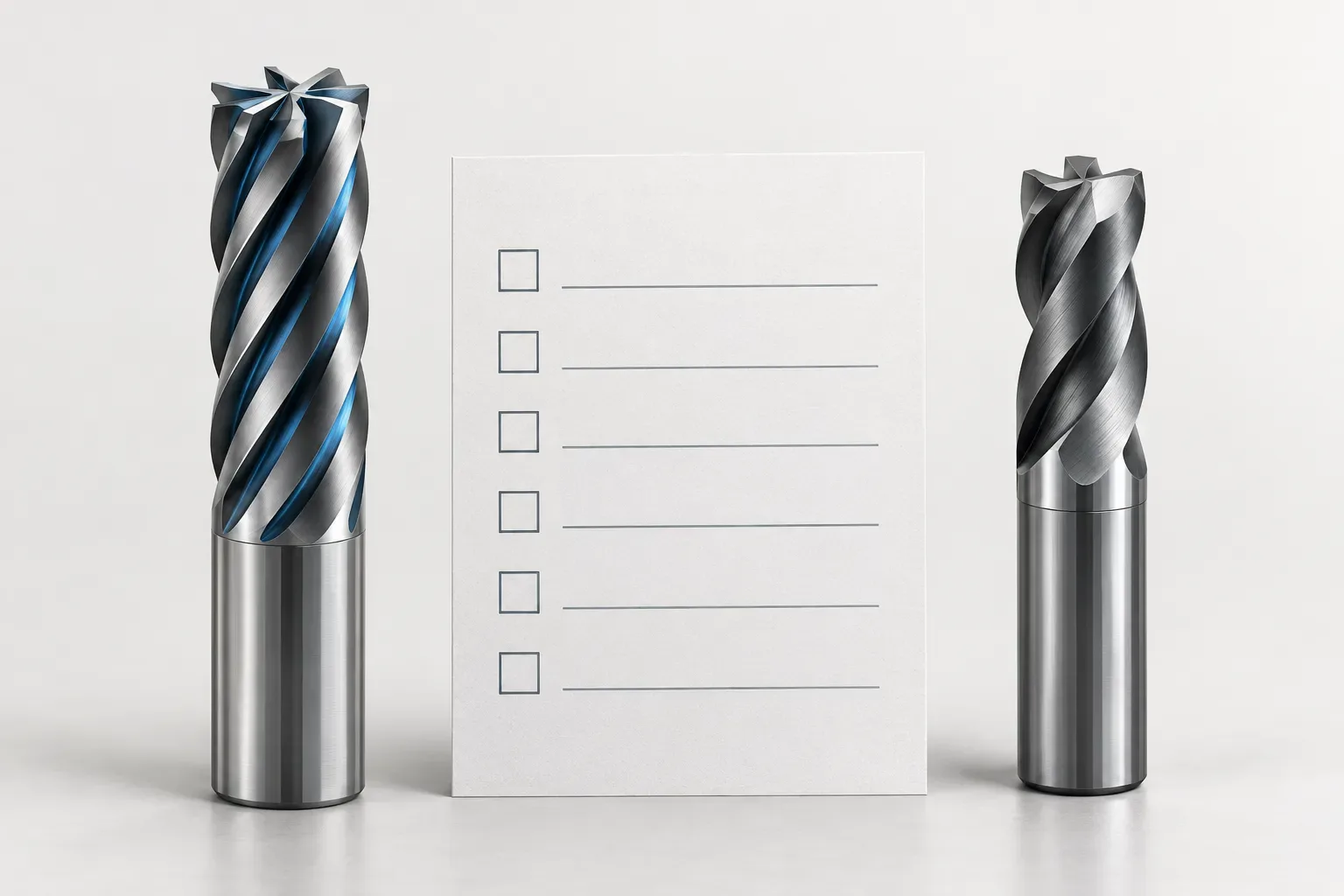
A six-flute carbide end mill should be evaluated as a specific cutting-tool configuration, not as an automatic upgrade from a cutter with fewer flutes. Compare the end profile, dimensions, application statement and recorded edge arrangement before considering a substitution. Shared dimensions make a comparison easier to organize, but do not prove equivalent behavior in a machining process.
This guide examines a six-flute square-end cutter alongside a four-flute product with matching principal dimensions. It explains what the catalogue records establish and which application questions remain outside that evidence. No comparative cutting trial, productivity gain or tool-life result is claimed.
Establish the purpose of the proposed change
An enquiry may begin because an existing tool has a different flute count, or because a new process calls for a six-flute candidate. State that reason clearly. Include the workpiece, part feature, operation and any known constraints so that the selection discussion has a defined task rather than a general request for a better tool.
If a current process is being changed, record the existing tool and the approved conditions separately. A new flute count does not automatically validate the old settings or prescribe new ones. The person responsible for the process needs to review the proposed configuration and the relevant application information before approving a change.
Read the six-flute square-end example
The quarter-inch six-flute square-end cutter has these recorded fields:
| Recorded field | Value |
|---|---|
| Cutting diameter (DC, in) | 0.25 |
| Shank diameter (DMM, in) | 0.25 |
| Length of cut (LOC, in) | 0.625 |
| Overall length (OAL, in) | 2.375 |
| Number of flutes (NOF) | 6 |
| Corner type | Square |
| Coating | Hybrid AlCrN |
| Variable pitch | No |
The record identifies a smooth shank, center cutting as yes and no through-spindle coolant. Steel is the primary workpiece group. These statements identify the cited configuration; they are not claims for every six-flute product or every steel grade and condition.
The square profile does not establish a numerical zero-radius edge guarantee. If an exact edge preparation or corner tolerance matters to the part or a qualified process, request the applicable drawing. Do not manufacture a tolerance from the absence of a radius value in the catalogue.
Compare the four-flute record field by field
The four-flute square-end comparison also lists a 0.25 inch cutting diameter, 0.25 inch shank, 0.625 inch cutting length and 2.375 inch overall length. It shares the square corner description and Hybrid AlCrN coating, but identifies four flutes and variable pitch as yes.
That contrast matters because it prevents a false claim that the only distinction is the flute count. Other recorded geometry attributes differ. Meanwhile, the records do not establish that all unlisted details are the same: substrate specification, tolerances and edge preparation should not be assumed identical merely because several dimensions match.
Avoid a universal rule about additional flutes
A greater flute count is a configuration difference that may be considered during application review. It is not independent evidence of a higher permitted feed, a better surface or a more stable process. Such conclusions require appropriate information for the actual tool, material, operation and assembly.
Keep the desired result as an application requirement. If a supplier recommends the six-flute candidate, ask which configuration and conditions the recommendation concerns and what supporting documentation is available. Avoid turning an illustrative comparison into a test report or using catalogue labels as numerical performance data.
Confirm installation and access before approving a candidate
The smooth shank and its diameter must match the selected holder and its applicable instructions. Check how the tool is gripped and whether the holder and cutter clear the intended feature. Neither overall length nor cutting length independently establishes an allowable projection or a complete working envelope.
The product's center-cutting field is also not a complete entry procedure. Identify the planned operation and obtain application-specific guidance where needed. If the enquiry has an unusual entry or access condition, describe it explicitly rather than expecting a flute-count label to answer it.
Keep the quotation and process review aligned
A useful comparison record should show which fields match, which differ and which remain unknown. Include the flute count, recorded pitch description, corner profile, dimensions, coating and material application. Attach the feature drawing and the intended holder information rather than a family photograph alone.
State the required quantity and whether alternatives are acceptable. Before ordering, ensure that the commercial offer identifies the same configuration considered in the technical discussion. If a process change requires a trial or qualification, keep that approval separate from the purchase description so that a six-flute order is not mistaken for a demonstrated machining result.
Frequently asked questions
Is a six-flute cutter automatically an upgrade?
No. Review the actual tool, operation, workpiece and assembly instead of treating flute count as a performance result.
Do the compared examples differ only in flute count?
No. Their recorded variable-pitch fields also differ, and unlisted details are not established as identical.
Can the original cutter settings be reused automatically?
No. Application conditions and any required process approval need review for the proposed configuration.