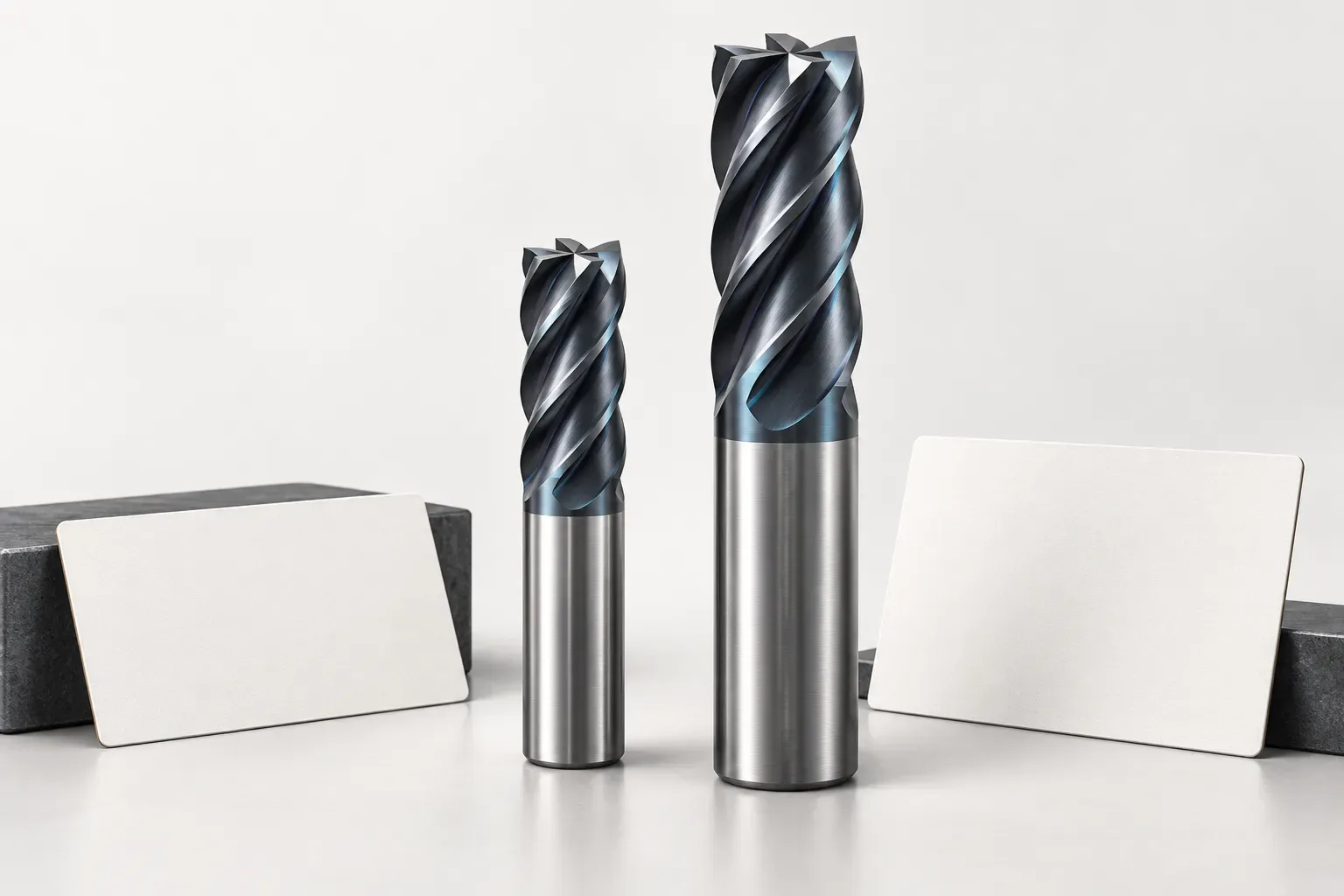
Select a five-flute carbide end mill by its complete dimensional record and documented application, not by assuming that the flute count identifies a single tool family. A small cutter and a larger cutter can share coating and flute count while having different corner radii, lengths and shank forms. Those differences belong in the purchase specification.
This guide uses two metric five-flute records to show how a size change can alter more than cutting diameter. Both examples list AlTiN coating and identify stainless steel and high-temperature alloys as primary workpiece groups. Those are catalogue application statements, not operating data for a particular alloy or a promise of machining performance.
Define the required feature and the size question
Start with the part feature, the workpiece designation and the reason for the five-flute requirement. If an existing tool is being replaced, record its full geometry before considering a larger or smaller alternative. A request that mentions only diameter and flute count leaves corner form, cutting length and holding details open to interpretation.
For a new application, explain the intended operation and the feature depth. Identify any restriction around the cutter or holder. Keep acceptance requirements separate from the product description so that a desired finish or dimensional result is not mistaken for a performance claim already supported by a listing.
Read the smaller configuration as its own record
The 3 mm five-flute corner-radius cutter lists:
| Recorded field | Value |
|---|---|
| Cutting diameter (DC, mm) | 3 |
| Shank diameter (DMM, mm) | 3 |
| Length of cut (LOC, mm) | 7 |
| Overall length (OAL, mm) | 54 |
| Corner radius (RE, mm) | 0.25 |
| Number of flutes (NOF) | 5 |
| Coating | AlTiN |
Its shank form is smooth. The record identifies center cutting as yes, variable pitch as no and through-spindle coolant as no. These attributes describe the selected product. They do not establish a ramp angle, an allowable engagement or a cooling procedure for every stainless or high-temperature material.
Check what changes on the larger example
The 8 mm five-flute radius configuration has an 8 mm cutting diameter, 8 mm shank, 12 mm cutting length, 58 mm overall length and 0.5 mm corner radius. Its listed shank form is Weldon rather than smooth. The coating and flute count are shared with the smaller example, but the geometry and holding description are not identical.
The radius changes from 0.25 mm in the smaller example to 0.5 mm in the larger one. Do not treat the larger cutter as a scaled copy while keeping the original radius in a quotation or tool record. The actual row for each size is the evidence for that configuration.
Keep material-group evidence within its limits
Both examples identify stainless steel and high-temperature alloys as primary groups. To request application advice, give the exact material designation and its relevant condition, together with the feature and planned operation. A broad group label does not identify every grade or establish the same cutting conditions throughout the group.
Do not infer carbide composition, coating thickness or a permissible temperature from the AlTiN label. Those details are not supplied by the cited configuration records. If they matter to a specification or an existing process qualification, request applicable documentation rather than adding assumed values to the order.
Treat flute count as one geometry field
A five-flute cutter may be proposed in a selection discussion, but the number alone does not prove that it will replace a four-flute or another cutter successfully. Compare the complete tool and the process. Ask which changed fields require review rather than accepting a universal rule about more flutes and better results.
Similarly, a product's center-cutting field should not be stretched into a complete programmed-entry recommendation. The actual motion, conditions and setup need their own supporting instructions. Keeping these questions distinct prevents a factual catalogue attribute from becoming an unsupported operational claim.
Verify the holder and document the purchase
Check the shank diameter and form against the actual holder and its instructions. Review the assembly for reach and clearance; the listed overall length does not independently establish available working reach. Where grip or installation limits are missing, obtain them before approving the setup.
For a quotation, provide the required cutter diameter, radius, cutting length, overall length, shank, flute count and coating. Add the workpiece designation, feature drawing and quantity. Highlight whether the smooth or Weldon configuration is required and keep any proposed alternative explicit. A clear record allows the technical response and commercial offer to refer to the same five-flute cutter rather than a loosely defined family.
Frequently asked questions
Do five-flute sizes share one corner radius?
Not in these examples. The 3 mm cutter lists a 0.25 mm radius and the 8 mm cutter lists a 0.5 mm radius.
Is every shank in the example family smooth?
No. The cited 3 mm configuration lists smooth and the 8 mm configuration lists Weldon.
Does AlTiN specify cutting conditions?
No. The coating name does not establish conditions for the actual alloy, operation and assembly.