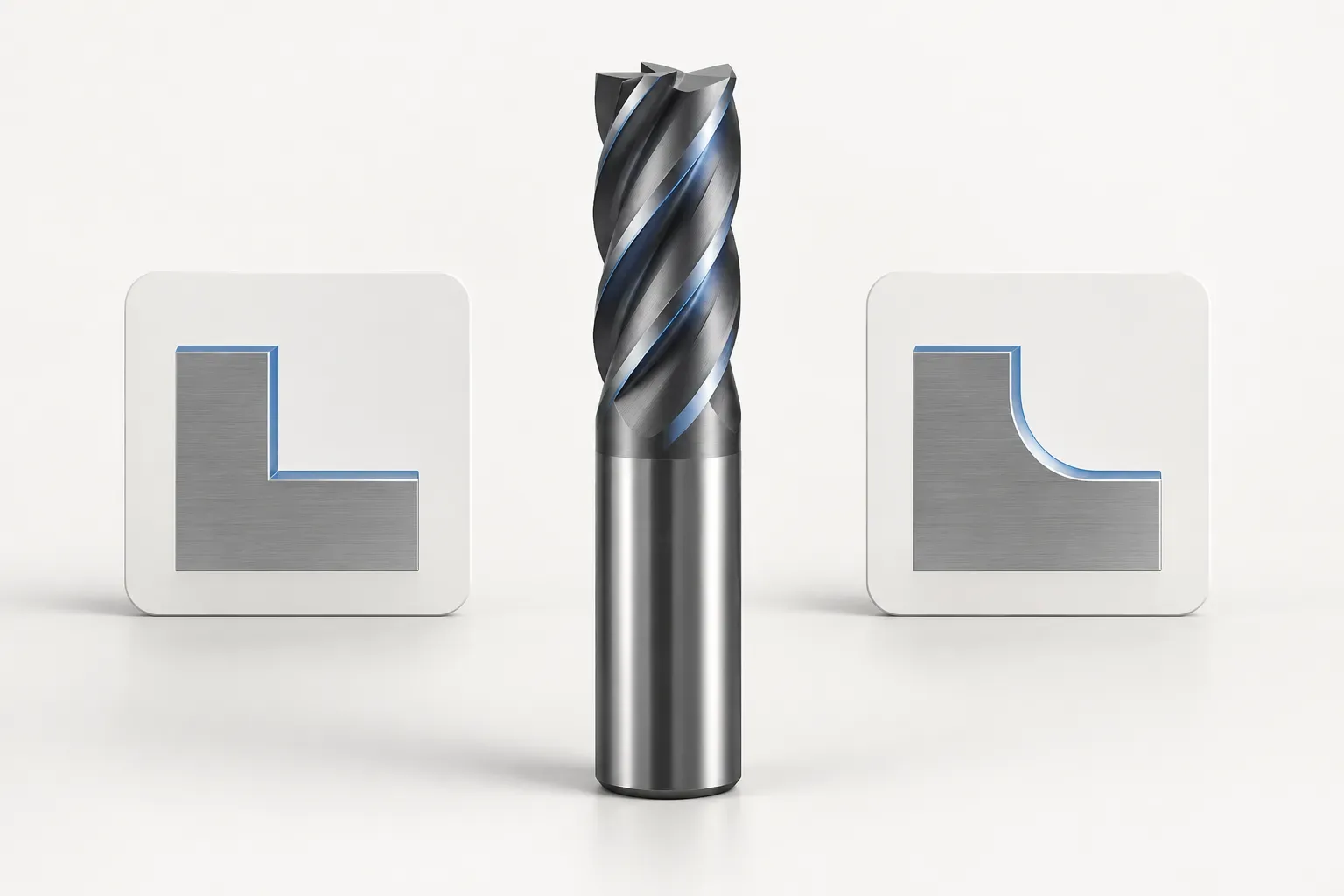
A four-flute carbide end mill can have different end geometries, lengths and cutting-edge arrangements. Select the exact configuration rather than using four flutes as a shorthand for a complete specification. This is particularly important when replacing a cutter with another product whose diameter and coating look familiar but whose geometry fields differ.
This guide focuses on configuration changes that can be hidden by similar product names. It compares one metric corner-radius cutter with two inch square-end records. The examples demonstrate how to organize information, not that those tools should perform the same operation or be substituted for one another.
Keep the end form separate from flute count
Start with the part feature and the required cutting profile. A four-flute radius cutter and a four-flute square-end cutter share a flute count, but that does not make their end geometry equivalent. Record corner type and any numerical radius or chamfer independently of the number of flutes.
Then identify the workpiece designation, operation and relevant holder constraints. A familiar flute count does not establish a suitable cutting speed, entry motion or surface outcome. Those application questions require information about the exact tool and setup, including facts that may not appear in a short catalogue title.
Read a metric radius example accurately
The 8 mm four-flute radius configuration lists an 8 mm cutting diameter, 8 mm Weldon shank, 12 mm cutting length, 58 mm overall length and 0.5 mm corner radius. Its coating is Hybrid AlCrN. The record identifies steel, stainless steel and cast iron as primary workpiece groups.
This configuration also records variable pitch as yes and center cutting as yes. These are separate product fields. They should remain traceable to that specific record rather than being copied into every four-flute description. They do not establish a guaranteed vibration reduction or a numerical entry limit.
Compare inch square-end records without hiding changes
The shorter quarter-inch square-end configuration provides another set of confirmed fields:
| Recorded field | Value |
|---|---|
| Cutting diameter (DC, in) | 0.25 |
| Length of cut (LOC, in) | 0.625 |
| Overall length (OAL, in) | 2.375 |
| Shank diameter (DMM, in) | 0.25 |
| Corner type | Square |
| Number of flutes (NOF) | 4 |
| Variable pitch | Yes |
A different listed quarter-inch four-flute square-end cutter has 0.75 inch cutting length and 2.75 inch overall length. That record identifies variable pitch as no. A shared diameter, flute count and square profile therefore does not resolve which length or cutting-edge arrangement an offer actually includes.
Do not use the words long or standard as substitutes for numerical length fields. Retain the listed cutting length and overall length alongside any catalogue length-type label. This makes it possible to identify an unintended substitution before a tool is received or discussed in application advice.
Check which claims the record supports
Flute count and variable-pitch descriptions are geometry attributes. They are not a test report. If an enquiry requires a particular finish, cycle time or behavior in a specific setup, state the requirement and request an appropriate technical review. Do not convert a catalogue feature into an unqualified promise of that result.
Likewise, a primary workpiece group is a starting point for application discussion. The cited inch square-end examples identify steel as primary; the metric radius example includes several primary groups. These statements should not be merged into a claim that every four-flute configuration covers every material.
Review the complete holder and cutter envelope
Compare shank diameter and form with the selected holder, then check access around the feature. A cutter can have sufficient overall length while presenting a cutting region or clamping arrangement that does not suit the task. Obtain relevant grip and installation limits instead of calculating working reach from overall length alone.
Keep all measurements in their original unit system during the first comparison. If conversions are later needed, show the calculation and retain the source value. A rounded converted value should not silently replace a nominal cutter or shank size in the purchasing record.
Build a replacement checklist that exposes differences
Ask the buyer or programmer to identify the incumbent tool's corner profile, cutting diameter, cutting length, overall length, shank, coating and flute count. Add any known pitch designation and the part requirement. Highlight fields that are unknown rather than selecting values from a visually similar cutter.
The milling tools catalogue can help locate documented candidates. When seeking a quotation, name the exact candidate and quantity, attach the relevant feature information and list the permitted changes. The result should identify one configuration clearly, while keeping unverified performance and installation questions separate from the confirmed product facts.
Frequently asked questions
Does four-flute mean variable pitch?
No. The cited records include both yes and no variable-pitch fields. Check the exact product.
Does a long label define cutting length?
No. Retain the numerical cutting length and overall length with their units rather than relying on the length-type label.
Can I assume the same material groups across four-flute cutters?
No. The cited examples have different primary-group records; review the selected configuration.