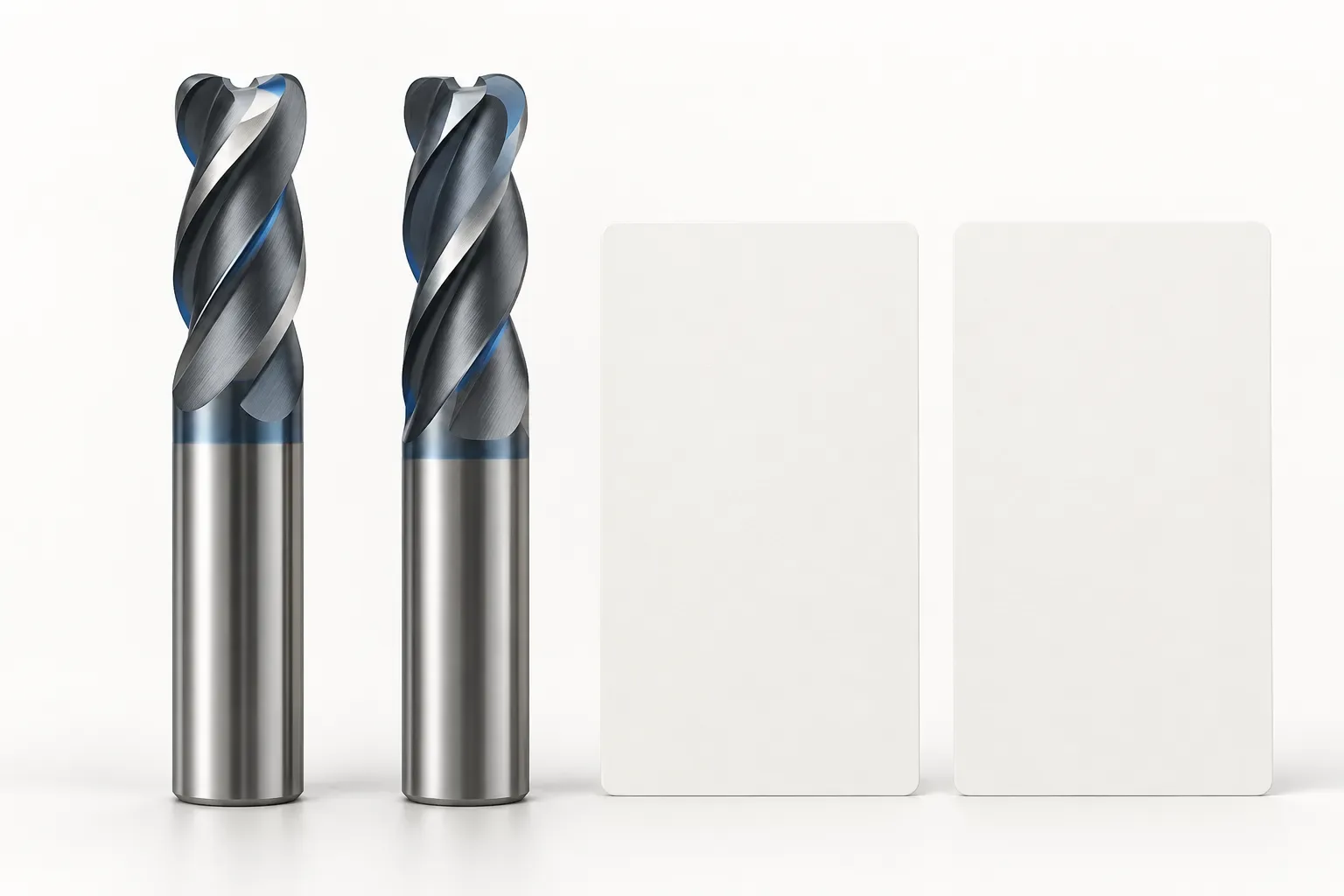
Selecting a three-flute carbide end mill requires a complete geometry and application record, even when the enquiry begins with aluminum machining. Flute count does not establish a coating, corner shape or cutting condition. Start with the actual workpiece and feature, then compare candidates that match the required diameter, radius, cutting length and holder interface.
This guide examines a particularly useful comparison: two recorded three-flute cutters with matching principal dimensions but different coating descriptions. That allows a buyer to identify what is genuinely shared and what still needs technical review. It is not a cutting trial or a claim that one configuration will outperform the other.
Establish why three flutes are part of the request
A replacement order may inherit a three-flute requirement from an existing process. Record that requirement with the tool's other known characteristics instead of assuming that flute count is the only feature that matters. If the request comes from a new application, explain the feature, operation and workpiece so the proposed geometry can be reviewed in context.
The final decision should identify the cutting tool and the intended assembly. Changes in shank, radius or length can matter even if the cutter still has three flutes. An offer should make those changes explicit rather than treating all three-flute products as equivalent stock items.
Compare the documented DLC configuration
The DLC-coated three-flute corner-radius cutter records:
| Recorded field | Value |
|---|---|
| Cutting diameter (DC, in) | 0.5 |
| Shank diameter (DMM, in) | 0.5 |
| Length of cut (LOC, in) | 1.25 |
| Overall length (OAL, in) | 3 |
| Corner radius (RE, in) | 0.12 |
| Number of flutes (NOF) | 3 |
| Coating | DLC |
| Primary workpiece material groups | N - Aluminum |
The record identifies a smooth shank, center cutting as yes, no variable pitch and no through-spindle coolant. These fields define the listed tool. They do not specify an entry program, an allowable coolant strategy or a feed and speed for a particular aluminum alloy.
Identify a dimensionally similar alternative carefully
The uncoated three-flute radius cutter also lists a 0.5 inch cutting diameter, 0.5 inch smooth shank, 1.25 inch cutting length, 3 inch overall length and 0.12 inch corner radius. Its primary material group is also aluminum. The coating description is uncoated rather than DLC.
These shared values make the records useful for a controlled purchasing comparison. They do not prove identical substrate composition, edge preparation, tolerances or manufacturing details that the listings do not supply. Similar principal dimensions are not evidence that two tools are the same product with a different coating label.
Ask the coating question without assuming an answer
If a supplier proposes a coating change, request the reason for the proposed configuration in the actual application. Provide the alloy, part feature, operation, cooling arrangement and existing process information. A response tied to those details is more useful than a broad statement that one coating is always better.
Do not attach a numerical friction value, temperature limit or tool-life multiplier to the comparison without applicable supporting data. None is established by the two product records used here. A coating name can be a verified purchase attribute while its performance in a specific job remains a separate technical question.
Keep radius and cutting length visible in the order
The 0.12 inch radius in both examples is a distinct corner-geometry field. It should not disappear from a shortened purchase description such as half-inch three-flute end mill. Include the radius alongside the diameter and cutting length so the supplier cannot reasonably interpret the request as a square-end configuration.
Likewise, keep cutting length separate from overall length. Check the assembly against the feature and available space using the actual holder documentation. Neither the shared overall length nor the number of flutes establishes an unrestricted reach or an approved engagement for the operation.
Document the selected configuration and unresolved questions
Prepare a comparison record listing every shared and changed field. Mark missing tolerance or installation information as a question, not as a copied value from another tool. If a production trial is required, define the acceptance criteria with the people responsible for the process rather than treating the purchase description as proof of the result.
For a quotation, include the exact candidate, quantity, workpiece designation, feature drawing and holder requirements. State whether the request permits an uncoated or coated alternative. A clear configuration decision helps keep the commercial offer, the tool that arrives and the application recommendation aligned without promising an outcome that has not been demonstrated.
Frequently asked questions
Are DLC and uncoated three-flute cutters interchangeable?
Matching dimensions do not establish complete equivalence. Review the actual configuration and application before approving a substitution.
Do these example cutters list aluminum as a primary group?
Yes. Both cited records identify aluminum as the primary workpiece group, without specifying cutting conditions for every alloy.
Does the three-flute label specify corner radius?
No. Corner type and radius are separate fields; the examples record a 0.12 inch radius.