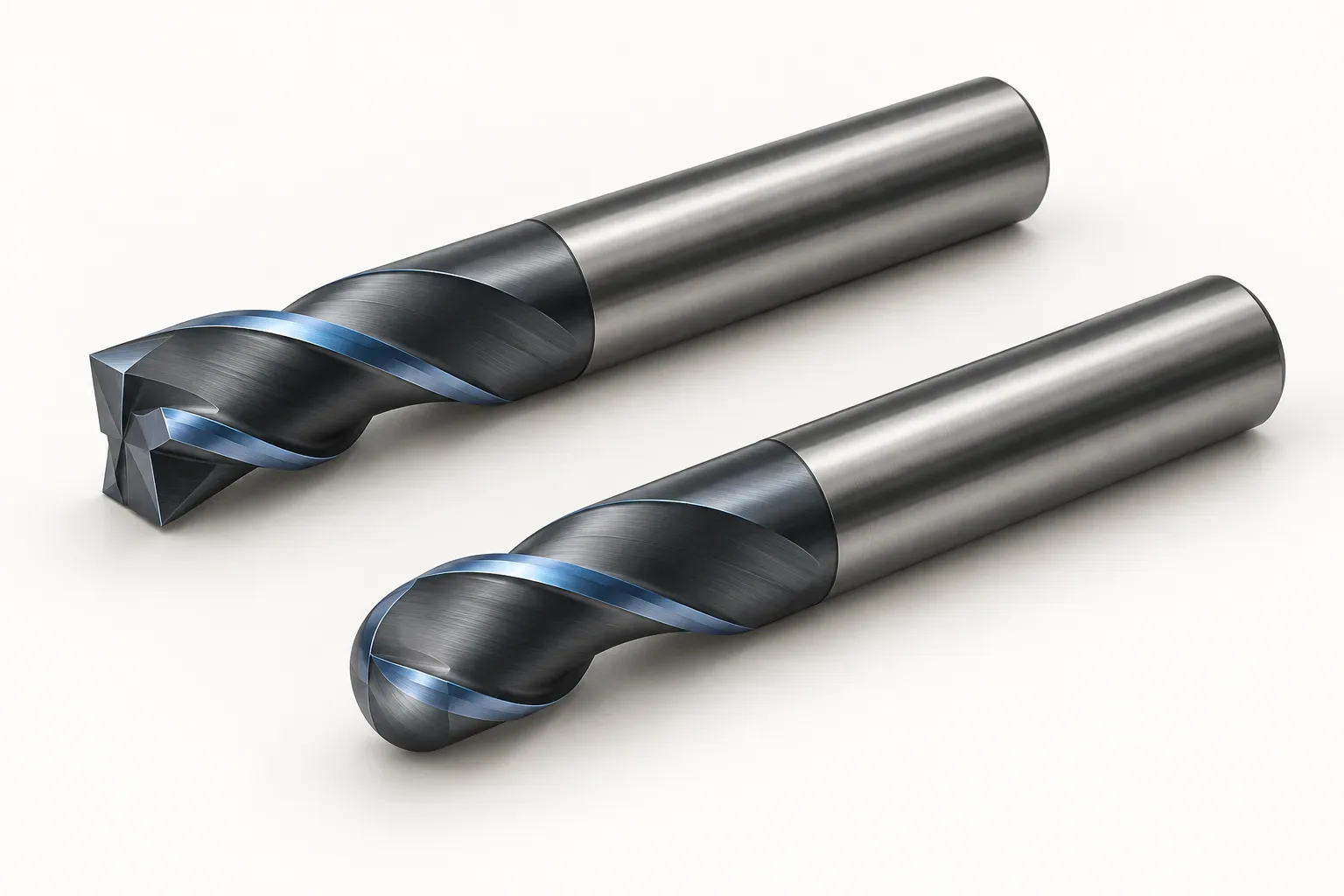
A two-flute carbide end mill is not identified completely by its flute count. The cutting profile, cutter and shank diameters, cutting length, overall length, coating and documented application group still need to match the job. Start with those fields before accepting a cutter as a replacement for an existing two-flute tool.
This guide concentrates on a practical purchasing problem: two cutters can share the same flute count while having different end forms and holding requirements. The examples are actual configurations in the current catalogue. Their dimensions do not establish a universal two-flute geometry or a preferred machining strategy.
Separate flute count from end profile
The number of flutes and the shape of the cutting end are independent catalogue fields. A request for a two-flute cutter can still leave the supplier uncertain whether the job needs a square or radiused corner. Describe the part feature and the proposed operation before narrowing the list by flute count.
A replacement enquiry should state whether the existing end geometry must remain unchanged. If it can change, explain which drawing requirements and application questions need review. Do not assume that fewer or more cutting edges produce a specific surface result, throughput improvement or tool life without data for the actual process.
Compare two confirmed configurations
The two-flute square-end configuration lists a 0.1875 inch cutting diameter, 0.25 inch smooth shank, 0.375 inch cutting length and 2 inch overall length. Its corner type is square and its coating is Hybrid AlCrN. Steel is the primary workpiece group recorded for that product.
The two-flute corner-radius configuration differs in several important fields:
| Recorded field | Value |
|---|---|
| Cutting diameter (DC, in) | 0.375 |
| Shank diameter (DMM, in) | 0.5 |
| Length of cut (LOC, in) | 1 |
| Overall length (OAL, in) | 4 |
| Corner type | Radius |
| Corner radius (RE, in) | 0.03 |
| Coating | Hybrid AlCrN |
Both have two flutes, but neither is a dimensionally identical substitute for the other. The second tool has a larger shank than its cutting diameter, just as the first example does. A quotation that specifies only cutting diameter and flute count would leave the holder interface and end geometry unresolved.
Check entry capability on the exact product
Both example records identify center cutting as yes. That is a configuration statement, not a complete entry procedure. It does not prescribe a particular ramp angle, plunge feed or programmed approach for every material and setup. Obtain the relevant application information before using a proposed entry motion.
Do not extend this field to every two-flute end mill. A similar photograph or a shared coating cannot establish an unlisted capability. Retain the exact product record with the enquiry so that any technical response can be tied to the same geometry, dimensions and configuration.
Keep cutting length and overall length separate
The radiused example lists 1 inch cutting length and 4 inch overall length. Those values should be compared with the feature depth and the complete assembly, not interpreted as a published overhang limit. Installation and clearance depend on the actual tool, holder, workpiece and required motion.
Check how the cutter is gripped and where the holder nose lies relative to the feature. A long tool can still have a cutting region that does not match the job. Conversely, having enough cutting length does not prove that the surrounding holder or noncutting tool section will clear every obstruction.
Avoid material assumptions based on flute count
The two examples list steel as the primary workpiece group. That evidence supports describing these configurations in that context; it does not support relabelling all two-flute cutters as steel tools or aluminum tools. Review each candidate's own application fields and the actual alloy and condition in the enquiry.
Cutting recommendations require more than a broad material group. Explain the operation, available cooling arrangement and assembly constraints when requesting technical advice. The catalogue facts alone do not establish cutting speed, feed, permissible load or a guaranteed finish.
Specify a two-flute replacement without losing details
Prepare a record with the exact corner form, cutting diameter, cutting length, overall length, shank diameter and form, coating and flute count. Include the workpiece designation, feature drawing, holder and quantity. If a field is missing from an offer, ask about it rather than assuming it matches the incumbent tool.
When comparing alternatives, highlight every changed field. A buyer may deliberately accept a different cutter after application review, but that is a new selection decision. It should not be hidden behind the shared phrase two-flute carbide end mill or an illustration that appears similar at first glance.
Frequently asked questions
Does two-flute identify the end shape?
No. The examples include square and corner-radius profiles, which need separate specification.
Can I select a holder from cutting diameter alone?
No. Both documented examples have a shank diameter different from their cutting diameter.
Does center cutting specify a plunge program?
No. The product field does not establish a complete entry procedure or its application limits.